Did the FDA approve Zepbound for sleep apnea?
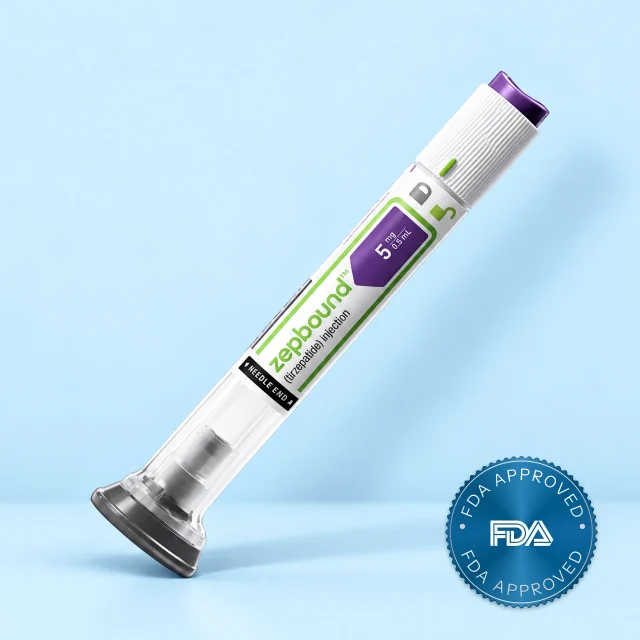
Yes. The Zepbound label lists two uses: long-term weight management, and the treatment of moderate to severe obstructive sleep apnea in adults with obesity.1 The FDA announced the sleep apnea approval on December 20, 2024, under a headline calling Zepbound the first medication for the condition.4
Reading the label wording
Three parts of that wording matter. It names obstructive sleep apnea, the kind in which the upper airway narrows or closes again and again during sleep. It says moderate to severe, a grade that a sleep study establishes. And it says adults with obesity, meaning a body mass index (BMI) of 30 or greater.5 The BMI calculator shows where you fall.
The label also says Zepbound is not recommended alongside another tirzepatide product or any GLP-1 receptor agonist.1
Do other GLP-1 medications have this approval?
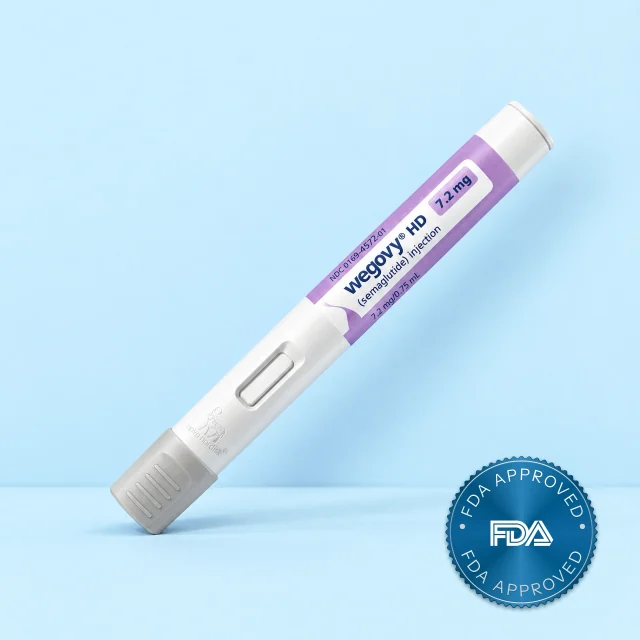
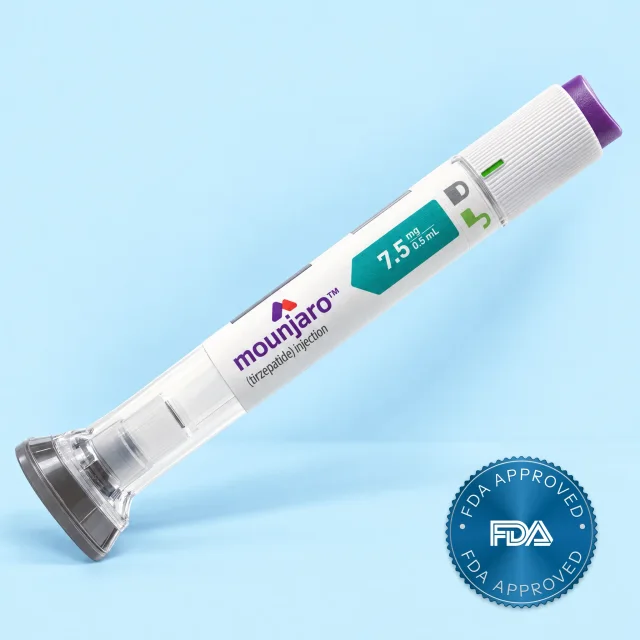
Of the four brand-name medications covered on this site, Zepbound is the only one whose label lists sleep apnea. Mounjaro contains the same tirzepatide, but it is approved for type 2 diabetes and is not FDA-approved for weight loss.6 Ozempic is also approved for type 2 diabetes and not for weight loss.7 Wegovy is approved for weight management.8
Compounded tirzepatide is a different product. It is not FDA-approved for sleep apnea or anything else. The FDA does not review compounded drugs for safety, effectiveness or quality, and compounded tirzepatide is neither a generic of Zepbound nor a product that went through the brand-name trials.9 A licensed provider decides whether it is ever appropriate. See our tirzepatide page.
How can a weekly injection improve sleep apnea?
Zepbound is not a breathing device, and a weekly injection does nothing mechanical to your airway. It acts on two hormone receptors, GIP and GLP-1.1 Medications in the GLP-1 family lower appetite and slow how quickly the stomach empties, so people tend to eat less and lose weight.10
Weight and nighttime breathing are linked. A study published in 2000 followed adults over time and compared changes in their weight with changes in their breathing during sleep. A 10% weight loss predicted a 26% decrease in breathing interruptions per hour, and a 10% weight gain predicted a 32% increase.11 That study observed weight change. It did not test a medication.
The Zepbound sleep apnea trials fit the same pattern: people taking it lost an average of 17.7% and 19.6% of their body weight over 52 weeks, and their breathing interruptions fell over the same period.1
Why it takes time
A benefit that travels with weight loss builds slowly. The first maintenance dose for sleep apnea is at least 12 weeks away, and the trials took their measurements at week 52.1 Think in months, not nights.
How much did breathing improve in the Zepbound trials?
The approval rests on two 52-week trials in adults with obstructive sleep apnea and obesity, published together as SURMOUNT-OSA.12 The label calls them Study 5 and Study 6. Study 5 enrolled people who were not using positive airway pressure (PAP) therapy, the group of treatments that includes CPAP. Study 6 enrolled people who were. Participants got Zepbound at the highest dose they could tolerate, 10 mg or 15 mg a week, or placebo.1
The main yardstick was the apnea-hypopnea index, or AHI. An apnea is a pause in breathing. A hypopnea is a stretch of shallow breathing. AHI counts both, so in plain words it is the number of breathing interruptions per hour of sleep. Lower is better.
| Result at week 52 | Study 5 (no PAP): Zepbound | Study 5 (no PAP): placebo | Study 6 (on PAP): Zepbound | Study 6 (on PAP): placebo |
|---|---|---|---|---|
| Change in AHI (events per hour) | −25.3 | −5.3 | −29.3 | −5.5 |
| Percent change in AHI | −50.7% | −3% | −58.7% | −2.5% |
| AHI reduced by at least 50% | 61.2% | 19% | 72.4% | 23.3% |
| Remission or mild non-symptomatic OSA | 42.2% | 15.9% | 50.2% | 14.3% |
| Change in body weight | −17.7% | −1.6% | −19.6% | −2.3% |
Week 52 results from the Zepbound prescribing information.1 At the start, AHI was about 46 to 53 events per hour (not far short of one a minute) and body weight about 113 to 117 kg (roughly 249 to 258 pounds). These are group averages and shares. Individual results vary.
The same figures in everyday terms
- Average drop. On Zepbound, 25.3 and 29.3 events an hour. On placebo, 5.3 and 5.5. The gap is about 20 events an hour in Study 5 and about 24 in Study 6.
- Best category. 42.2% and 50.2% on Zepbound ended the year in remission or with mild sleep apnea and no symptoms, compared with 15.9% and 14.3% on placebo.
Where the evidence stops
These results are not a promise. Read the fourth row from the other side: 57.8% of people on Zepbound in Study 5 and 49.8% in Study 6 had not reached remission or mild non-symptomatic OSA at week 52. The trials also compared Zepbound with placebo, not with PAP.
Are you a candidate for Zepbound for sleep apnea?
The label wording is short: adults with obesity who have moderate to severe obstructive sleep apnea.1 In practice a prescriber looks for all of the following.
- Obstructive sleep apnea graded moderate to severe. A sleep study establishes both the diagnosis and the severity. Symptoms alone do not.
- Obesity. For adults, a BMI of 30 or greater.5
- Age 18 or older.
- No reason to avoid tirzepatide. Zepbound must not be used by anyone with a personal or family history of medullary thyroid carcinoma, with Multiple Endocrine Neoplasia syndrome type 2 (MEN 2), or with a known serious allergic reaction to tirzepatide.1
No sleep study yet?
People usually end up being tested because of snoring, because a bed partner has watched them stop breathing, or because they are worn out during the day. If that sounds familiar, a primary care or sleep clinician can order a sleep study.
When the sleep apnea approval does not fit
With mild sleep apnea, or a BMI under 30, the sleep apnea approval does not describe you. Zepbound’s other approved use may: weight management in adults with obesity, or with overweight and at least one weight-related condition.1 See the Zepbound page.
What FitRx handles
FitRx providers can prescribe Zepbound when it is appropriate. You complete an online intake, and a U.S.-licensed provider reviews it, typically within 1 to 2 business days. Mention your sleep apnea diagnosis and whether you use PAP therapy. Sleep studies and PAP management are not part of the FitRx weight loss membership, so your sleep clinician stays in charge of both. Not everyone qualifies.
How many milligrams of Zepbound are used for sleep apnea?
For obstructive sleep apnea, the label’s maintenance dose is 10 mg or 15 mg a week. Nobody starts there. The label sets out a climb: 2.5 mg once weekly for 4 weeks, then 5 mg, then increases of 2.5 mg after at least 4 weeks on the current dose, up to a maximum of 15 mg.1
| Weekly dose | Earliest timing | Role |
|---|---|---|
| 2.5 mg | Weeks 1 to 4 | Starting dose, not a maintenance dose |
| 5 mg | Weeks 5 to 8 | Building up |
| 7.5 mg | Weeks 9 to 12 | Building up |
| 10 mg | Week 13 onward | Lower maintenance dose for sleep apnea |
| 12.5 mg | Weeks 17 to 20 | Optional step toward 15 mg |
| 15 mg | Week 21 onward | Higher maintenance dose, and the maximum |
Week numbers assume every increase happens at the 4-week minimum.1 Your provider may space the steps further apart, which the label permits.
One difference from weight management: there, 5 mg counts as a maintenance dose too. The sleep apnea indication skips it, which matches the trials, where the target was the maximum tolerated dose of 10 mg or 15 mg.1 Which one you settle on is your provider’s decision.
The injection goes under the skin, at any time of day, with or without a meal. If you miss a dose, take it as soon as possible within 4 days (96 hours). After that, skip it.1
Does Zepbound replace CPAP, or do you use both?
That decision belongs to the clinician who manages your sleep apnea. What the evidence says is that Zepbound was studied both ways: in people who were not using PAP therapy (Study 5) and in people who were (Study 6).1 Neither study tested giving up a machine you have been prescribed.
| Zepbound | CPAP and other PAP therapy | |
|---|---|---|
| How it works | A weekly injection that lowers appetite and body weight | A machine whose air pressure keeps the airway open while the mask is on |
| When it acts | Gradually, over months | During the hours you wear it |
| Who manages it | The provider who prescribes it | Your sleep clinician |
The PAP column is a general description, not a comparison of results. The trials compared Zepbound with placebo.1
What each study shows
Everyone in Study 6 was on PAP therapy. In the group that added Zepbound, AHI fell by an average of 29.3 events an hour, compared with 5.5 with placebo.1,12 That is evidence about adding Zepbound to PAP, not about replacing one with the other. In Study 5, where nobody was on PAP therapy, the average fall was 25.3 on Zepbound and 5.3 on placebo.
What to do about your machine
Keep your current treatment
Use what you were prescribed unless your sleep clinician changes it.
Tell both clinicians
Your sleep clinician should know about Zepbound. Your prescriber should know whether you use PAP therapy.
Ask about retesting
How rested you feel is a poor gauge of your breathing while you are asleep. A repeat sleep study is the gauge, and whether to continue, adjust or stop PAP therapy is your sleep clinician’s decision.
If you come off Zepbound
In SURMOUNT-4, a weight management trial, adults took tirzepatide for 36 weeks and were then assigned to continue or switch to placebo. By week 88, those who continued had lost a further 5.5%, while those who switched had regained 14.0%.13 Since weight gain predicted more breathing interruptions in the study described earlier,11 talk with both clinicians before you stop.
What will you pay for Zepbound for sleep apnea, and does insurance help?
The sleep apnea approval did not create a separate product, so Lilly’s published Zepbound prices apply. The list price is $499 to $1,086.37 per fill.14 These are Lilly’s terms as of November 18, 2026.
| Your situation | What you could pay | Details |
|---|---|---|
| Commercial insurance that covers the single-dose pen | As little as $25 for a 1-, 2- or 3-month fill | Savings card required. It takes off up to $100 per 1-month fill, $200 per 2-month fill or $300 per 3-month fill, up to $1,300 a calendar year. Expires December 31, 2026. |
| Commercial insurance that does not cover Zepbound | As low as $499 for a 1-month fill of single-dose pens | Savings card required. |
| Self-pay through LillyDirect | $299 a month for 2.5 mg, $399 for 5 mg, $449 for 7.5 mg to 15 mg | KwikPen or single-dose vials. $449 requires a refill within 45 days. Otherwise 7.5 mg is $499 and higher doses are $699. |
| Medicare, Medicaid, TRICARE or other government coverage | Depends on the program | Not eligible for the savings card. |
Sources: Lilly’s Zepbound savings, pricing and LillyDirect pages.2,3,14 A month is 28 days. Prices and terms change, so confirm them with Lilly or your pharmacy before you fill.
Commercial plans and prior authorization
Whether your plan treats a prescription for sleep apnea differently from one for weight management is something only your plan can answer.
FitRx’s insurance coordination team submits prior authorizations to commercial plans. Most decisions come back in 2 to 14 business days, and after a denial the team can resubmit, up to three requests. Approval is the plan’s decision and is never guaranteed. Our GLP-1 insurance checker explains how a coverage check works.
If you have Medicare
The Medicare GLP-1 Bridge is a short-term federal program, running July 1, 2026 through December 31, 2027, with a $50 copay for a one-month supply of a covered weight management drug. It specifically excludes people with moderate-to-severe sleep apnea, because a Part D plan may cover a GLP-1 for that condition.15,16 So the place to ask is your Part D plan.
FitRx does not work with government insurance (Medicare, Medicaid or TRICARE), so we cannot process Part D or Bridge coverage. Medicare.gov/glp1bridge and 1-800-MEDICARE have the current rules.
Paying cash through LillyDirect
LillyDirect is Lilly’s pharmacy service. It fills and delivers prescriptions but does not write them.3 At 10 mg or 15 mg, the doses the label names for sleep apnea, its self-pay price as of November 18, 2026 is $449 a month when each refill comes within 45 days and $699 when it does not. For other ways to fill a prescription, see tirzepatide near me.
FitRx membership ($39 the first month, then $135 a month) is separate. You pay for Zepbound at the pharmacy or through LillyDirect, and FitRx does not sell it or set its price.
What are the side effects at sleep apnea doses?
The label is the same whichever use Zepbound is prescribed for. The most common side effects involve the stomach and gut. The 10 mg and 15 mg columns are shown because those are the maintenance doses for sleep apnea.1
| Side effect | Placebo | Zepbound 10 mg | Zepbound 15 mg |
|---|---|---|---|
| Nausea | 8% | 29% | 28% |
| Diarrhea | 8% | 21% | 23% |
| Vomiting | 2% | 11% | 13% |
| Constipation | 5% | 14% | 11% |
| Abdominal pain | 5% | 9% | 10% |
| Injection site reactions | 2% | 8% | 8% |
| Fatigue | 3% | 6% | 7% |
Share of adults reporting each reaction in two pooled weight management trials, from the Zepbound prescribing information.1 These are not figures from the sleep apnea trials.
If a step up in dose is rough, tell your provider. Vomiting and diarrhea can leave you short of fluid, so keep drinking.
The boxed warning, in plain words
Zepbound’s label carries a boxed warning. Tirzepatide caused thyroid C-cell tumors in rats. Whether it does the same in people is not known. Anyone with a personal or family history of medullary thyroid carcinoma, or with MEN 2, should not use it.1
Other serious risks on the label
- Pancreatitis. Severe stomach-area pain that will not go away, sometimes felt in the back.
- Gallbladder problems. Upper stomach pain, fever, yellowing of the skin or eyes, or clay-colored stools.
- Kidney injury from dehydration, serious allergic reactions, and low blood sugar when taken with insulin or a sulfonylurea.
- Aspiration during anesthesia. Food or liquid can get into the lungs during general anesthesia or deep sedation. Tell the team ahead of any procedure that you take Zepbound, and mention your sleep apnea too.
Zepbound may also harm an unborn baby.1 Our guide to GLP-1 side effects covers what is common, what is serious and how long side effects last.