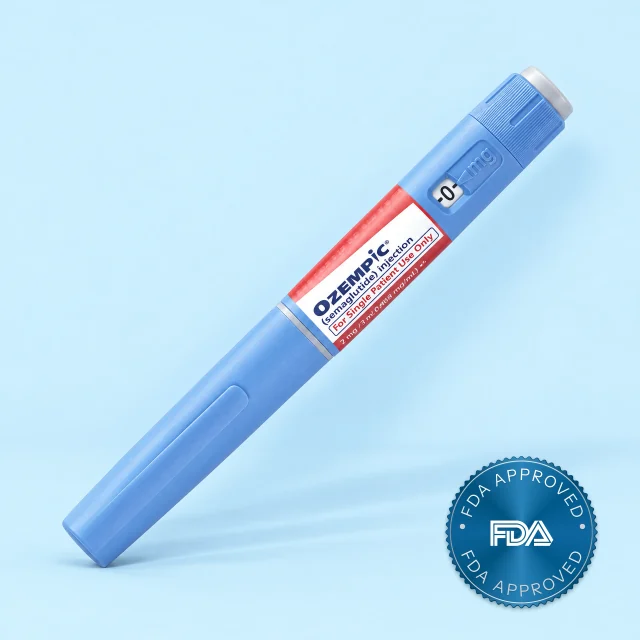
What is the difference between Mounjaro and Ozempic?
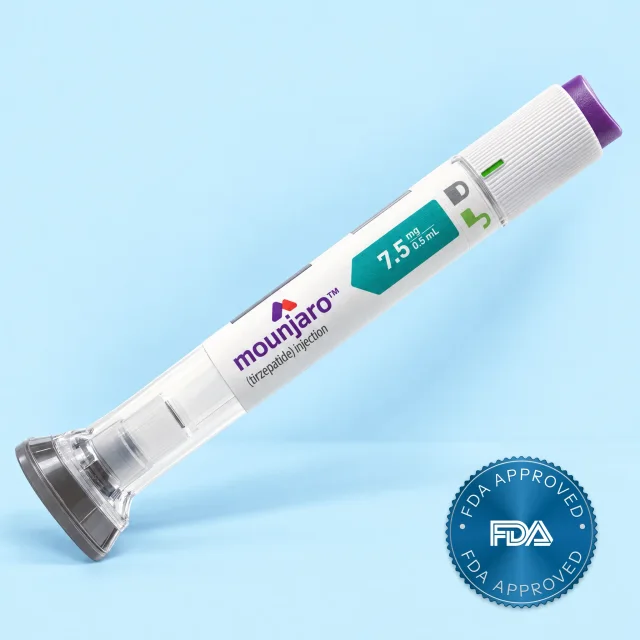
They are different medicines from different companies, and both act on the GLP-1 receptor (our GLP-1 meaning guide explains the term). The table shows the practical differences. The sections below take them one at a time.
| Mounjaro | Ozempic | |
|---|---|---|
| Active ingredient | Tirzepatide | Semaglutide |
| Maker | Eli Lilly | Novo Nordisk |
| Acts on | GIP and GLP-1 receptors | GLP-1 receptor |
| FDA-approved for | Type 2 diabetes: blood sugar control (ages 10 and up), and lowering cardiovascular risk in adults at high risk | Type 2 diabetes in adults: blood sugar control, lowering cardiovascular risk with established cardiovascular disease, and lowering kidney and cardiovascular risk with chronic kidney disease |
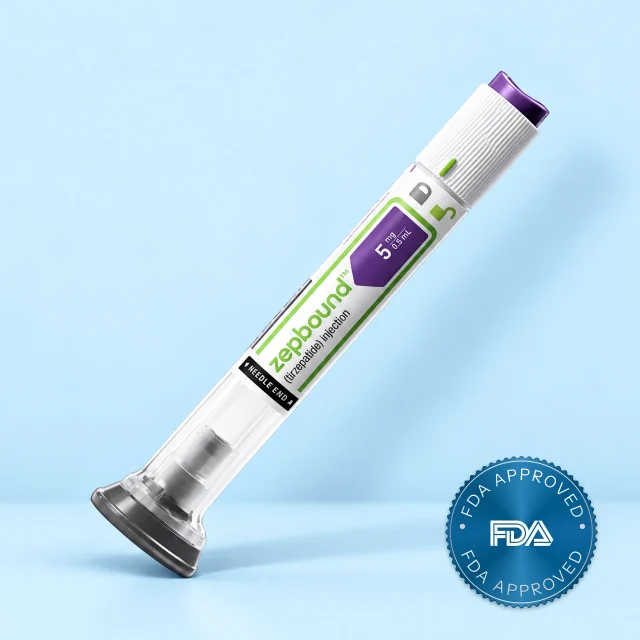
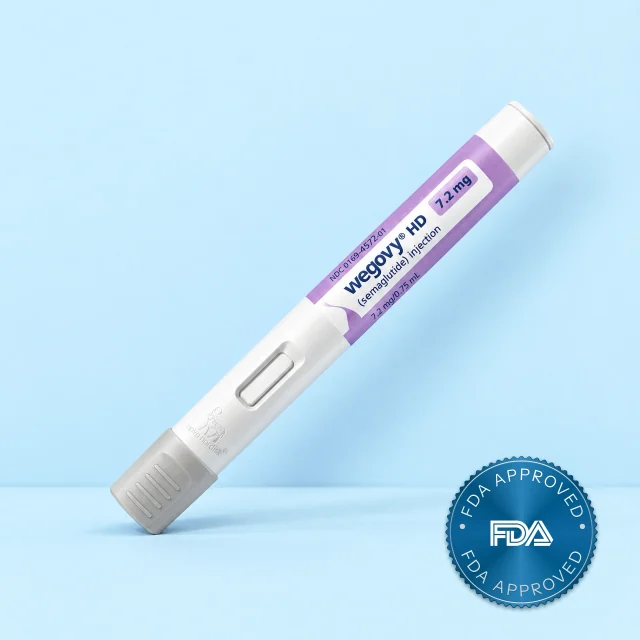
| Approved for weight loss? | No. For weight management, tirzepatide is sold as Zepbound | No. For weight management, semaglutide is sold as Wegovy |
| Weekly doses | 2.5 mg to 15 mg, in 2.5 mg steps | 0.25, 0.5, 1 and 2 mg |
| How it comes | Single-dose pen, four-dose KwikPen or vial | Multi-dose pen or single-dose prefilled syringe |
| Maker’s self-pay price | From $499 a month | $199 to $499 a month |
| With commercial insurance that covers it | As little as $25 | As little as $25 a month |
Uses and doses are from each label.1,2 Prices are the manufacturers’ as of November 18, 2026, and can change.6,7 The cost section has the terms.
Which leads to more weight loss, Mounjaro or Ozempic?
In the trial that compared them directly in type 2 diabetes, people on Mounjaro lost more weight on average. Keep in mind that both drugs are FDA-approved for type 2 diabetes, not for weight loss. These figures come from diabetes trials.1,2
SURPASS-2, the head-to-head trial
SURPASS-2 enrolled adults with type 2 diabetes who were already taking metformin. About 470 people per group took Mounjaro 5 mg, 10 mg or 15 mg, or Ozempic 1 mg, for 40 weeks.3
| Group | Average weight lost | In pounds | Share of starting weight |
|---|---|---|---|
| Mounjaro 5 mg | 7.6 kg | About 17 lb | About 8% |
| Mounjaro 10 mg | 9.3 kg | About 21 lb | About 10% |
| Mounjaro 15 mg | 11.2 kg | About 25 lb | About 12% |
| Ozempic 1 mg | 5.7 kg | About 13 lb | About 6% |
Average change at 40 weeks, from the Mounjaro label.1 Starting weight averaged about 94 kg. Pounds are our rounded conversion. Individual results vary.
Every Mounjaro dose came out ahead of Ozempic 1 mg, and the 15 mg group lost nearly twice as much. These are averages: some people lost more and some lost less.
Two limits of that trial
- It used Ozempic 1 mg, not 2 mg. Ozempic’s top dose was not part of SURPASS-2. In a separate 40-week trial on Ozempic’s label, adults with type 2 diabetes lost an average of 6.4 kg on 2 mg and 5.6 kg on 1 mg.2 That study had different participants, so it cannot simply be added to the table.
- Everyone had type 2 diabetes. Trials in people without diabetes have shown larger weight changes. On Zepbound 15 mg, average loss was 20.9% without diabetes and 14.7% with it. On Wegovy, it was 14.9% and 9.6%.8,9
Without diabetes: SURMOUNT-5
SURMOUNT-5 compared the two ingredients in 751 adults with obesity and without diabetes, at the highest doses each person could tolerate of the weight-management versions, Zepbound and Wegovy. After 72 weeks, average weight loss was 20.2% with tirzepatide and 13.7% with semaglutide.10
If you do not have type 2 diabetes and your goal is weight management, Zepbound and Wegovy are the FDA-approved products with these ingredients. Mounjaro and Ozempic are not.
How do they compare on blood sugar, heart and kidney protection?
Type 2 diabetes is what both are approved to treat, so their labels say the most here.
Blood sugar
A1C (also written HbA1c) is a blood test of average blood sugar. In SURPASS-2 it fell by 2.0, 2.2 and 2.3 percentage points on Mounjaro 5 mg, 10 mg and 15 mg, and by 1.9 points on Ozempic 1 mg. The share of people reaching an A1C below 7% was 82%, 86% and 86% on Mounjaro and 79% on Ozempic.1,3
Mounjaro led at every dose, and Ozempic’s results were strong too. In Ozempic’s own trial of its two higher doses, A1C fell by 2.1 points on 2 mg and 1.9 points on 1 mg.2
Heart
Both labels include an indication for lowering the risk of major cardiovascular events (cardiovascular death, heart attack and stroke). The wording and the evidence differ.
- Ozempic: for adults with type 2 diabetes and established cardiovascular disease. In SUSTAIN 6, over 2.1 years, 6.6% of people on Ozempic had a major cardiovascular event, compared with 8.9% on placebo (hazard ratio 0.74, 95% confidence interval 0.58 to 0.95).2
- Mounjaro: for adults with type 2 diabetes at high risk for these events, added in August 2026. SURPASS-CVOT compared it with dulaglutide, another diabetes medication, in 6,647 people per group over a median of 210 weeks. Major cardiovascular events occurred in 12.1% on Mounjaro and 13.0% on dulaglutide (hazard ratio 0.92, 0.83 to 1.01). Death from any cause occurred in 8.5% and 10.1% (hazard ratio 0.84, 0.75 to 0.94).1
One trial used a placebo and the other an active drug, so the two results cannot be compared with each other.
Kidneys
Only Ozempic’s label has a kidney indication: lowering the risk of sustained kidney function decline, end-stage kidney disease and cardiovascular death in adults with type 2 diabetes and chronic kidney disease. In the FLOW trial of the 1 mg dose, the kidney outcome occurred in 18.7% of people on Ozempic and 23.2% of the comparison group (hazard ratio 0.76, 0.66 to 0.88). The hazard ratio for cardiovascular death was 0.71 (0.56 to 0.89).2,11
Do Mounjaro and Ozempic have the same side effects?
Largely, yes. The most common side effects of both are in the stomach and gut. The table shows rates from the placebo-controlled trials on each label.
| Side effect | Mounjaro 5 / 10 / 15 mg | Mounjaro trials, placebo | Ozempic 0.5 / 1 mg | Ozempic trials, placebo |
|---|---|---|---|---|
| Nausea | 12% / 15% / 18% | 4% | 15.8% / 20.3% | 6.1% |
| Diarrhea | 12% / 13% / 17% | 9% | 8.5% / 8.8% | 1.9% |
| Vomiting | 5% / 5% / 9% | 2% | 5.0% / 9.2% | 2.3% |
| Constipation | 6% / 6% / 7% | 1% | 5.0% / 3.1% | 1.5% |
| Abdominal pain | 6% / 5% / 5% | 4% | 7.3% / 5.7% | 4.6% |
| Any stomach or gut reaction | 37.1% / 39.6% / 43.6% | 20.4% | 32.7% / 36.4% | 15.3% |
Share of adults reporting each reaction in pooled placebo-controlled trials.1,2 Mounjaro’s label also lists decreased appetite (5% to 11%) and indigestion (5% to 8%).
These are separate trials with different participants, so a lower number in one column does not prove one drug is gentler. The table also stops at Ozempic 1 mg. In the trial of Ozempic 2 mg and 1 mg, stomach and gut reactions were reported by 34% and 30.8%.2
Ozempic’s label notes that most nausea, vomiting and diarrhea happened while the dose was being raised. Few people stopped treatment because of stomach and gut reactions: 3.0% to 6.6% on Mounjaro and 3.1% to 3.8% on Ozempic.1,2 Both medication guides say to drink fluids when you have nausea, vomiting or diarrhea, to lower the chance of dehydration.
Warnings the two labels share
Both carry a boxed warning about thyroid C-cell tumors, seen in rodent studies. Neither should be used by anyone with a personal or family history of medullary thyroid carcinoma, or with Multiple Endocrine Neoplasia syndrome type 2 (MEN 2). Both labels also warn about pancreatitis, gallbladder problems, kidney injury from dehydration, low blood sugar when taken with insulin or a sulfonylurea, diabetic retinopathy complications, serious allergic reactions, severe stomach reactions (neither is recommended with severe gastroparesis) and aspiration during general anesthesia or deep sedation.1,2
Get medical help for severe stomach pain that will not go away, a lump or swelling in your neck, or upper stomach pain with fever or yellowing of the skin or eyes.
Two differences
- Birth control pills. Mounjaro’s label advises switching to a non-oral method, or adding a barrier method, for 4 weeks after starting and for 4 weeks after each dose increase.1 The highlights of Ozempic’s label do not list that step.
- Pregnancy planning. Ozempic’s label says to stop at least 2 months before a planned pregnancy.2 Mounjaro’s says that, based on animal studies, it may cause fetal harm.
Our GLP-1 side effects guide covers what is common, what is serious and how long side effects last.
How does dosing differ between Mounjaro and Ozempic?
Both are injected once a week, and both start low and step up. The milligram numbers are very different and do not translate from one drug to the other.
| Mounjaro | Ozempic | |
|---|---|---|
| Starting dose | 2.5 mg | 0.25 mg for 4 weeks |
| Steps up | 2.5 mg at a time, after at least 4 weeks on the current dose, if more blood sugar control is needed | 0.5 mg after 4 weeks. Then 1 mg and 2 mg if more blood sugar control is needed, each after at least 4 weeks |
| Maximum dose | 15 mg a week (10 mg in pediatric patients) | 2 mg a week |
| Missed dose | Take it within 4 days (96 hours), otherwise skip it | Take it within 5 days, otherwise skip it |
| Changing your injection day | Doses must be at least 3 days (72 hours) apart | Doses must be more than 2 days (48 hours) apart |
| Forms | Single-dose pen, single-dose vial, multi-dose vial or four-dose KwikPen | Pens that deliver 0.25 mg or 0.5 mg doses, four 1 mg doses or four 2 mg doses. Also single-dose prefilled syringes |
From each prescribing information.1,2 Your prescriber sets your dose.
- Milligrams do not compare. These are different molecules, so 5 mg of Mounjaro is not five times 1 mg of Ozempic.
- The top dose is a ceiling, not a goal. Both labels tie the later increases to whether more blood sugar control is needed. Ozempic’s maintenance doses are 0.5 mg, 1 mg or 2 mg.
- Ozempic tablets are a separate product. They are taken once a day for type 2 diabetes, starting at 1.5 mg.12 Mounjaro comes only as an injection.
The Ozempic dosage guide has the full schedule, and the Mounjaro and Ozempic pages cover each drug on its own.
Mounjaro vs. Ozempic cost: what will you pay?
List prices are close: $1,112.16 per fill for Mounjaro and $1,027.51 per pen for Ozempic.5,13 What you pay depends on your insurance and on the manufacturer programs below, shown as published on November 18, 2026.
| Your situation | Mounjaro | Ozempic |
|---|---|---|
| Commercial insurance that covers it | As little as $25 for a 1-, 2- or 3-month fill of single-dose pens with the Mounjaro Savings Card. Savings are capped at $150 per 1-month fill, $300 per 2-month fill or $450 per 3-month fill, and at $1,950 a calendar year and 13 fills. | As little as $25 a month with the Ozempic savings offer. Savings are capped at $100 a month, for up to 48 months. |
| Commercial insurance that does not cover it | As low as $499 for a 1-month fill with the card. Savings are capped at $647 a month and $8,411 a year, up to 13 fills. | The self-pay prices in the next row. |
| Paying yourself | From $499 a month for single-dose pens at every dose, through LillyDirect, with a prescription. | New patients: $199 a month for the first 2 fills of 0.25 mg or 0.5 mg (through December 31, 2026). Then $349 a month for 0.25 mg, 0.5 mg or 1 mg, and $499 a month for 2 mg. |
| Medicare, Medicaid or other government coverage | Not eligible for the card. | Not eligible for the $25 offer. |
Lilly and Novo Nordisk terms as of November 18, 2026.4,6,7 They change. Confirm them with the manufacturer or your pharmacy before you fill.
A condition on the Mounjaro card. The prescription must be for a use consistent with the FDA-approved labeling, which means type 2 diabetes. A Mounjaro prescription written only for weight loss does not qualify. The card counts a month as 28 days and up to four pens, and it expires December 31, 2026.4
Insurance. Each plan sets its own rules. FitRx’s insurance coordination team submits prior authorizations to commercial plans, and most decisions come back in 2 to 14 business days. FitRx does not work with Medicare, Medicaid or TRICARE. The GLP-1 insurance checker explains the process.
Compounded medication. When a provider judges it appropriate, FitRx offers compounded semaglutide from $151 a month and compounded tirzepatide from $216 a month, each with a 3-month supply, on top of membership. Compounded medications are not FDA-approved. The FDA does not review them for safety, effectiveness or quality. They are not generics of Ozempic or Mounjaro and were not tested in the brand-name trials.14 See the tirzepatide and semaglutide pages.
Can you switch between Mounjaro and Ozempic?
People do move from one to the other, for reasons such as side effects or a change in coverage. It is a prescriber’s decision, and three general points apply.
- Not both at once. The label for Zepbound, which is the same tirzepatide as Mounjaro, says it is not recommended with any GLP-1 receptor agonist, and semaglutide is one.8 A switch means stopping one and starting the other.
- No milligram-for-milligram conversion. The two are different molecules with different dose ranges. A high dose of one does not tell you the dose of the other.
- Your provider sets the starting dose and the timing. Each label has its own starting dose and steps. How they apply after a switch is your prescriber’s judgment.
Tell your provider your current dose, any side effects, whether you take insulin or a sulfonylurea, and whether you use birth control pills. Do not change doses or swap pens on your own.
Mounjaro vs. Ozempic: which one is the better fit?
On the SURPASS-2 averages, Mounjaro lowered A1C and weight more than Ozempic 1 mg in adults with type 2 diabetes.3 That does not make it the right choice for everyone.
| If this describes you | What to raise with your provider |
|---|---|
| Type 2 diabetes, and the largest average drop in A1C and weight matters most | Mounjaro led at every dose against Ozempic 1 mg. |
| Type 2 diabetes with chronic kidney disease | Only Ozempic’s label has a kidney indication. |
| Type 2 diabetes with established cardiovascular disease | Both labels have a cardiovascular indication, worded differently. |
| You use birth control pills | Mounjaro’s label calls for a non-oral or barrier method for 4 weeks after starting and after each dose increase. |
| You are paying without insurance | Ozempic’s listed self-pay prices are lower below the 2 mg dose (as of November 18, 2026). |
| No diabetes, and your goal is weight loss | Neither is approved for that. Zepbound and Wegovy are. |
Getting either one through FitRx
FitRx providers can prescribe Mounjaro, Ozempic, Zepbound or Wegovy when appropriate. You complete an online intake, and a U.S.-licensed provider reviews it, typically within 1 to 2 business days. Membership is $39 for the first month, then $135 a month, and medication is billed separately. Not everyone qualifies.