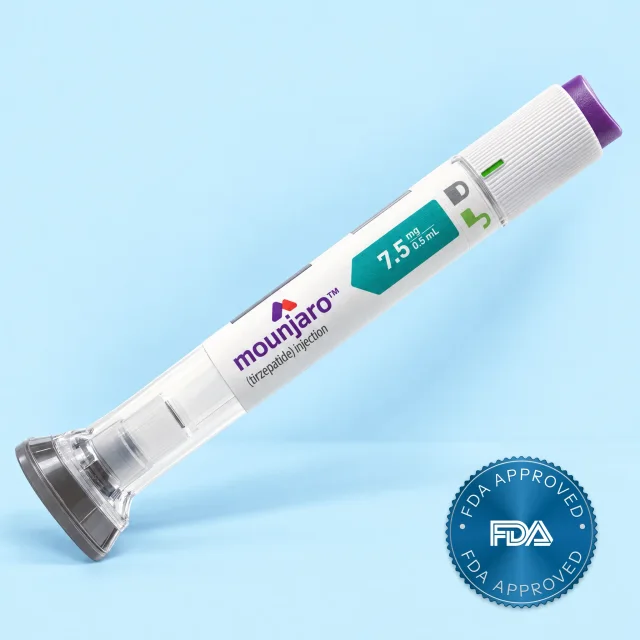
Mounjaro (tirzepatide) injection
Mounjaro doses, side effects, savings card and coupon, explained
Mounjaro is a once-weekly tirzepatide injection from Eli Lilly. The FDA has approved it to improve blood sugar in adults and children 10 and older with type 2 diabetes, and to lower the risk of major cardiovascular events in adults with type 2 diabetes who are at high risk for them. It is not approved for weight loss.1 The tirzepatide brand approved for weight management is Zepbound.
This page covers Mounjaro doses, Mounjaro side effects and who the Mounjaro Savings Card really helps. A licensed FitRx provider can review your health history online and tell you which medication, if any, fits.
- Your intake is read by a U.S.-licensed provider, typically within 1 to 2 business days
- An insurance coordination team files prior authorizations with commercial plans
- Unlimited secure messaging with your provider and a video or phone visit each month
FitRx membership is $39 for the first month and $135 a month after that. Medication is paid for separately. Mounjaro is approved for type 2 diabetes, not for weight loss. A provider decides what to prescribe, and not everyone qualifies.
What the research shows
Tirzepatide and weight in type 2 diabetes: an average loss of up to 14.7% over 72 weeks
Tirzepatide, the active ingredient in Mounjaro, acts on the receptors for two gut hormones, GIP and GLP-1.1 Its effect on weight has been measured in two kinds of studies.
The weight management trial. SURMOUNT-2 followed adults who had obesity or overweight and also had type 2 diabetes for 72 weeks. Average weight loss was 12.8% on tirzepatide 10 mg and 14.7% on 15 mg, compared with 3.2% on placebo.2,3
To be plain: SURMOUNT-2 studied tirzepatide for weight management in people with type 2 diabetes, and its results sit on Zepbound’s label. Mounjaro itself is approved for blood sugar control in type 2 diabetes, not for weight loss.1
Mounjaro’s own label trials. These measured HbA1c, a blood test that reflects average blood sugar over the past few months. In SURPASS-1, with Mounjaro as the only diabetes medication for 40 weeks, HbA1c fell by 1.8 points on 5 mg and 1.7 points on 10 mg and on 15 mg, compared with 0.1 on placebo. Weight fell by 6.3 kg, 7.0 kg and 7.8 kg, compared with 1.0 kg on placebo, from a starting weight of about 86 kg.1
In SURPASS-2, with Mounjaro added to metformin for 40 weeks, HbA1c fell by 2.0 to 2.3 points and weight by 7.6 kg, 9.3 kg and 11.2 kg across the three doses, from about 94 kg.1,4 The comparison section has the full table.
These are group averages. The slider applies the SURMOUNT-2 averages to a starting weight you choose.
Brand-name Mounjaro and compounded tirzepatide are two different things
When a FitRx provider decides tirzepatide is appropriate, it can reach you in one of two forms. They share an ingredient name and little else.
FDA-approved for type 2 diabetes
Brand-name Mounjaro
Manufactured by Eli Lilly and reviewed by the FDA for safety, effectiveness and quality in its approved uses, all of which are in type 2 diabetes. It is not approved for weight loss.1
- The tirzepatide product tested in the SURPASS diabetes trials
- Bought at a pharmacy or through LillyDirect, at your plan’s copay or a cash price
- Prior authorizations for commercial plans are filed by FitRx’s insurance coordination team
Not FDA-approved
Compounded tirzepatide
Made to fill one person’s prescription by a state-licensed compounding pharmacy. Through FitRx the medication starts at $216 a month when you take a 3-month supply. That is on top of membership, and shipping is included.
- Ships as vials, in 1-month or 3-month supplies
- Not a generic of Mounjaro or Zepbound, and not the product used in their trials
- Offered only when a provider decides it is appropriate for you
What “not FDA-approved” means. The FDA does not evaluate compounded tirzepatide for safety, effectiveness or quality before it is dispensed. It is not a generic of Mounjaro or Zepbound, and it has not been through the brand-name trials. The agency’s position is that compounded drugs should only be used by patients whose medical needs cannot be met by an FDA-approved drug.5 A licensed provider decides whether that describes you.
Questions that shape the choice
- Do you have type 2 diabetes? Every approved use of Mounjaro is in type 2 diabetes, and the Mounjaro Savings Card requires a prescription for an approved use.
- Is weight management the goal? Zepbound is the tirzepatide brand with that approval. Using Mounjaro for weight loss alone would be outside its approved uses, often called off-label.
As of May 31, 2026, the FDA had received more than 730 adverse event reports for compounded tirzepatide, and it notes that a cause cannot always be determined.5 Our tirzepatide page covers the ingredient across both brands.
How care works at FitRx, step by step
Complete the online intake
Answer questions about your health history, the medicines you take and what you hope to change. If you have type 2 diabetes, say so clearly. Mounjaro’s approved uses and its savings card both depend on that diagnosis.
A licensed provider reads it
A U.S.-licensed, board-certified physician or nurse practitioner reviews your intake, typically within 1 to 2 business days, and decides whether medication is appropriate and which one.
Coverage paperwork, if needed
For a brand-name medication on a commercial plan, FitRx’s insurance coordination team submits the prior authorization. Most decisions arrive in 2 to 14 business days.
Prescription and follow-up
If medication is appropriate, the prescription goes to a partner pharmacy. You can then message your provider as needed and meet by video or phone each month.
FitRx works with licensed providers in all 50 states and DC, and its weight loss program is for adults 18 and older.
If your goal is weight management and you do not have type 2 diabetes, the label standard that applies is the one for Zepbound and Wegovy: a BMI of 30 or higher, or 27 or higher with a weight-related condition.3,6 The BMI calculator shows where you stand. The provider makes the final call, and the answer may be a different medication or none.
What a FitRx membership covers, and what it leaves out
Mounjaro’s label describes it as an addition to diet and exercise, and membership is the support around the medication.1
Your provider
A licensed provider reviews your intake, answers unlimited secure messages, and sees you by video or phone every month.
Your coordinator and coach
A care coordinator you can message, and a dedicated coach.
Your insurance paperwork
Prior authorizations for brand-name GLP-1 medications, sent to your commercial plan and resubmitted after a denial, up to three requests.
The price: $39 for the first month, then $135 a month, billed monthly. Quarterly, semi-annual and annual plans are discounted. HSA and FSA cards are accepted. You can cancel in the patient portal at any time. Memberships cannot be paused, and a prior authorization only stays in place while the membership is active.
Left out of that price: medication. FitRx does not sell brand-name Mounjaro and has no say in what it costs. You pay the pharmacy your plan’s copay or a cash price. The weight loss program also does not work with government insurance, including Medicare, Medicaid and TRICARE.
Mounjaro side effects: the common ones and the ones to act on
The most common Mounjaro side effects are stomach side effects. The table shows how often each was reported in the placebo-controlled trials pooled on the label.1
| Side effect | Placebo | 5 mg | 10 mg | 15 mg |
|---|---|---|---|---|
| Nausea | 4% | 12% | 15% | 18% |
| Diarrhea | 9% | 12% | 13% | 17% |
| Decreased appetite | 1% | 5% | 10% | 11% |
| Vomiting | 2% | 5% | 5% | 9% |
| Constipation | 1% | 6% | 6% | 7% |
| Indigestion (dyspepsia) | 3% | 8% | 8% | 5% |
| Abdominal pain | 4% | 6% | 5% | 5% |
Share of people reporting each reaction in a pool of placebo-controlled trials: 235 on placebo, 237 on 5 mg, 240 on 10 mg and 241 on 15 mg. From the Mounjaro prescribing information.1
Counting every stomach or gut reaction together, 37.1% of people on 5 mg, 39.6% on 10 mg and 43.6% on 15 mg reported at least one, compared with 20.4% on placebo. These reactions led 3.0%, 5.4% and 6.6% of people at the three doses to stop treatment.1
Why they show up around dose changes
Mounjaro doses rise in small steps, with at least four weeks between them.1 In SURMOUNT-5, a weight management trial of tirzepatide in adults without diabetes, most adverse events were gastrointestinal, mild to moderate, and occurred mainly while doses were being raised.7 If a step up is hard on you, tell your provider before the next one is due.
Fluids, low blood sugar and other medicines
- Drink enough. The medication guide says to drink fluids when you have nausea, vomiting or diarrhea, to lower the chance of dehydration. Fluid loss is behind the kidney injury on the label.1
- Know your low blood sugar risk. The label warns about hypoglycemia when Mounjaro is used with insulin or a sulfonylurea.
- Mention your pills. Mounjaro slows stomach emptying, which can change how oral medicines are absorbed. For birth control pills, the label advises a non-oral method or an added barrier method for 4 weeks after starting and 4 weeks after every dose increase.
Serious risks and their warning signs
These are the label’s warnings. Learn the signs before your first injection.1
- Thyroid C-cell tumors (the boxed warning). Tirzepatide caused these tumors in rats, and nobody knows whether it does in people. Mounjaro is not for anyone with a personal or family history of medullary thyroid carcinoma, or with MEN 2. Signs: a lump or swelling in the neck, hoarseness, trouble swallowing, shortness of breath.
- Pancreatitis. Severe pain in the stomach area that will not go away, sometimes felt in the back, with or without vomiting.
- Gallbladder problems. Fever, yellowing of the skin or eyes, clay-colored stools, or pain in the upper stomach.
- Serious allergic reactions, including anaphylaxis and angioedema.
- Severe stomach reactions. Mounjaro is not recommended for people with severe gastroparesis.
- Diabetic retinopathy complications in people with a history of diabetic retinopathy.
- Aspiration during anesthesia. Tell your providers about any planned surgery or procedure that uses general anesthesia or deep sedation.
The important safety information below has the full summary. Our GLP-1 side effects guide covers the whole drug class.
Mounjaro doses: all six strengths, the schedule and missed doses
There are six Mounjaro doses: 2.5 mg, 5 mg, 7.5 mg, 10 mg, 12.5 mg and 15 mg, each injected under the skin once a week. Treatment starts at 2.5 mg. The dose can then go up 2.5 mg at a time, after at least 4 weeks on the current dose, if more blood sugar control is needed.1
| Weekly dose | Earliest week the label allows | Notes |
|---|---|---|
| 2.5 mg | Week 1 | Starting dose. |
| 5 mg | Week 5 | Reached after at least 4 weeks on 2.5 mg. |
| 7.5 mg | Week 9 | Only if more blood sugar control is needed. |
| 10 mg | Week 13 | Highest dose for pediatric patients. |
| 12.5 mg | Week 17 | Above the pediatric maximum. |
| 15 mg | Week 21 | Highest dose on the label, for adults. |
Dose steps and limits from the Mounjaro prescribing information.1 The weeks are our arithmetic for the fastest schedule the 4-week rule permits. They are not a target.
On Mounjaro’s label the reason to move up is blood sugar, not weight. Zepbound uses the same six steps, but its label names 5 mg, 10 mg and 15 mg as the maintenance doses for weight management.1,3 Which dose you take, and when it changes, is your provider’s decision.
The maximum is 15 mg a week for adults and 10 mg a week for pediatric patients, meaning children 10 and older with type 2 diabetes.1 FitRx treats adults 18 and older.
If you miss a dose
The label gives a 4-day window. A dose that is up to 4 days (96 hours) late can still be taken, as soon as you remember. A dose later than that is skipped, and the next one is taken on the regular day. The injection day itself can move, as long as two doses end up at least 3 days (72 hours) apart.1
Pens, vials and the KwikPen
Mounjaro is supplied in the same forms as Zepbound: a single-dose pen, a single-dose vial, a multi-dose vial and a KwikPen.1
- Single-dose pen. One prefilled weekly dose per pen, in all six strengths. The savings card’s $25 offer and LillyDirect’s self-pay price are written around this form.8,9
- KwikPen. A pen for one patient that holds four weekly doses. A KwikPen must never be shared.
- Vials. Doses from a vial are drawn up with a syringe.
Mounjaro’s label says a dose can be taken at any time of day, with or without meals, in the abdomen or thigh, or in the back of the upper arm when another person gives it, changing the site each time.1 Follow the directions that come with your own prescription.
Mounjaro pens are prefilled, so there are no units to work out. Unit conversions only come up with compounded tirzepatide in vials, which is not FDA-approved. The FDA does not review it for safety, effectiveness or quality, and it is not a generic of Mounjaro. Our guide to tirzepatide dosing in units explains the math.
The Mounjaro Savings Card and coupon terms: $25 for some, $499 for others
The Mounjaro coupon people search for is the Mounjaro Savings Card from Eli Lilly. It can bring a fill down to $25, but only for people with commercial insurance that covers Mounjaro and a prescription for an FDA-approved use. Mounjaro is approved for type 2 diabetes, not for weight loss, and that decides most of what follows.1,8
Lilly’s list price is $1,112.16 per fill.10 The table uses Lilly’s published terms as of November 18, 2026.
| If you have | The Mounjaro price | Conditions |
|---|---|---|
| Commercial plan covers Mounjaro, and the prescription is for type 2 diabetes | As little as $25 for a 1-, 2- or 3-month fill of single-dose pens | The card takes off no more than $150 for a 1-month fill, $300 for 2 months or $450 for 3 months, and no more than $1,950 in a calendar year. |
| Commercial plan does not cover Mounjaro | As low as $499 for a 1-month fill | The card takes off no more than $647 a month and $8,411 a year. The approved-use requirement still applies. |
| No coverage, or a plan to pay cash | $499 a month and up through LillyDirect | Single-dose prefilled pen, at every dose. A prescription is required. |
| Prescription written only for weight loss | The card does not apply | Weight loss is not an FDA-approved use of Mounjaro. |
| Medicare, Medicaid, TRICARE or another government program | Depends on the program | Government-program beneficiaries are excluded from the card. |
Sources: Lilly’s Mounjaro savings, pricing and LillyDirect pages.8,9,10 Both card tiers allow up to 13 fills a year. A month is 28 days and up to four pens. The current card expires December 31, 2026. Prices and terms change, so check them with Lilly or your pharmacy before you fill.
What the caps do to a real copay
“As little as $25” is the floor. The caps decide whether you reach it. The card removes at most $150 from a 1-month fill, so by arithmetic a plan copay of $175 comes down to $25 and a copay of $250 comes down to $100. The yearly limit of $1,950 equals 13 one-month fills at the full $150.
The approved-use rule
The card’s terms require a prescription for an approved use consistent with FDA-approved product labeling.8 Mounjaro’s labeling covers blood sugar control in type 2 diabetes and cardiovascular risk reduction in adults with type 2 diabetes at high risk.1 A Mounjaro prescription written only for weight loss does not meet that requirement, so it does not qualify for the card.
If weight management is your goal, Zepbound is the tirzepatide brand approved for it, with a savings card and self-pay prices of its own.
Who is excluded
People covered by government-funded programs cannot use the Mounjaro Savings Card.8 Medicare, Medicaid and TRICARE are the familiar examples. FitRx does not work with government insurance either. The Medicare GLP-1 Bridge, a temporary federal program, lists Foundayo, Wegovy and the Zepbound KwikPen as its covered drugs. Mounjaro is not among them.11
Getting a commercial plan to cover Mounjaro
For members, FitRx’s insurance coordination team submits prior authorizations for brand-name GLP-1 medications. Most decisions come back in 2 to 14 business days. After a denial the team can resubmit, up to three requests in all. The plan makes the decision, and approval is never guaranteed. Our GLP-1 insurance checker explains how a coverage check works.
Your total with FitRx
There are two bills: the FitRx membership ($39 for the first month, then $135 a month) and the medication, paid to the pharmacy. With a covering commercial plan and the savings card, the Mounjaro part can be as little as $25 a fill.
What LillyDirect does for Mounjaro, and the one thing it does not do
LillyDirect is Eli Lilly’s pharmacy service. As of November 18, 2026, it lists a self-pay price for the Mounjaro single-dose prefilled pen starting at $499 a month at every dose from 2.5 mg to 15 mg. It delivers the medication or supports retail pickup. A prescription is required.9
LillyDirect fills prescriptions. It does not write them, although its Mounjaro page links to independent virtual care.9
| Question | FitRx | LillyDirect |
|---|---|---|
| Does it evaluate you and prescribe? | Yes, when a provider finds medication appropriate | No. A prescriber has to send the prescription. |
| What do you pay it for? | Care: $39 the first month, then $135 a month | The medication: from $499 a month self-pay |
| Who helps with doses and side effects? | Your provider, by message and in monthly visits | Whoever prescribed it |
LillyDirect details from Lilly’s published pages as of November 18, 2026.9 Confirm the current price with LillyDirect.
One comparison is worth making before you pay cash. Mounjaro’s self-pay price does not drop at low doses, while LillyDirect lists Zepbound, the same tirzepatide, at $299 a month for 2.5 mg and $399 for 5 mg.12 Zepbound is approved for weight management. Mounjaro is not.
If you plan to pay cash, ask your provider whether your prescription can be filled through LillyDirect.
How Mounjaro compares with Zepbound, Ozempic and Wegovy
Mounjaro and Ozempic are approved for type 2 diabetes and are not approved for weight loss. Zepbound and Wegovy are approved for weight management.
| Medication | Ingredient | FDA-approved for | Weight result in a label trial |
|---|---|---|---|
| Mounjaro | Tirzepatide | Type 2 diabetes: blood sugar control, and cardiovascular risk reduction in high-risk adults. Not approved for weight loss. | 7.6 kg to 11.2 kg at 40 weeks, roughly 8% to 12% (people with type 2 diabetes)1 |
| Zepbound | Tirzepatide | Weight management; moderate to severe obstructive sleep apnea in adults with obesity | 20.9% at 72 weeks on 15 mg without diabetes; 14.7% with type 2 diabetes3 |
| Ozempic | Semaglutide | Type 2 diabetes, including cardiovascular and kidney risk reduction. Not approved for weight loss. | 5.6 kg on 1 mg and 6.4 kg on 2 mg at 40 weeks, roughly 6% (people with type 2 diabetes)13 |
| Wegovy | Semaglutide | Weight management; cardiovascular risk reduction; MASH with liver fibrosis | 14.9% at 68 weeks on 2.4 mg without diabetes6 |
Each row comes from a different trial with different participants, so the rows cannot be ranked against each other.
Mounjaro against semaglutide 1 mg
In SURPASS-2, people with type 2 diabetes who were taking metformin received one of three Mounjaro doses or semaglutide 1 mg, the ingredient in Ozempic, for 40 weeks. Each group had about 470 people.1,4
| Result at 40 weeks | Mounjaro 5 mg | Mounjaro 10 mg | Mounjaro 15 mg | Semaglutide 1 mg |
|---|---|---|---|---|
| Change in HbA1c (points) | −2.0 | −2.2 | −2.3 | −1.9 |
| Reached an HbA1c below 7% | 82% | 86% | 86% | 79% |
| Change in weight | −7.6 kg | −9.3 kg | −11.2 kg | −5.7 kg |
| Rough share of starting weight | 8% | 10% | 12% | 6% |
SURPASS-2 results as reported in the Mounjaro prescribing information. Starting weight averaged about 94 kg.1 This was a diabetes trial. Mounjaro and Ozempic are not approved for weight loss.
A second head-to-head trial, SURMOUNT-5, looked at weight management in 751 adults with obesity and no diabetes. After 72 weeks at the highest dose each person could tolerate, average weight loss was 20.2% with tirzepatide and 13.7% with semaglutide.7 That is the setting Zepbound and Wegovy are approved for. Our Mounjaro vs. Ozempic guide goes deeper.
Heart outcomes
Mounjaro’s cardiovascular indication was added to its label in August 2026. In the outcomes trial on the label, tirzepatide was compared with dulaglutide in 6,647 people per group over a median of 210 weeks. A major cardiovascular event (cardiovascular death, heart attack or stroke) occurred in 12.1% of the tirzepatide group and 13.0% of the dulaglutide group, a hazard ratio of 0.92 (95% confidence interval 0.83 to 1.01).1
Your diagnosis, other medications, coverage and tolerance all count in the choice. For more on the two ingredients, see tirzepatide and semaglutide.
The FitRx care team
A licensed provider decides, not a form and not a coupon
Whether Mounjaro, Zepbound, another medication or no medication suits you depends on your diagnosis, your history and what else you take. At FitRx a U.S.-licensed physician or nurse practitioner reads your intake and makes that decision, and the care team stays reachable as your dose changes.
- U.S.-licensed providers review every intake and make every prescribing decision
- Unlimited secure messaging, plus monthly video or phone visits
- A care coordinator and a coach alongside your provider
- An insurance coordination team for brand-name GLP-1 prior authorizations
This page was written and reviewed by the FitRx care team and last updated November 18, 2026. It is general information, not personal medical advice.
Mounjaro FAQs: doses, savings card and side effects
What is Mounjaro used for?
Mounjaro is FDA-approved, with diet and exercise, to improve blood sugar control in adults and children 10 and older with type 2 diabetes, and to reduce the risk of major cardiovascular events in adults with type 2 diabetes who are at high risk for them. It is not approved for weight loss.
Is Mounjaro approved for weight loss?
No. Mounjaro is approved for type 2 diabetes, not for weight loss. The tirzepatide brand the FDA has approved for weight management is Zepbound.
How is Mounjaro different from Zepbound?
They are the same molecule, tirzepatide, made by Eli Lilly, with the same dose steps from 2.5 mg to 15 mg. The approvals differ: Mounjaro for type 2 diabetes, Zepbound for weight management and for moderate to severe obstructive sleep apnea in adults with obesity.
What are the Mounjaro doses?
Mounjaro doses are 2.5 mg, 5 mg, 7.5 mg, 10 mg, 12.5 mg and 15 mg, taken once a week. Treatment starts at 2.5 mg and can go up 2.5 mg at a time after at least 4 weeks on the current dose, if more blood sugar control is needed. The maximum is 15 mg a week for adults and 10 mg a week for pediatric patients.
What if I miss a Mounjaro dose?
The label says to take it as soon as possible if no more than 4 days (96 hours) have passed since it was due. After 4 days, skip it and take your next dose on the usual day. You can change your injection day if two doses are at least 3 days (72 hours) apart.
Which Mounjaro side effects are most common?
Nausea, diarrhea, decreased appetite, vomiting, constipation, indigestion and abdominal pain. In the placebo-controlled trials on the label, nausea was reported by 12% of people on 5 mg, 15% on 10 mg and 18% on 15 mg, compared with 4% on placebo.
What are the serious side effects of Mounjaro?
Mounjaro has a boxed warning about thyroid C-cell tumors, which tirzepatide caused in rats. Whether it causes them in people is not known. The label also warns about pancreatitis, low blood sugar when used with insulin or a sulfonylurea, serious allergic reactions, kidney injury from fluid loss, severe stomach reactions, diabetic retinopathy complications, gallbladder disease, and aspiration during general anesthesia or deep sedation.
Is there a coupon for Mounjaro?
Yes: the Mounjaro Savings Card from Eli Lilly. As of November 18, 2026, people with commercial insurance that covers Mounjaro and a prescription for an FDA-approved use may pay as little as $25 for a 1-, 2- or 3-month fill of single-dose pens. Savings are capped at $150 for a 1-month fill and $1,950 a calendar year. The current card expires December 31, 2026. Confirm the terms with Lilly before you fill.
Who qualifies for the Mounjaro Savings Card?
People with commercial insurance and a Mounjaro prescription for an FDA-approved use, which means type 2 diabetes. If the plan covers Mounjaro, a fill can cost as little as $25. If it does not, a 1-month fill can be as low as $499. People in government-funded programs are excluded.
Does the Mounjaro Savings Card work for a weight loss prescription?
Not when weight loss is the only reason for the prescription. The card requires a prescription for an approved use consistent with FDA-approved labeling, and Mounjaro is approved for type 2 diabetes, not for weight loss. Zepbound, the same tirzepatide, is approved for weight management and has its own savings card.
Can I use the Mounjaro Savings Card with Medicare or Medicaid?
No. People in government-funded programs, such as Medicare and Medicaid, are excluded from the Mounjaro Savings Card. FitRx does not work with government insurance either.
How much does Mounjaro cost without insurance?
As of November 18, 2026, Lilly's list price is $1,112.16 per fill, and LillyDirect lists a self-pay price for the single-dose prefilled pen starting at $499 a month at every dose. You still need a prescription, because LillyDirect is a pharmacy service and does not prescribe. Prices change, so confirm before you fill.
How much weight did people lose in the Mounjaro and tirzepatide trials?
In Mounjaro's 40-week diabetes trial SURPASS-2, average weight loss was 7.6 kg to 11.2 kg depending on dose. In SURMOUNT-2, a 72-week weight management trial of tirzepatide in adults with type 2 diabetes and obesity or overweight, it was 12.8% on 10 mg and 14.7% on 15 mg, compared with 3.2% on placebo. These are averages, and Mounjaro is not approved for weight loss.
Is Mounjaro better than Ozempic?
In SURPASS-2, a 40-week trial in people with type 2 diabetes taking metformin, HbA1c fell by 2.0 to 2.3 points on Mounjaro and 1.9 points on semaglutide 1 mg, the ingredient in Ozempic. Average weight loss was 7.6 kg to 11.2 kg versus 5.7 kg. Neither drug is approved for weight loss, and the right choice depends on your health history and coverage.
Is compounded tirzepatide the same as Mounjaro?
No. Mounjaro is an FDA-approved brand-name drug. Compounded tirzepatide is not FDA-approved, which means the FDA has not checked it for safety, effectiveness or quality. It is also not a generic of Mounjaro or Zepbound, and the brand-name trials did not test it. Whether it suits a given patient is a licensed provider's call.
Can FitRx providers prescribe Mounjaro?
Yes, when a provider decides it is appropriate. You complete an online intake and a U.S.-licensed provider reviews it, typically within 1 to 2 business days. Membership is $39 for the first month, then $135 a month, and medication is billed separately. FitRx does not work with government insurance.
Important safety information for Mounjaro
Boxed warning: risk of thyroid C-cell tumors. In rats, tirzepatide caused thyroid C-cell tumors. It is not known whether Mounjaro causes these tumors, including medullary thyroid carcinoma (MTC), in humans. Mounjaro must not be used by anyone with a personal or family history of MTC, or by anyone with Multiple Endocrine Neoplasia syndrome type 2 (MEN 2). Tell your provider if you notice a lump or swelling in your neck, hoarseness, trouble swallowing or shortness of breath.
What Mounjaro is for. Mounjaro (tirzepatide) is a prescription injection used with diet and exercise to improve blood sugar control in adults and children 10 years and older with type 2 diabetes. It is also used to reduce the risk of cardiovascular death, non-fatal heart attack and non-fatal stroke in adults with type 2 diabetes who are at high risk for these events. Mounjaro is not FDA-approved for weight loss.1
Do not use Mounjaro if you or a family member has ever had MTC, if you have MEN 2, or if you have had a serious allergic reaction to tirzepatide.
Warnings on the label. Mounjaro can cause:
- Inflammation of the pancreas (acute pancreatitis). Mounjaro should be stopped if pancreatitis is suspected. Get medical help for severe stomach-area pain that will not go away, with or without vomiting.
- Low blood sugar when used with insulin or an insulin secretagogue such as a sulfonylurea.
- Serious allergic reactions, including anaphylaxis and angioedema.
- Acute kidney injury caused by fluid loss. Drink fluids if you have nausea, vomiting or diarrhea.
- Severe stomach and intestinal reactions. Mounjaro is not recommended for people with severe gastroparesis.
- Complications of diabetic retinopathy in people with a history of it.
- Acute gallbladder disease. Signs include upper stomach pain, fever, yellowing of the skin or eyes, and clay-colored stools.
- Food or liquid entering the lungs during general anesthesia or deep sedation. Tell your providers about any planned surgery or procedure.
Never share a Mounjaro KwikPen with another person.
Most common side effects (5% or more of people): nausea, diarrhea, decreased appetite, vomiting, constipation, indigestion and abdominal pain.
Pregnancy and birth control. Based on animal studies, Mounjaro may harm an unborn baby. Tell your provider if you are pregnant or plan to be. If you take birth control pills, switch to a non-oral method or add a barrier method for 4 weeks after starting Mounjaro and for 4 weeks after each dose increase.
Other medicines. Mounjaro delays stomach emptying and may affect how medicines taken by mouth are absorbed.
This summary does not replace the full prescribing information or a conversation with your provider.1 Side effects can be reported to the FDA at www.fda.gov/medwatch or 1-800-FDA-1088.
A note on compounded tirzepatide. Tirzepatide made by a compounding pharmacy is not FDA-approved. The FDA does not review its safety, effectiveness or quality, it is not a generic of Mounjaro or Zepbound, and it was not part of their clinical trials.5
Talk through Mounjaro and your other options with a provider
Complete the online intake. A licensed provider reviews it and tells you what they recommend, including when the answer is no medication.
Start onlineFitRx membership costs $39 in month one and $135 a month from then on. Medication is a separate charge. Not everyone qualifies.
References (13)
- Mounjaro (tirzepatide) injection. Prescribing information. Eli Lilly and Company; revised August 2026. https://pi.lilly.com/us/mounjaro-uspi.pdf
- Garvey WT, Frias JP, Jastreboff AM, et al. Tirzepatide once weekly for the treatment of obesity in people with type 2 diabetes (SURMOUNT-2). Lancet. 2023;402(10402):613-626. https://pubmed.ncbi.nlm.nih.gov/37385275/
- Zepbound (tirzepatide) injection. Prescribing information. Eli Lilly and Company; revised August 2026. https://pi.lilly.com/us/zepbound-uspi.pdf
- Frias JP, Davies MJ, Rosenstock J, et al. Tirzepatide versus semaglutide once weekly in patients with type 2 diabetes (SURPASS-2). N Engl J Med. 2021;385(6):503-515. https://pubmed.ncbi.nlm.nih.gov/34170647/
- U.S. Food and Drug Administration. FDA's concerns with unapproved GLP-1 drugs used for weight loss. Content current as of October 1, 2026. https://www.fda.gov/drugs/postmarket-drug-safety-information-patients-and-providers/fdas-concerns-unapproved-glp-1-drugs-used-weight-loss
- Wegovy (semaglutide) injection and tablets. Prescribing information. Novo Nordisk; revised June 2026. https://www.novo-pi.com/wegovy.pdf
- Aronne LJ, Horn DB, le Roux CW, et al. Tirzepatide as compared with semaglutide for the treatment of obesity (SURMOUNT-5). N Engl J Med. 2025;393(1):26-36. https://pubmed.ncbi.nlm.nih.gov/40353578/
- Eli Lilly and Company. Mounjaro savings and coverage, including Savings Card terms and conditions. https://mounjaro.lilly.com/savings-coverage
- Eli Lilly and Company. LillyDirect: Mounjaro self-pay pricing and pharmacy options. https://www.lilly.com/lillydirect/medicines/mounjaro
- Eli Lilly and Company. Mounjaro pricing information (list price). https://pricinginfo.lilly.com/mounjaro
- Centers for Medicare & Medicaid Services. Medicare GLP-1 Bridge. https://www.cms.gov/medicare/coverage/prescription-drug-coverage/medicare-glp-1-bridge
- Eli Lilly and Company. LillyDirect: Zepbound self-pay pricing and pharmacy options. https://www.lilly.com/lillydirect/medicines/zepbound
- Ozempic (semaglutide) injection. Prescribing information. Novo Nordisk; revised May 2026. https://www.novo-pi.com/ozempic.pdf
Sources were opened and checked on November 18, 2026. Prices, savings programs and labels change; confirm current terms with the manufacturer, your pharmacy or your provider.