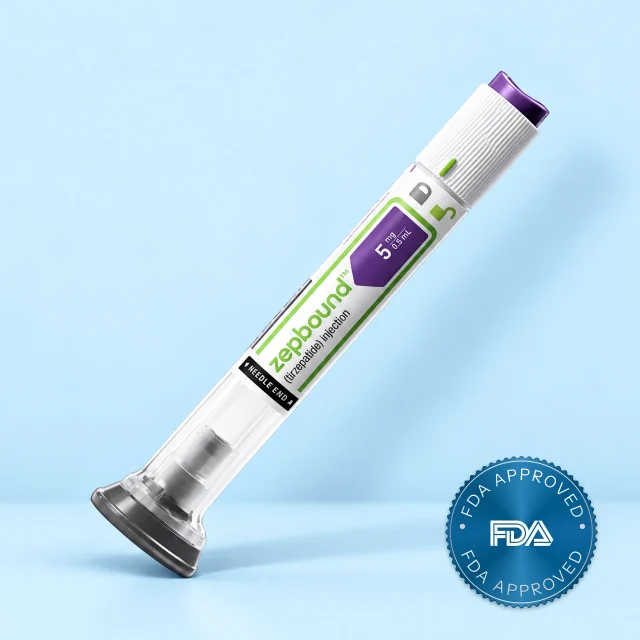
Zepbound (tirzepatide) injection
Zepbound online: cost, coupon, side effects and how to get a prescription
Zepbound is a once-weekly tirzepatide injection that the FDA has approved for long-term weight management and for moderate to severe obstructive sleep apnea in adults with obesity.1 With FitRx, the whole process happens online: a licensed provider reviews your health history, decides whether Zepbound is appropriate, and stays with you through every dose change.
- Reviewed by a U.S.-licensed provider, typically within 1 to 2 business days
- Prior authorization paperwork handled by an insurance coordination team
- Unlimited messaging with your provider, plus monthly video or phone visits
FitRx membership costs $39 in month one and $135 a month from then on. Medication is a separate charge. A provider decides whether a prescription is appropriate, and not everyone qualifies.
What the main trial found
Adults on the highest Zepbound dose lost an average of 20.9% of their body weight
The trial behind Zepbound’s approval, SURMOUNT-1, followed adults with obesity, or with overweight and a weight-related condition, for 72 weeks. None had diabetes. Everyone was asked to follow a reduced-calorie diet and be more active, and they were randomly assigned to weekly tirzepatide or a placebo injection.2
People taking 5 mg lost 15.0% of their weight on average, those on 10 mg lost 19.5% and those on 15 mg lost 20.9%. The placebo group lost 3.1%. The starting weight averaged about 231 pounds. On the 15 mg dose, 90.9% of people lost at least 5% of their weight and 56.7% lost 20% or more.1
Those numbers are averages across a large group. Some people lost more, some lost less, and some stopped because of side effects. Use the slider to see what the trial averages would look like at your starting weight.
Two ways to get tirzepatide through FitRx
Tirzepatide is the active ingredient in Zepbound. If a FitRx provider decides tirzepatide is appropriate for you, there are two routes, and they are not interchangeable.
FDA-approved
Brand-name Zepbound
Made by Eli Lilly and reviewed by the FDA for safety, effectiveness and quality. It comes as a single-dose pen, a KwikPen that holds four weekly doses, or a single-dose vial.1
- The product studied in the SURMOUNT trials
- FitRx’s insurance coordination team submits prior authorizations for commercial plans
- You pay your pharmacy or LillyDirect: a copay with coverage, or a cash price without it
Not FDA-approved
Compounded tirzepatide
Prepared for an individual prescription by a state-licensed compounding pharmacy. Through FitRx it starts at $216 a month with a 3-month supply, on top of membership, with shipping included.
- Supplied in a vial and drawn up with a syringe
- Not a generic version of Zepbound, and not tested in the Zepbound trials
- Prescribed only when a provider decides it is appropriate for you
What “not FDA-approved” means. The FDA does not review compounded drugs for safety, effectiveness or quality before they are dispensed. The agency says compounded drugs should only be used by patients whose medical needs cannot be met by an FDA-approved drug.3 Your provider will talk through whether that applies to you.
From intake to first dose: how it works
Tell us about your health
Fill out an online intake covering your weight history, medical conditions, current medications and goals. It takes a few minutes, and you can add your insurance card if you want coverage checked.
A licensed provider reviews it
A U.S.-licensed physician or nurse practitioner looks at your intake, typically within 1 to 2 business days. They may ask follow-up questions or order labs before deciding.
Prescription and paperwork
If Zepbound is appropriate, your provider writes the prescription. When your plan needs a prior authorization, FitRx submits it. Most decisions come back in 2 to 14 business days.
Ongoing care
You start at 2.5 mg and check in as you go. Your provider adjusts the dose, helps with side effects, and is reachable by message between monthly visits.
Zepbound’s label covers adults with obesity (a BMI of 30 or higher) and adults with overweight (a BMI of 27 or higher) who have at least one weight-related condition.1 Not sure where you fall? The BMI calculator takes a few seconds. Your provider makes the final call, and sometimes the answer is that a different treatment, or no medication, is the better choice.
What a FitRx membership includes
Zepbound works best as part of a plan, and the label itself says it is meant to be used with a reduced-calorie diet and more physical activity.1 Membership is the care around the prescription.
Provider care
Review of your intake by a licensed provider, unlimited secure messaging, and monthly video or phone visits to adjust your plan.
Coordination and coaching
A care coordinator for logistics and a dedicated coach for the day-to-day: eating enough protein, staying active, handling plateaus.
Insurance help
A team that submits prior authorizations for brand-name GLP-1 medications and resubmits after a denial, up to three requests.
What it costs: $39 for the first month, then $135 a month, billed monthly. You can cancel any time in the patient portal. Quarterly, semi-annual and annual plans are discounted, and HSA and FSA cards are accepted. A membership cannot be paused, and it has to stay active to keep a prior authorization in place.
What it does not include: the medication. Brand-name Zepbound is paid for at the pharmacy or through LillyDirect, at your plan’s copay or a cash price. FitRx does not sell it or set its price. FitRx’s weight loss program is also not available to people with government insurance such as Medicare, Medicaid or TRICARE.
Zepbound side effects: what is common and what is serious
Most Zepbound side effects involve the stomach and gut. In the weight management trials they were the most frequently reported problems at every dose.1
| Side effect | Placebo | 5 mg | 10 mg | 15 mg |
|---|---|---|---|---|
| Nausea | 8% | 25% | 29% | 28% |
| Diarrhea | 8% | 19% | 21% | 23% |
| Vomiting | 2% | 8% | 11% | 13% |
| Constipation | 5% | 17% | 14% | 11% |
| Abdominal pain | 5% | 9% | 9% | 10% |
| Indigestion | 4% | 9% | 9% | 10% |
| Injection site reactions | 2% | 6% | 8% | 8% |
| Fatigue | 3% | 5% | 6% | 7% |
| Belching | 1% | 4% | 5% | 5% |
| Hair loss | 1% | 5% | 4% | 5% |
| Acid reflux | 2% | 4% | 4% | 5% |
Share of adults reporting each reaction in two pooled 72-week trials, from the Zepbound prescribing information.1
Living with the common ones
The dosing schedule is built to limit these effects: everyone starts at 2.5 mg, which is a starting dose and not a treatment dose, and moves up no faster than every four weeks.1 In the head-to-head SURMOUNT-5 trial, most adverse events were gastrointestinal, mild to moderate, and happened mainly while doses were being raised.4 If a new dose is rough, tell your provider. Staying at the current dose for longer is an option the label allows.
Vomiting and diarrhea can dehydrate you, and dehydration is how the kidney problems on the label happen. Keep fluids up, and message your care team if you cannot keep liquids down.
Serious risks
These are uncommon, but you should know the warning signs before your first dose:
- Thyroid C-cell tumors. Zepbound carries a boxed warning because tirzepatide caused thyroid tumors in rats. Whether it does in people is not known. Do not use it if you or a family member has had medullary thyroid carcinoma, or if you have MEN 2.
- Pancreatitis. Severe pain in the upper abdomen that does not go away, sometimes spreading to the back, with or without vomiting.
- Gallbladder problems. Pain in your upper stomach area, fever, yellowing of the skin or eyes, or clay-colored stools.
- Severe stomach problems. Zepbound is not recommended for people with severe gastroparesis.
- Kidney injury from fluid loss, serious allergic reactions, low blood sugar when taken with insulin or a sulfonylurea, and vision changes in people with type 2 diabetes.
- Aspiration during anesthesia. Tell your surgical team you take Zepbound before any procedure with general anesthesia or deep sedation.
The full list is in the important safety information below. For a wider view across the drug class, see our guide to GLP-1 side effects.
Zepbound doses and schedule
Zepbound is a once-weekly injection that goes under the skin. Pick one day of the week and keep to it. The hour does not matter, and neither does whether you have eaten.1
| Stage | Weekly dose | How long |
|---|---|---|
| Starting dose | 2.5 mg | 4 weeks |
| First treatment dose | 5 mg | At least 4 weeks |
| Step-up doses, if needed | 7.5 mg, 10 mg, 12.5 mg | At least 4 weeks each |
| Maximum dose | 15 mg | Ongoing |
The recommended maintenance doses for weight management are 5 mg, 10 mg or 15 mg a week. For obstructive sleep apnea they are 10 mg or 15 mg. Not everyone needs the top dose; the right one is the dose that works and that you tolerate.
If you miss a dose, take it as soon as you can within 4 days (96 hours). After that, skip it and take the next dose on your usual day. You can change your injection day as long as the two doses are at least 3 days (72 hours) apart.1
Zepbound is a long-term treatment. In the SURMOUNT-4 trial, adults who had lost an average of 20.9% over 36 weeks were then assigned to keep taking tirzepatide or switch to placebo. A year later, the group that continued had lost a further 5.5%, while the group that stopped had regained 14.0%.5 Talk with your provider before stopping.
Zepbound cost and coupon: who actually pays $25
What you pay for Zepbound depends almost entirely on your insurance. Eli Lilly lists the price at $499 to $1,086.37 per fill, depending on the form and dose.6 Few people pay that. Here is how it breaks down, using Lilly’s published terms as of November 18, 2026.
| Your situation | What you could pay | The fine print |
|---|---|---|
| Commercial insurance that covers Zepbound | As little as $25 for a 1-, 2- or 3-month fill of single-dose pens | Savings card required. It takes off up to $100 per 1-month fill, $200 per 2-month fill or $300 per 3-month fill, up to $1,300 a calendar year and 13 fills. |
| Commercial insurance that does not cover Zepbound | As low as $499 for a 1-month fill of single-dose pens | Savings card required. KwikPens are sold at the self-pay prices instead. |
| No insurance, or paying cash | $299 to $449 a month through LillyDirect | KwikPen or single-dose vials. See the LillyDirect section for prices by dose. |
| Medicare Part D | No more than $50 a month for the KwikPen, if you qualify for the Medicare GLP-1 Bridge | A temporary federal program with its own eligibility rules. FitRx cannot process it. |
| Medicaid, TRICARE, VA or other government coverage | Depends on the program | Not eligible for the savings card. |
Sources: Lilly’s Zepbound savings and pricing pages.6,7 Prices and terms change. Confirm them with Lilly or your pharmacy before you fill.
How the Zepbound savings card works
The $25 figure in Zepbound advertising is real, but it applies to one group: people with commercial insurance whose plan already covers the single-dose pen. The card is a copay card. It pays part of what your plan leaves you with, up to the limits in the table. For this program a month is 28 days and up to four pens. The current card expires on December 31, 2026.7
People enrolled in any government-funded program are excluded. That includes Medicare, Medicare Part D, Medicare Advantage, Medigap, Medicaid, TRICARE, and Department of Defense and Veterans Affairs coverage.7
Getting your plan to cover it
Many commercial plans that cover Zepbound still require a prior authorization: your prescriber has to send clinical details showing you meet the plan’s criteria. FitRx’s insurance coordination team does this for members. Most decisions come back in 2 to 14 business days, and after a denial the team can resubmit, up to three requests in total. Approval is the plan’s decision and is never guaranteed. You can read how the process works on our GLP-1 insurance coverage page.
Zepbound and Medicare
The Medicare GLP-1 Bridge is a short-term federal program that runs from July 1, 2026 through December 31, 2027. Eligible Part D members pay a $50 copay for a one-month supply of a covered weight management drug, and for Zepbound that means the KwikPen only.8,9 FitRx does not work with government insurance, so we cannot process Bridge coverage. Medicare.gov and 1-800-MEDICARE have the eligibility rules.
The total, with FitRx
Your monthly cost has two parts: the FitRx membership ($39 the first month, then $135) and the medication, which you pay for separately at the pharmacy. With covered insurance and the savings card, the medication part can be as little as $25. HSA and FSA cards are accepted for membership; whether they cover the medication depends on your plan.
LillyDirect fills Zepbound prescriptions. It does not write them.
LillyDirect is Eli Lilly’s own pharmacy service. It ships Zepbound to your door, with free delivery, and it is the only place to buy Zepbound single-dose vials. It is also where Lilly’s self-pay prices apply.10
| Dose | Self-pay price per month | Condition |
|---|---|---|
| 2.5 mg | $299 | None |
| 5 mg | $399 | None |
| 7.5 mg | $449 | Refill within 45 days; otherwise $499 |
| 10 mg, 12.5 mg, 15 mg | $449 | Refill within 45 days; otherwise $699 |
LillyDirect self-pay prices for the Zepbound KwikPen or single-dose vials as of November 18, 2026. A month is 28 days: one KwikPen or four vials.10
A few details matter before you choose this route:
- The $449 price has a clock on it. It is part of Lilly’s Zepbound Journey Program, which requires each refill within 45 days of the last. Miss the window and the regular price applies.
- Supplies are extra. The KwikPen needs pen needles, bought separately. Vials need needles and syringes, and you draw up each dose yourself.
- Vials are cash only. Single-dose vials are sold only through LillyDirect and cannot be billed to insurance.
- You still need a prescriber. LillyDirect is a pharmacy. A licensed clinician has to evaluate you and send the prescription.
That last point is where FitRx fits. If you plan to pay cash, tell your provider during intake and ask about having your prescription sent to LillyDirect. You would pay LillyDirect for the medication and FitRx for the care around it: the evaluation, dose changes, side effect support and coaching.
Zepbound compared with other GLP-1 medications
Zepbound is one of several medications in this family. They differ in active ingredient, in what the FDA has approved them for, and in how much weight loss their trials showed.
| Medication | Active ingredient | FDA-approved for | Average weight loss in its main trial |
|---|---|---|---|
| Zepbound | Tirzepatide | Weight management; obstructive sleep apnea with obesity | 20.9% at 72 weeks (15 mg, adults without diabetes)1 |
| Wegovy | Semaglutide | Weight management; cardiovascular risk reduction; MASH | 14.9% at 68 weeks (2.4 mg, adults without diabetes)11 |
| Mounjaro | Tirzepatide | Type 2 diabetes. Not approved for weight loss. | About 12% at 40 weeks (15 mg, adults with type 2 diabetes)12 |
| Ozempic | Semaglutide | Type 2 diabetes. Not approved for weight loss. | About 6% at 40 weeks (1 mg or 2 mg, adults with type 2 diabetes)13 |
These trials enrolled different people for different lengths of time, so the rows are not a like-for-like comparison. People with type 2 diabetes tend to lose less weight on these medications than people without it.
One trial did compare two of them directly. SURMOUNT-5 assigned 751 adults with obesity and without diabetes to tirzepatide or semaglutide at the highest dose each person could tolerate. After 72 weeks, average weight loss was 20.2% with tirzepatide and 13.7% with semaglutide.4
A bigger average is not the whole decision. Insurance coverage, other health conditions, side effects and what you have tried before all count. Mounjaro contains the same tirzepatide as Zepbound but is approved for type 2 diabetes, which affects what a plan will cover. Our pages on tirzepatide and semaglutide go deeper on each ingredient, and your provider can help you weigh them.

The FitRx care team
Every prescription decision is made by a licensed provider
Zepbound is not right for everyone, and a form cannot decide that. At FitRx a U.S.-licensed physician or nurse practitioner reads your intake, checks for the conditions and medications that make tirzepatide risky, and decides what to prescribe, if anything. The same team stays reachable as your dose changes.
- U.S.-licensed providers review every intake and make every prescribing decision
- Unlimited secure messaging, plus monthly video or phone visits
- A care coordinator and a coach alongside your provider
- An insurance coordination team for brand-name GLP-1 prior authorizations
This page was written and reviewed by the FitRx care team and last updated November 18, 2026. It is general information, not personal medical advice.
Zepbound FAQs
Can I get Zepbound prescribed online?
Yes, if a licensed provider decides it is appropriate for you. With FitRx you complete an online intake, a U.S.-licensed provider reviews it, typically within 1 to 2 business days, and if Zepbound is a fit they write the prescription. Not everyone qualifies, and your provider may recommend a different treatment.
Who qualifies for Zepbound?
Zepbound is FDA-approved for adults with obesity, meaning a BMI of 30 or higher, and for adults with overweight, meaning a BMI of 27 or higher, who also have at least one weight-related condition. It is also approved for moderate to severe obstructive sleep apnea in adults with obesity. A provider reviews your health history and makes the final decision.
How much does Zepbound cost without insurance?
As of November 18, 2026, LillyDirect lists self-pay prices for the Zepbound KwikPen or single-dose vials of $299 a month for 2.5 mg, $399 for 5 mg, and $449 for 7.5 mg through 15 mg when you refill within 45 days. Without the timely refill, 7.5 mg is $499 and the higher doses are $699. Prices change, so confirm with LillyDirect before you fill.
Is there a Zepbound coupon?
Lilly offers a Zepbound savings card. If you have commercial insurance that covers the single-dose pen, you may pay as little as $25 for a 1-, 2- or 3-month fill, with savings capped at $100 per 1-month fill and $1,300 a calendar year. If your commercial plan does not cover Zepbound, the card brings a 1-month fill of pens to as low as $499. The current card expires December 31, 2026.
Can I use the Zepbound savings card with Medicare or Medicaid?
No. People enrolled in government-funded programs, including Medicare, Medicare Part D, Medicare Advantage, Medicaid, TRICARE and VA coverage, are not eligible for the savings card. Some Medicare Part D members may qualify for the separate Medicare GLP-1 Bridge, which is run by the federal government. FitRx does not work with government insurance.
What is LillyDirect?
LillyDirect is Eli Lilly's pharmacy service. It delivers Zepbound to your home and is the only source for Zepbound single-dose vials. It does not evaluate patients or write prescriptions, so you still need a licensed prescriber to send one.
What are the most common Zepbound side effects?
In clinical trials the most common were nausea, diarrhea, vomiting, constipation, abdominal pain, indigestion, injection site reactions, fatigue, allergic reactions, belching, hair loss and acid reflux. Nausea was reported by 25% to 29% of people on Zepbound, compared with 8% on placebo. Stomach side effects happen mostly while the dose is being raised.
Does Zepbound cause hair loss?
Hair loss was reported by 4% to 5% of adults taking Zepbound in the weight management trials, compared with 1% on placebo. If you notice it, tell your provider.
How quickly does Zepbound work?
The first four weeks are at 2.5 mg, a starting dose meant to help your body adjust and not a treatment dose. In the main trial, weight loss built up over 72 weeks. How quickly you see a change depends on your dose, your starting point and how you respond.
What is the highest dose of Zepbound?
The maximum dose is 15 mg once a week. The recommended maintenance doses for weight management are 5 mg, 10 mg or 15 mg, and many people do not need the highest dose.
What happens if I stop taking Zepbound?
Weight often returns. In the SURMOUNT-4 trial, adults who switched from tirzepatide to placebo after 36 weeks regained 14.0% of their body weight over the following year, while those who continued lost a further 5.5%. Talk with your provider before stopping so you can plan together.
Is Zepbound the same as Mounjaro?
They contain the same active ingredient, tirzepatide, in the same doses, and both are made by Eli Lilly. The difference is what the FDA approved them for. Zepbound is approved for weight management and obstructive sleep apnea with obesity. Mounjaro is approved for type 2 diabetes and is not approved for weight loss.
Is Zepbound better than Wegovy?
In SURMOUNT-5, a trial that compared them directly in adults with obesity and without diabetes, average weight loss at 72 weeks was 20.2% with tirzepatide, the ingredient in Zepbound, and 13.7% with semaglutide, the ingredient in Wegovy. That is an average. Which one suits you depends on your health history, your insurance and how you tolerate each drug.
Is compounded tirzepatide the same as Zepbound?
No. Compounded tirzepatide is not FDA-approved. The FDA does not review compounded drugs for safety, effectiveness or quality, and compounded tirzepatide is not a generic of Zepbound and was not tested in the Zepbound trials. A licensed provider decides whether a compounded medication is appropriate for a particular patient.
Does FitRx accept insurance for Zepbound?
The FitRx membership fee is separate from the cost of your medication. For the medication, FitRx's insurance coordination team submits prior authorizations to commercial plans, and most decisions come back in 2 to 14 business days. FitRx's weight loss program is not available to people with government insurance such as Medicare, Medicaid or TRICARE.
Can Zepbound treat sleep apnea?
Yes. Zepbound is FDA-approved to treat moderate to severe obstructive sleep apnea in adults with obesity, alongside a reduced-calorie diet and more physical activity. In the trials behind that approval, breathing interruptions during sleep fell by about 25 to 29 events an hour on Zepbound, compared with about 5 on placebo.
Can I take Zepbound if I am pregnant or planning to be?
No. Zepbound may harm an unborn baby and should be stopped when pregnancy is recognized. It can also make birth control pills less effective. The label advises switching to a non-oral method or adding a barrier method for 4 weeks after starting and for 4 weeks after each dose increase.
Important safety information for Zepbound
Boxed warning: risk of thyroid C-cell tumors. Tirzepatide caused thyroid C-cell tumors in rats. It is not known whether Zepbound causes these tumors, including medullary thyroid carcinoma (MTC), in people. Do not use Zepbound if you or anyone in your family has had MTC, or if you have Multiple Endocrine Neoplasia syndrome type 2 (MEN 2). Tell your provider about a lump or swelling in your neck, hoarseness, trouble swallowing or shortness of breath.
What Zepbound is for. Zepbound (tirzepatide) is a prescription injection used with a reduced-calorie diet and increased physical activity to reduce excess body weight and keep it off in adults with obesity, or with overweight and at least one weight-related medical condition, and to treat moderate to severe obstructive sleep apnea in adults with obesity. It should not be used with other tirzepatide products or with any GLP-1 receptor agonist.1
Do not use Zepbound if you have a personal or family history of MTC, if you have MEN 2, or if you have had a serious allergic reaction to tirzepatide or any ingredient in Zepbound.
Warnings and precautions. Zepbound can cause:
- Severe stomach and intestinal reactions. It is not recommended for people with severe gastroparesis.
- Kidney injury, when vomiting or diarrhea leads to dehydration.
- Gallbladder problems, including gallstones.
- Inflammation of the pancreas (pancreatitis). Stop and get medical help for severe abdominal pain that will not go away.
- Serious allergic reactions, including anaphylaxis and angioedema.
- Low blood sugar, especially when used with insulin or a sulfonylurea.
- Worsening of diabetic retinopathy in people with type 2 diabetes. Report vision changes.
- Food or liquid getting into the lungs during general anesthesia or deep sedation. Tell every clinician involved in a procedure that you take Zepbound.
A Zepbound KwikPen must never be shared between people, even if the needle is changed.
Most common side effects (5% or more of people): nausea, diarrhea, vomiting, constipation, abdominal pain, indigestion, injection site reactions, fatigue, allergic reactions, belching, hair loss and gastroesophageal reflux.
Pregnancy and birth control. Zepbound may harm an unborn baby. Stop taking it if you become pregnant. Birth control pills may not work as well while you take Zepbound: use a non-oral method, or add a barrier method, for 4 weeks after you start and for 4 weeks after each dose increase.
Other medicines. Zepbound slows stomach emptying and may change how other medicines taken by mouth are absorbed. Tell your provider about everything you take.
This is a summary and does not replace the full prescribing information or a conversation with your provider.1 You can report side effects of prescription drugs to the FDA at www.fda.gov/medwatch or 1-800-FDA-1088.
About compounded tirzepatide. Compounded tirzepatide is not FDA-approved. The FDA does not review compounded drugs for safety, effectiveness or quality. It is not a generic of Zepbound or Mounjaro and has not been studied in their clinical trials.3
Find out whether Zepbound fits your health history
Answer a few questions online. A licensed provider reviews your intake and tells you what they recommend.
Get startedFitRx membership costs $39 in month one and $135 a month from then on. Medication is a separate charge. Not everyone qualifies.
References (13)
- Zepbound (tirzepatide) injection. Prescribing information. Eli Lilly and Company; revised August 2026. https://pi.lilly.com/us/zepbound-uspi.pdf
- Jastreboff AM, Aronne LJ, Ahmad NN, et al. Tirzepatide once weekly for the treatment of obesity (SURMOUNT-1). N Engl J Med. 2022;387(3):205-216. https://pubmed.ncbi.nlm.nih.gov/35658024/
- U.S. Food and Drug Administration. FDA's concerns with unapproved GLP-1 drugs used for weight loss. Content current as of October 1, 2026. https://www.fda.gov/drugs/postmarket-drug-safety-information-patients-and-providers/fdas-concerns-unapproved-glp-1-drugs-used-weight-loss
- Aronne LJ, Horn DB, le Roux CW, et al. Tirzepatide as compared with semaglutide for the treatment of obesity (SURMOUNT-5). N Engl J Med. 2025;393(1):26-36. https://pubmed.ncbi.nlm.nih.gov/40353578/
- Aronne LJ, Sattar N, Horn DB, et al. Continued treatment with tirzepatide for maintenance of weight reduction in adults with obesity (SURMOUNT-4). JAMA. 2024;331(1):38-48. https://pubmed.ncbi.nlm.nih.gov/38078870/
- Eli Lilly and Company. Zepbound pricing information (list price). https://pricinginfo.lilly.com/zepbound
- Eli Lilly and Company. Zepbound savings and support, including Savings Card terms and conditions. https://zepbound.lilly.com/savings
- Centers for Medicare & Medicaid Services. Medicare GLP-1 Bridge. https://www.cms.gov/medicare/coverage/prescription-drug-coverage/medicare-glp-1-bridge
- Medicare.gov. Weight loss drugs and the Medicare GLP-1 Bridge. https://www.medicare.gov/coverage/weight-loss-drugs
- Eli Lilly and Company. LillyDirect: Zepbound self-pay pricing and pharmacy options. https://www.lilly.com/lillydirect/medicines/zepbound
- Wegovy (semaglutide) injection and tablets. Prescribing information. Novo Nordisk; revised June 2026. https://www.novo-pi.com/wegovy.pdf
- Mounjaro (tirzepatide) injection. Prescribing information. Eli Lilly and Company; revised August 2026. https://pi.lilly.com/us/mounjaro-uspi.pdf
- Ozempic (semaglutide) injection. Prescribing information. Novo Nordisk; revised May 2026. https://www.novo-pi.com/ozempic.pdf
Sources were opened and checked on November 18, 2026. Prices, savings programs and labels change; confirm current terms with the manufacturer, your pharmacy or your provider.