
Food Noise Score Calculator
Some people find that food is on their mind for much of the day, hungry or not. That experience has picked up a name: food noise. This food noise score calculator has you rate seven statements about it, then turns your answers into a score from 1 to 5 and sets it beside a published reference group. Allow about two minutes.
Calculate your food noise score
Seven statements, about two minutes. For each one, choose how well it describes you right now. Your answers stay in this browser tab; nothing is saved or sent.
Your result is compared with a published reference group: adults with a BMI of 25 or higher who filled out the same questionnaire at another telehealth company before starting GLP-1 treatment. They are not FitRx members.
Question 1 of 7
How well does this statement describe you right now?
Your results
Out of 100 people in the reference group
lower score than yours higher score than yours
Where your score sits on the 1 to 5 scale
Light band: middle 80% of the reference group (1.4 to 4.4). Dark band: middle 50% (2.0 to 3.6). Line: reference group average (2.8).
Your score by area
Questions are the RAID-FN (Ro Allison Indiana Dhurandhar Food Noise) Inventory, Short Form, used with attribution. Scores run from 1 to 5; higher means more food noise. This is not a diagnosis.
This quiz is a self-reflection tool. It is not a diagnosis, it does not screen for an eating disorder, and it is not medical advice. Your score is compared with a published group of another telehealth company's patients, not with FitRx members. If you are worried about your eating or your thoughts about food, talk with a licensed clinician.
What is food noise?
Food noise is a phrase from everyday conversation. It is the label many people reach for when food keeps crossing their mind without an invitation: a mental tab that stays open on the next snack, the leftovers in the fridge, or dinner plans made at breakfast. It describes an experience, and this page does not treat it as a diagnosis.
It is not the same thing as hunger. Hunger is a physical signal that builds before a meal and settles after one. Food noise is about thoughts, and the first statement in the quiz makes the difference plain: it asks about thinking of food "even when I am not hungry or eating."
The research literature is catching up with the phrase. A 2023 paper in the journal Nutrients asked the question in its title, "What is food noise?", and proposed a conceptual model built around food cue reactivity, a research term for the way people respond to cues about food.1
A research team then developed and validated a questionnaire to put a number on it. It is called the RAID-FN Inventory, and it sorts food noise into three factors: preoccupation, persistence and dysphoria.2 This quiz uses its 7-item short form. The authors' openICPSR data record reports an internal consistency of 0.90 and a test-retest reliability of 0.89 for the short form. In plain terms, the seven statements tend to move together, and people who take it twice tend to land on similar scores.
Thinking about food is part of being a person who eats. What the quiz tries to capture is degree: how much of your attention those thoughts take today, how sticky they are, and how you feel about having them.
How does the food noise score calculator work?
Press "Start the quiz" and the statements appear one at a time. For each one, you choose how well it describes you right now:
| Answer | Points |
|---|---|
| Not at all like me | 1 |
| Not like me | 2 |
| Somewhat like me | 3 |
| Like me | 4 |
| Very much like me | 5 |
Picking an answer moves you to the next statement after a short pause. The Back button lets you change an earlier answer, and a progress line shows which of the seven questions you are on. After the seventh, you see your results. Your answers stay in your browser tab. Nothing is saved or sent, and "Start over" clears them.
The seven statements and the three areas
Each statement belongs to one of three areas. The quiz asks them in this order:
| Area | What it looks at | Statements |
|---|---|---|
| Preoccupation (3 statements) | How much mental space food takes up | "I think about food all the time, even when I am not hungry or eating." "When I am eating a meal, I am already thinking about what my next meal will be." "Every day, I wonder if I have some of the foods I might want to eat later." |
| Persistence (2 statements) | How hard the thoughts are to shake | "When I start thinking about food, I find it difficult to stop thinking about it." "When I push thoughts of food out of my mind, I can still feel them tickle the back of my mind." |
| Dysphoria (2 statements) | How distressing the thoughts feel | "I hate myself for not being able to control my thoughts about food." "I hate that I always have food on my mind." |
The statements are the RAID-FN (Ro Allison Indiana Dhurandhar Food Noise) Inventory, Short Form, developed by Dhurandhar and colleagues and published in the journal Appetite in 2026. Used with attribution.2
The math
- Overall score. Add up your seven answers and divide by seven. The result runs from 1.0 to 5.0 and is shown to one decimal place. A bigger number means more food noise.
- Area scores. The same average, taken over the three preoccupation answers, the two persistence answers and the two dysphoria answers.
Every statement counts the same. Nothing is weighted, and no statement is scored in reverse.
A worked example
Say someone answers 3, 4 and 2 on the preoccupation statements, 4 and 3 on persistence, and 2 and 3 on dysphoria.
- Overall: 3 + 4 + 2 + 4 + 3 + 2 + 3 = 21, and 21 ÷ 7 = 3.0
- Preoccupation: (3 + 4 + 2) ÷ 3 = 3.0
- Persistence: (4 + 3) ÷ 2 = 3.5
- Dysphoria: (2 + 3) ÷ 2 = 2.5
The reference group average is 2.83, so the result reads "0.2 above the reference group average." The next section shows how that 3.0 becomes "more food noise right now than about 56 out of 100 people in the reference group."
Who is your food noise score compared with?
Not FitRx members. The comparison uses figures published by Ro, another telehealth company, for its own patients: people with a BMI of 25 or higher who answered the same questionnaire before GLP-1 treatment.3 They are not a sample of the general population either.
Five points from that group are published, and the quiz is built on them:
| Point in the reference group | Score |
|---|---|
| 10th percentile | 1.43 |
| 25th percentile | 2.00 |
| Average (mean) | 2.83 |
| 75th percentile | 3.57 |
| 90th percentile | 4.43 |
Reference figures as reported by Ro for its patients with a BMI of 25 or higher before GLP-1 treatment.3
A percentile is the share of the group that scored lower. When your score falls between two published points, the quiz assumes scores are spread evenly between them and works out your position in proportion. It also treats the ends of the scale as fixed: a score of 1 is the bottom of the group and a score of 5 is the top. Two things about that are worth knowing:
- The middle is an approximation. The median of the group was not published, so the quiz uses the average, 2.83, as the 50th percentile.
- The answer is an estimate. It is rounded to a whole number and kept between 1 and 99, and it rests on five points, not on every person's score.
For the example score of 3.0, which sits between the average (2.83) and the 75th percentile (3.57), the arithmetic is 50 + (3.00 − 2.83) ÷ (3.57 − 2.83) × 25 = 55.7, shown as 56. Here is what the quiz reports for a few other scores:
| Sum of seven answers | Overall score | What the result says |
|---|---|---|
| 7 | 1.0 | Lower than nearly everyone in the reference group |
| 10 | 1.4 | More than about 10 out of 100 |
| 14 | 2.0 | More than about 25 out of 100 |
| 20 | 2.9 | More than about 51 out of 100 |
| 21 | 3.0 | More than about 56 out of 100 |
| 25 | 3.6 | More than about 75 out of 100 |
| 31 | 4.4 | More than about 90 out of 100 |
| 35 | 5.0 | Higher than nearly everyone in the reference group |
Worked out with the same five reference points and the same proportional method the quiz uses.
Keep the group in mind when you read the sentence at the top of your results. "More than about 56 out of 100" means 56 out of 100 people in that published group: patients of another company, with a BMI of 25 or higher, who had not yet started a GLP-1. It does not tell you how you compare with adults in general, or with people who take a GLP-1 medication.
How should you read your food noise score?
The results screen shows the same score in several ways:
- The headline. One sentence that places you against the reference group, out of 100 people.
- Your score and the average. Your number on the 1 to 5 scale and how far it sits above or below the reference group average, shown as 2.8. A score of 1.43 or lower is flagged as the lowest 10% of the group, and 4.43 or higher as the highest 10%.
- 100 dots. Each dot stands for one person in the reference group, split into those who scored lower than you and those who scored higher.
- The 1 to 5 strip. A marker for you, a line for the average, a light band for the middle 80% of the group (1.4 to 4.4) and a dark band for the middle 50% (2.0 to 3.6).
- Your score by area. A bar each for preoccupation, persistence and dysphoria.
A few points help keep the number in proportion:
- A score describes today. The statements ask about right now. If you take the quiz again on another day, in a different mood or a different week, your answers may shift.
- There is no pass mark. The quiz does not apply a cutoff that separates a normal score from a high one. It tells you where you sit in one group, and that is all.
- Only the overall score is compared. The three area scores are your own averages. They are not placed against the reference group, so use them to see which side of food noise stands out for you, not to rank yourself.
- It is not a diagnosis. A high score does not mean you have an eating disorder, and a low score does not rule one out. The quiz measures food noise and nothing else.
If your eating or your thoughts about food worry you, or they are upsetting you or getting in the way of your day, talk with a clinician such as your primary care provider or a mental health professional. A conversation with someone who can ask about your history will tell you more than a seven-question score can.
Used well, the score is a starting point for your own reflection. Because nothing is saved, jot the number down if you want to compare it with a later attempt. You can also bring it to an appointment as a way into a conversation that is otherwise hard to start: "thoughts about food take up a lot of my day" is useful for a provider to hear.
Food noise and GLP-1 medication: what is known?
Many people who take a GLP-1 medication say that thoughts about food get quieter. Those are personal reports. They are worth taking seriously, and they are not the same as a measured result.
Here is what can be said with confidence. GLP-1 medications act on the hormone system that helps regulate appetite: they slow stomach emptying and reduce appetite.4 Our guide to what GLP-1 means explains the hormone and the medications in plain language. Appetite and food noise overlap, but they are not identical, and this page does not quote a figure for how much any medication changes a food noise score, because we do not have a verified one to give you.
Three more facts keep expectations honest:
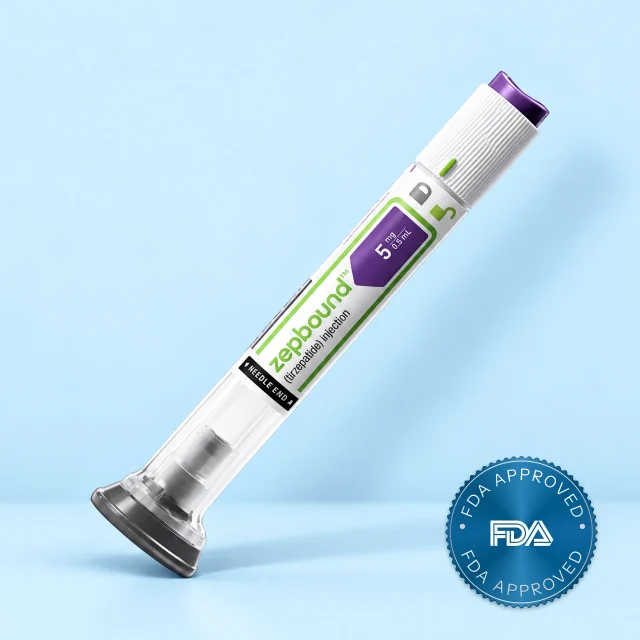
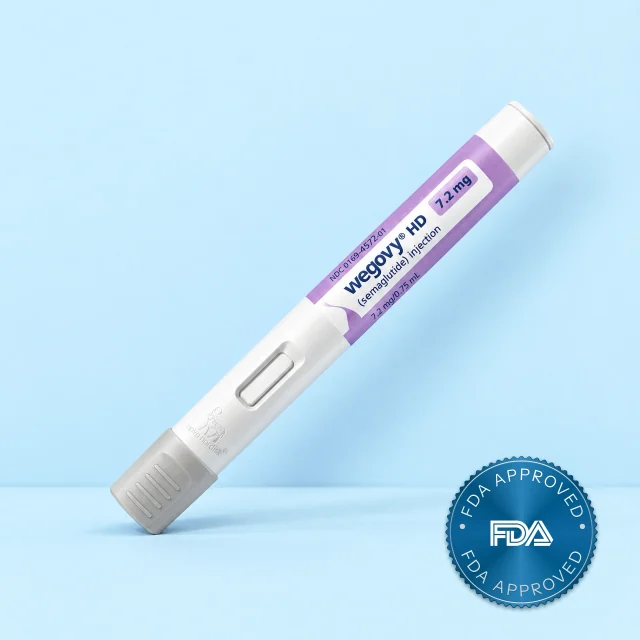
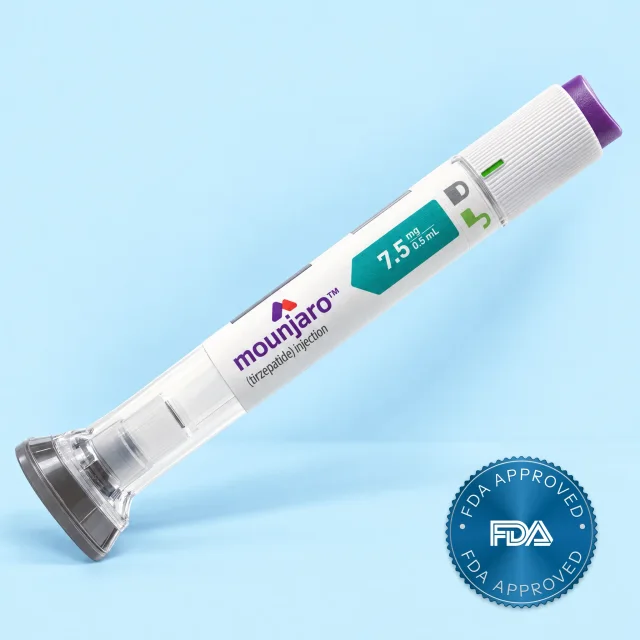
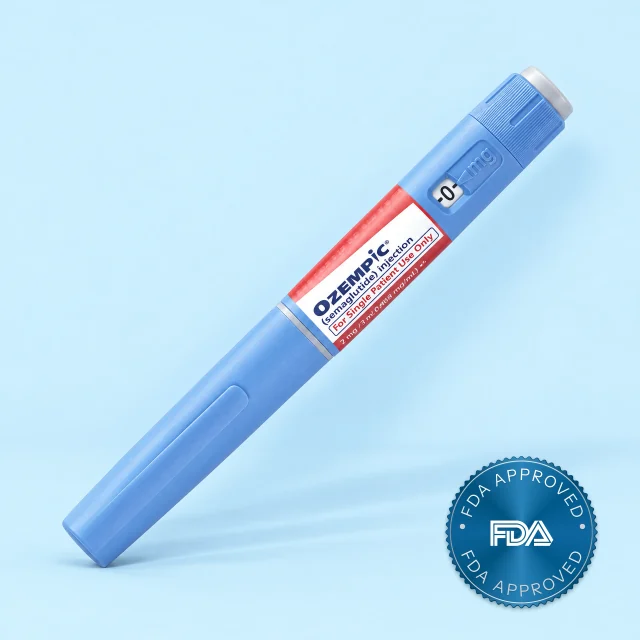
- No medication is FDA-approved to treat food noise. Zepbound and Wegovy are approved, alongside a reduced-calorie diet and increased physical activity, for weight management in adults with obesity, or with overweight and at least one weight-related condition.5,6 Mounjaro and Ozempic are approved for type 2 diabetes and are not approved for weight loss.7,8 Food noise does not appear among the approved uses on any of the four labels.
- The reference group was measured before treatment. The comparison in this quiz says nothing about what scores look like on medication.
- These are prescription drugs with real side effects. Stomach side effects such as nausea, diarrhea, vomiting and constipation are the most common, and all four labels carry a boxed warning about the risk of thyroid C-cell tumors.5,6,7,8 Our GLP-1 side effects guide covers what is common and what is serious.
Zepbound and Mounjaro contain tirzepatide. Wegovy and Ozempic contain semaglutide. Whether any of them is appropriate is a decision for a licensed provider who has reviewed your health history. The label standard for Wegovy and Zepbound is a BMI of 30 or higher, or 27 or higher with a weight-related condition, in adults 18 and older, and the provider makes the final call. A food noise score is not part of that standard. You can check your number with the BMI calculator.
Two sibling tools cover the practical side of eating. The calorie deficit calculator works out a daily calorie target, and the protein calculator gives you a daily protein range.
Frequently asked questions
What is a normal food noise score?
There is no official normal. The quiz does not use a cutoff, and it only shows where you sit in one published reference group. In that group the average score was 2.83, and the middle half of people scored between 2.00 and 3.57. The group was made up of another telehealth company's patients with a BMI of 25 or higher, before GLP-1 treatment, so it is not a picture of adults in general.
Does a high food noise score mean I have an eating disorder?
No. This quiz is a self-reflection tool. It is not a diagnosis and it does not screen for an eating disorder or any other condition. A high score does not mean you have one, and a low score does not rule one out. If you are worried about your eating or your thoughts about food, talk with a clinician, such as your primary care provider or a mental health professional.
Who is in the reference group?
They are not FitRx members. The figures were published by Ro, another telehealth company, for its own patients with a BMI of 25 or higher who filled out the same questionnaire before GLP-1 treatment. The published points are an average of 2.83, a 10th percentile of 1.43, a 25th of 2.00, a 75th of 3.57 and a 90th of 4.43. Your result is an estimate based on those five points.
Where do the seven questions come from?
They are the short form of the RAID-FN (Ro Allison Indiana Dhurandhar Food Noise) Inventory, a questionnaire developed by Dhurandhar and colleagues and published in the journal Appetite in 2026. It measures food noise across three factors: preoccupation, persistence and dysphoria. The statements are used here with attribution.
Can GLP-1 medication quiet food noise?
Many people who take a GLP-1 medication say thoughts about food get quieter, and these medications are known to reduce appetite. Those are personal reports, though, and this page does not quote a figure for how much any medication changes a food noise score. No medication is FDA-approved to treat food noise. Zepbound and Wegovy are approved for weight management. Mounjaro and Ozempic are approved for type 2 diabetes and are not approved for weight loss.
What do the three area scores mean?
Preoccupation is how much mental space food takes up (three statements). Persistence is how hard the thoughts are to shake (two statements). Dysphoria is how distressing the thoughts feel (two statements). Each area score is the average of your answers in that area, from 1 to 5. Only your overall score is compared with the reference group. The area scores are not.
Are my answers saved?
No. Your answers stay in your browser tab, and nothing is saved or sent. The score is worked out on the page. If you want to compare today's result with a later one, write the number down, because pressing Start over or closing the tab clears it.
References (8)
- Hayashi D, Edwards C, Emond JA, et al. What is food noise? A conceptual model of food cue reactivity. Nutrients. 2023;15(22):4809. https://pubmed.ncbi.nlm.nih.gov/38004203/
- Dhurandhar EJ, Maki KC, Dhurandhar NV, et al. Development and rigorous multistep validation of a psychometric tool to measure food noise. Appetite. 2026;217:108339. https://pubmed.ncbi.nlm.nih.gov/41101555/
- Ro. Food noise score calculator: reference distribution for Ro patients with a BMI of 25 or higher before GLP-1 treatment. https://ro.co/research-lab/tools/food-noise-score-calculator/
- Drucker DJ. Mechanisms of action and therapeutic application of glucagon-like peptide-1. Cell Metab. 2018;27(4):740-756. https://pubmed.ncbi.nlm.nih.gov/29617641/
- Zepbound (tirzepatide) injection. Prescribing information. Eli Lilly and Company; revised August 2026. https://pi.lilly.com/us/zepbound-uspi.pdf
- Wegovy (semaglutide) injection and tablets. Prescribing information. Novo Nordisk; revised June 2026. https://www.novo-pi.com/wegovy.pdf
- Mounjaro (tirzepatide) injection. Prescribing information. Eli Lilly and Company; revised August 2026. https://pi.lilly.com/us/mounjaro-uspi.pdf
- Ozempic (semaglutide) injection. Prescribing information. Novo Nordisk; revised May 2026. https://www.novo-pi.com/ozempic.pdf
Sources were opened and checked on November 18, 2026. Prices, savings programs and labels change; confirm current terms with the manufacturer, your pharmacy or your provider.
A score is a starting point. A provider can take it from there.
FitRx connects you with a licensed provider who reviews your health history, listens to what eating and appetite are like for you, and decides whether GLP-1 medication is appropriate.
Get startedFitRx membership costs $39 in month one and $135 a month from then on. Medication is a separate charge. Not everyone qualifies.

The FitRx care team
A quiz gives you a number. A care team gives you someone to talk to.
Seven statements can tell you how loud food feels today. They cannot ask a follow-up question. FitRx members work with a licensed provider, a care coordinator and a coach, all online, so questions about appetite, eating patterns, side effects and what to try next go to people who know your history.
- U.S.-licensed providers review every intake and make every prescribing decision
- Unlimited secure messaging, plus monthly video or phone visits
- A care coordinator and a coach alongside your provider
- An insurance coordination team for brand-name GLP-1 prior authorizations
This page was written and reviewed by the FitRx care team and last updated November 18, 2026. It is general information, not personal medical advice.
GLP-1 medications our providers can prescribe
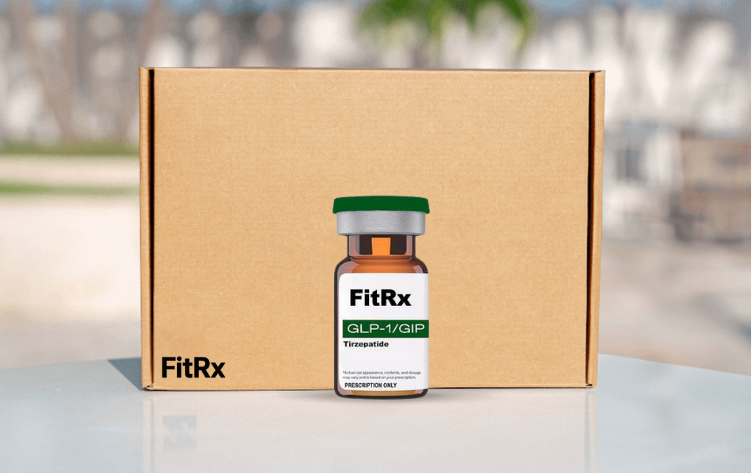
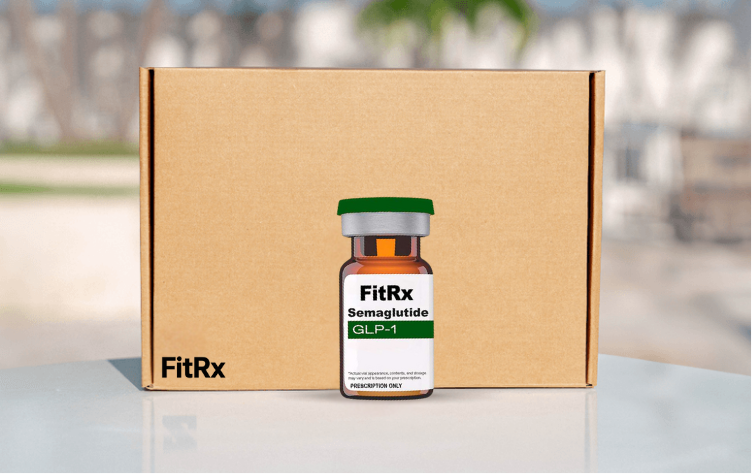
A provider decides which medication, if any, fits your health history. Compounded semaglutide and compounded tirzepatide are not FDA-approved and are not the same as the brand-name products.
More free weight loss tools
- Calorie Deficit CalculatorDaily calories to lose 1 or 2 pounds a week, and how long your goal may take.
- TDEE CalculatorHow many calories you burn in a day, activity included.
- BMR CalculatorThe calories your body uses at complete rest.
- BMI CalculatorYour body mass index and the CDC category it falls in.
- Protein CalculatorA daily protein range for losing fat, maintaining or building muscle.
- Knee Relief CalculatorHow much load comes off your knees for every pound you lose.
- GLP-1 Supply TrackerFDA shortage status for GLP-1 medications, by brand and dose.
- GLP-1 Pipeline TrackerWeight loss drugs in development, by class, developer and trial phase.
- GLP-1 Insurance CheckerHow a GLP-1 coverage check works and what happens after it.