
Calorie Deficit Calculator
A calorie deficit is the gap between what you eat and what your body uses. Give this calorie deficit calculator your size, your activity level and the weight you are aiming for. It returns a daily calorie target for losing 1 or 2 pounds a week, and an estimate of how many weeks the goal could take.
Daily calories to reach your goal
1,670 calories a day
Sample numbers. Enter your details to see yours.
- Maintenance calories (TDEE)2,170
- Calories at rest (BMR)1,578
- Daily deficit500
- Estimated time to goal30 weeks
A calorie target is a starting point. A licensed provider can look at your history, your appetite and whether a GLP-1 medication belongs in the plan.
See if you qualifyThis calculator gives estimates for adults 18 and older, based on published equations and a simple rule of thumb. It is not a measurement, a diagnosis or medical advice. It flags any target under 1,200 calories a day for women or 1,500 for men; eating below those levels should happen only with medical supervision. Talk with a licensed clinician before cutting calories if you are pregnant, breastfeeding, managing a medical condition or have a history of disordered eating.
What does it mean to be in a calorie deficit?
You are in a calorie deficit on any day you eat fewer calories than your body uses. A calorie is a unit of energy. Food supplies it, and your body spends it around the clock. When less comes in than goes out, your body covers the shortfall from its own stores, which are mostly body fat. Keep that going for weeks and your weight comes down.
The spending side has a name: total daily energy expenditure, or TDEE. It adds up the energy your body uses at rest, the energy it takes to digest food, and the energy you spend moving, from a workout to a walk across a parking lot. TDEE is also called maintenance calories, because eating that amount keeps your weight about where it is. The TDEE calculator takes that number apart piece by piece.
Over any stretch of time you are in one of three states:
| State | What is happening | What your weight tends to do |
|---|---|---|
| Calorie balance | You eat about what you use | Holds steady |
| Calorie surplus | You eat more than you use | Rises, as the extra is stored |
| Calorie deficit | You eat less than you use | Falls, as stored energy fills the gap |
A deficit can come from eating less, from moving more, or from both. This calculator works on the eating side. It holds your activity at the level you choose and takes the whole deficit out of food, which is why its answer is a number of calories to eat. That leaves two decisions: how large the gap should be, and how long you will need to hold it.
How does the calorie deficit calculator work out your number?
The calorie deficit calculator runs four steps in a row. Each one builds on the result before it.
Step 1: calories at rest (BMR)
Basal metabolic rate is what your body would use in a day of complete rest. The calculator converts your entries to metric first (1 lb = 0.45359237 kg, 1 in = 2.54 cm), then estimates BMR with the Mifflin-St Jeor equation, published in 1990.1 If you fill in the optional body fat field, it uses the Katch-McArdle formula instead.2
| Formula | Used when | Calories per day |
|---|---|---|
| Mifflin-St Jeor, men | Body fat is left blank | (10 × weight in kg) + (6.25 × height in cm) − (5 × age) + 5 |
| Mifflin-St Jeor, women | Body fat is left blank | (10 × weight in kg) + (6.25 × height in cm) − (5 × age) − 161 |
| Katch-McArdle | Body fat is entered | 370 + (21.6 × lean body mass in kg) |
Why Mifflin-St Jeor by default? A systematic review compared four widely used equations with measured values and found it the most reliable: it came within 10% of the measured resting rate in more people, with and without obesity, than the others did.3 The review also found that errors remain for individuals, so every figure downstream is an estimate.
Lean body mass is your weight minus your fat: weight in kg × (1 − body fat percentage ÷ 100). Katch-McArdle uses nothing else, so once you enter body fat, your age and height stop affecting the resting estimate. A rough guess produces a rough answer, so leave the field blank unless you have a measured figure. The BMR calculator shows this first step by itself.
Step 2: maintenance calories (TDEE)
BMR is multiplied by a factor for the activity level you select:
| Activity level | What it describes | Multiplier |
|---|---|---|
| Sedentary | Desk job, little exercise | 1.2 |
| Light | Exercise 1 to 3 days a week | 1.375 |
| Moderate | Exercise 3 to 5 days a week | 1.55 |
| Very active | Hard exercise 6 to 7 days a week | 1.725 |
| Extra active | Physical job plus training | 1.9 |
Step 3: the deficit
The toggle in the results panel sets the pace. At 1 lb a week the calculator subtracts 500 calories a day from your maintenance number. At 2 lb a week it subtracts 1,000. Both come from an old rule of thumb that treats a pound of body weight as 3,500 calories: 500 calories a day for 7 days adds up to 3,500. The rule is a simplification, and the timeline section below explains where it falls short.
Step 4: the timeline
The calculator subtracts your goal weight from your current weight, divides by the pace, and rounds up to a whole week.
A worked example
A 40-year-old woman is 5 feet 5 inches tall and weighs 200 pounds. She exercises a couple of days a week, so she picks the light activity level. Her goal is 170 pounds.
- Convert: 200 lb × 0.45359237 = 90.72 kg, and 65 in × 2.54 = 165.1 cm.
- BMR: (10 × 90.72) + (6.25 × 165.1) − (5 × 40) − 161 = 907.2 + 1,031.9 − 200 − 161 = 1,578 calories.
- TDEE: 1,578 × 1.375 = 2,170 calories to maintain her weight.
- Target at 1 lb a week: 2,170 − 500 = 1,670 calories a day.
- Timeline: 200 − 170 = 30 lb to lose, so 30 weeks.
Move the toggle to 2 lb a week and her target becomes 1,170 calories with a 15-week timeline. Because 1,170 is under 1,200, the calculator adds a warning. These are the sample numbers the results panel shows before you enter your own.
What the calculator accepts
- Age: a whole number from 18 to 100. The formulas are for adults.
- Height: 3 to 8 feet, plus 0 to 11 inches. Half inches are fine.
- Current weight: 70 to 700 lb.
- Goal weight: at least 50 lb and lower than your current weight. This tool plans weight loss only.
- Body fat: optional. If entered, 3% to 70%.
The calculator keeps the decimals through every step and rounds each figure to the nearest calorie only when it displays it. The line under your results names the formula that was used.
How big should your calorie deficit be?
The calculator offers two sizes: 500 or 1,000 calories a day. Which one suits you depends mostly on how high your maintenance number is.
Clinical guidelines for managing overweight and obesity in adults describe the eating side in two ways: a deficit of 500 to 750 calories a day, or a set intake of 1,200 to 1,500 calories a day for women and 1,500 to 1,800 for men.4 Hold the calculator's two settings up against that:
- 1 lb a week (500 a day) sits at the low end of the guideline deficit range.
- 2 lb a week (1,000 a day) is larger than the guideline range. It leaves a workable amount of food only when maintenance calories are high.
The calculator treats the bottom of each intake range as a warning line: 1,200 calories for women, 1,500 for men. If your target, rounded to the nearest calorie, falls below the line for the sex you selected, a warning appears under the result. Working backwards shows how much maintenance each pace needs:
| Warning line | 1 lb a week stays clear when maintenance is | 2 lb a week stays clear when maintenance is | |
|---|---|---|---|
| Women | 1,200 calories | About 1,700 or more | About 2,200 or more |
| Men | 1,500 calories | About 2,000 or more | About 2,500 or more |
Here is how that plays out for the woman in the worked example, whose maintenance is 2,170 calories:
| Pace | Daily deficit | Daily target | Time to lose 30 lb | Warning? |
|---|---|---|---|---|
| 1 lb a week | 500 | 1,670 calories | 30 weeks | No |
| 2 lb a week | 1,000 | 1,170 calories | 15 weeks | Yes, below 1,200 |
The faster pace halves her timeline on paper, but it puts her under the low end of the guideline intake range. A man of the same age, height, weight and activity level maintains at 2,398 calories. His 1 lb target is 1,898. His 2 lb target is 1,398, which is under his 1,500 line, so he gets the warning too.
Choosing a goal weight
The goal weight field drives the timeline, so enter one you would stand behind. It does not have to be the last stop. The same guidelines note that losing 5% to 10% of body weight brings health benefits.4 For someone who weighs 200 pounds, that is 10 to 20 pounds. A first goal in that range is a reasonable place to begin, and you can set the next one when you get there. To see where a goal weight falls among the CDC weight categories, try the BMI calculator.
How long will it take to reach your goal weight?
The estimated time to goal is plain division, rounded up to the next whole week:
| Pounds to lose | At 1 lb a week | At 2 lb a week |
|---|---|---|
| 10 | 10 weeks | 5 weeks |
| 15 | 15 weeks | 8 weeks |
| 30 | 30 weeks | 15 weeks |
| 45 | 45 weeks | 23 weeks |
| 60 | 60 weeks | 30 weeks |
This is the calculator’s arithmetic, not a prediction.
That arithmetic assumes each 500-calorie day takes off the same amount of weight in week 30 as in week 1. Bodies do not work that way. Research that models long-term weight change shows that loss slows over time, and that the 3,500-calories-per-pound rule overstates how much weight a fixed deficit removes in the long run.5,6
One reason shows up in the calculator’s own equation. A lighter body uses less energy, so the same meals produce a smaller gap. Here is the woman from the worked example, recalculated as her weight drops and nothing else changes:
| Her weight | Maintenance (TDEE) | Target at 1 lb a week | Gap if she still eats 1,670 |
|---|---|---|---|
| 200 lb | 2,170 | 1,670 | 500 |
| 190 lb | 2,107 | 1,607 | 437 |
| 180 lb | 2,045 | 1,545 | 375 |
| 170 lb | 1,983 | 1,483 | 313 |
Calories a day from the Mifflin-St Jeor equation at the light activity level (1.375), with age held at 40. Estimates, rounded to the nearest calorie.
By the time she nears her goal, the plan that began as a 500-calorie deficit is closer to 300, by the equation’s own estimate. So read the weeks figure as the short end of the range, not a fixed date. Two habits keep the plan honest:
- Recalculate every 10 to 15 pounds. Enter your new weight and use the updated target.
- Judge the trend, not the day. Scale weight moves from one morning to the next with water, salt and digestion. Look at two or three weeks together before deciding that progress has stalled.
When is a calorie deficit too large?
A deficit has gone too far when the food that is left cannot cover what your body needs, or when you cannot function on it. Four signs to watch for:
- The target is under the warning line. Below 1,200 calories a day for women or 1,500 for men, the calculator still shows the number, but it adds a note suggesting the slower pace or a conversation with a clinician first. Those lines are the low ends of the intake ranges in clinical guidelines,4 and eating less than that should happen only under medical supervision.
- Protein gets squeezed out. Weight lost on any plan includes some lean mass along with the fat.7 Research on weight loss diets supports 1.2 to 1.6 grams of protein per kilogram of body weight a day,8 and that is harder to fit into a very small calorie budget.
- The rest of your diet thins out. The less you eat, the less room there is for the vitamins, minerals and fiber that come with food.
- Your body is telling you. Feeling weak, dizzy or worn out most days is a signal. So is finding that thoughts of food crowd out everything else. Move your intake back toward maintenance and talk with a clinician.
Talk to a clinician before using any calorie target if you are pregnant or breastfeeding, under 18, managing a medical condition, or have a history of disordered eating. The calculator’s default equation was developed in healthy adults, and nothing in the math adjusts for any of these.
How do you keep a calorie deficit going? 6 practical steps
Start with the pace your maintenance can support
If the 2 lb a week setting triggers the warning, the choice is made: use 1 lb a week. If both settings stay above your line, the slower one still leaves you more food to work with.
Give protein first claim on your calories
Studies of weight loss diets point to a daily 1.2 to 1.6 grams of protein for each kilogram you weigh, split so that a meal carries roughly 25 to 30 grams.8 Some foods carry a lot of protein for few calories: 3 ounces of roasted chicken breast has about 26 grams of protein and 140 calories.9 The protein calculator turns the range into grams for your weight and goal.
Track honestly for a couple of weeks
A calorie target helps only if you know roughly what you eat now. Log everything for two weeks, drinks and cooking oil included, and compare your usual days with the number. The point is to train your eye, not to count forever.
Move more, and keep your strength work
Everyday movement such as walking, stairs and chores counts, and the amount people do varies a great deal.10 Resistance training gives your body a reason to hold on to muscle while the scale drops. Do not add workout calories on top of your target, because your activity level already includes them.
Recalculate as you lose
Every 10 to 15 pounds, enter your new weight. If the new target would dip under your warning line, keep eating at the line and let the pace slow.
If hunger keeps winning, ask about medication
Sometimes the arithmetic is fine and appetite is the obstacle. That says nothing about your willpower, and it is worth raising with a provider.
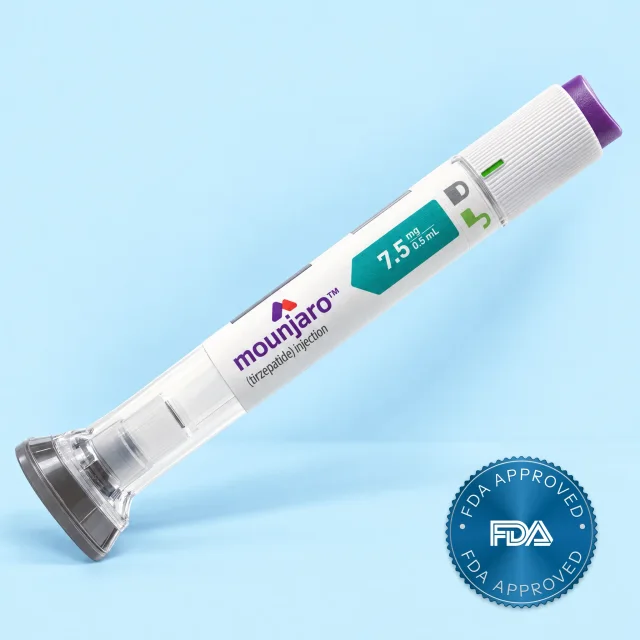
Hunger is driven by hormones, and prescription GLP-1 medications act on that system: they slow stomach emptying and reduce appetite.11 Zepbound (tirzepatide) and Wegovy (semaglutide) are FDA-approved for weight management in adults with obesity, or with overweight and at least one weight-related condition. Both labels say the medication is to be used with a reduced-calorie diet and increased physical activity.12,13 The medication is meant to work alongside a calorie deficit, not to replace one.
These are prescription drugs with real side effects, described in our guide to GLP-1 side effects, and they are not right for everyone. A licensed provider can review your health history and tell you whether one is appropriate for you.
Frequently asked questions
How many calories should I eat to lose 1 pound a week?
The calculator's answer is your maintenance calories minus 500. For example, a 40-year-old woman who is 5 feet 5 inches tall, weighs 200 pounds and is lightly active maintains her weight at about 2,170 calories a day, so her target is about 1,670. Your own number depends on your size and activity. It should stay at or above 1,200 calories a day for women or 1,500 for men unless a clinician is supervising.
Is a 1,000-calorie deficit too much?
It depends on your maintenance calories. Clinical guidelines describe a deficit of 500 to 750 calories a day, so 1,000 is beyond that range. It also takes a high maintenance number to leave enough food: about 2,200 calories or more for women, and about 2,500 or more for men, before the target clears the calculator's warning line. If your result shows the warning, use the 1 pound a week pace or talk with a clinician.
How accurate is the estimated time to goal?
It is simple division: pounds to lose divided by 1 or 2 pounds a week, rounded up to a whole week. Real weight loss is less even than that. Research that models long-term weight change shows that loss slows over time and that the 3,500-calories-per-pound rule overstates long-run results. Treat the weeks figure as the short end of the range, and recalculate every 10 to 15 pounds.
Why has my weight loss slowed when I am eating the same calories?
A lighter body uses less energy, so the same intake creates a smaller deficit. In the example on this page, estimated maintenance falls from about 2,170 calories a day at 200 pounds to about 1,983 at 170 pounds. If intake stays at 1,670, the gap shrinks from 500 calories to about 313. Enter your current weight to get an updated target.
Do I need to enter my body fat percentage?
No. The field is optional. Without it, the calculator uses the Mifflin-St Jeor equation, which a systematic review found to be the most reliable of four common equations. With it, the calculator switches to the Katch-McArdle formula, which works from lean body mass. Fill it in only if you have a measured figure, because a rough guess gives a rough answer.
References (13)
- Mifflin MD, St Jeor ST, Hill LA, et al. A new predictive equation for resting energy expenditure in healthy individuals. Am J Clin Nutr. 1990;51(2):241-247. https://pubmed.ncbi.nlm.nih.gov/2305711/
- McArdle WD, Katch FI, Katch VL. Exercise Physiology: Nutrition, Energy, and Human Performance. Wolters Kluwer. (Source of the Katch-McArdle lean-mass equation.)
- Frankenfield D, Roth-Yousey L, Compher C. Comparison of predictive equations for resting metabolic rate in healthy nonobese and obese adults: a systematic review. J Am Diet Assoc. 2005;105(5):775-789. https://pubmed.ncbi.nlm.nih.gov/15883556/
- Jensen MD, Ryan DH, Apovian CM, et al. 2013 AHA/ACC/TOS guideline for the management of overweight and obesity in adults. Circulation. 2014;129(25 Suppl 2):S102-S138. https://pubmed.ncbi.nlm.nih.gov/24222017/
- Hall KD, Sacks G, Chandramohan D, et al. Quantification of the effect of energy imbalance on bodyweight. Lancet. 2011;378(9793):826-837. https://pubmed.ncbi.nlm.nih.gov/21872751/
- Thomas DM, Martin CK, Lettieri S, et al. Can a weight loss of one pound a week be achieved with a 3500-kcal deficit? Commentary on a commonly accepted rule. Int J Obes (Lond). 2013;37(12):1611-1613. https://pubmed.ncbi.nlm.nih.gov/23628852/
- Neeland IJ, Linge J, Birkenfeld AL. Changes in lean body mass with glucagon-like peptide-1-based therapies and mitigation strategies. Diabetes Obes Metab. 2024;26(Suppl 4):16-27. https://pubmed.ncbi.nlm.nih.gov/38937282/
- Leidy HJ, Clifton PM, Astrup A, et al. The role of protein in weight loss and maintenance. Am J Clin Nutr. 2015;101(6):1320S-1329S. https://pubmed.ncbi.nlm.nih.gov/25926512/
- U.S. Department of Agriculture, Agricultural Research Service. FoodData Central (SR Legacy food composition data). https://fdc.nal.usda.gov/
- Levine JA. Non-exercise activity thermogenesis (NEAT). Best Pract Res Clin Endocrinol Metab. 2002;16(4):679-702. https://pubmed.ncbi.nlm.nih.gov/12468415/
- Drucker DJ. Mechanisms of action and therapeutic application of glucagon-like peptide-1. Cell Metab. 2018;27(4):740-756. https://pubmed.ncbi.nlm.nih.gov/29617641/
- Zepbound (tirzepatide) injection. Prescribing information. Eli Lilly and Company; revised August 2026. https://pi.lilly.com/us/zepbound-uspi.pdf
- Wegovy (semaglutide) injection and tablets. Prescribing information. Novo Nordisk; revised June 2026. https://www.novo-pi.com/wegovy.pdf
Sources were opened and checked on November 18, 2026. Prices, savings programs and labels change; confirm current terms with the manufacturer, your pharmacy or your provider.
Holding a deficit is easier with support.
A FitRx provider reviews your health history, talks through your goals and decides whether GLP-1 medication is appropriate for you. Care is fully online.
Get startedFitRx membership costs $39 in month one and $135 a month from then on. Medication is a separate charge. Not everyone qualifies.

The FitRx care team
The math takes a minute. Sticking with it takes a team.
A daily calorie target is quick to calculate and hard to live by for 30 weeks. FitRx members work with a licensed provider, a care coordinator and a coach, all online. When hunger, a stalled scale or side effects get in the way, you can message people who know your history.
- U.S.-licensed providers review every intake and make every prescribing decision
- Unlimited secure messaging, plus monthly video or phone visits
- A care coordinator and a coach alongside your provider
- An insurance coordination team for brand-name GLP-1 prior authorizations
This page was written and reviewed by the FitRx care team and last updated November 18, 2026. It is general information, not personal medical advice.
GLP-1 medications our providers can prescribe
A provider decides which medication, if any, fits your health history. Compounded semaglutide and compounded tirzepatide are not FDA-approved and are not the same as the brand-name products.





More free weight loss tools
- TDEE CalculatorHow many calories you burn in a day, activity included.
- BMR CalculatorThe calories your body uses at complete rest.
- BMI CalculatorYour body mass index and the CDC category it falls in.
- Protein CalculatorA daily protein range for losing fat, maintaining or building muscle.
- Food Noise ScoreA seven-question score for how loud thoughts about food are right now.
- Knee Relief CalculatorHow much load comes off your knees for every pound you lose.
- GLP-1 Supply TrackerFDA shortage status for GLP-1 medications, by brand and dose.
- GLP-1 Pipeline TrackerWeight loss drugs in development, by class, developer and trial phase.
- GLP-1 Insurance CheckerHow a GLP-1 coverage check works and what happens after it.