Tirzepatide dosing for weight loss in units: the chart
Each cell below is one sum: the dose, divided by the vial’s concentration, times 100. The rows are the six dose strengths on the Zepbound label.2 The columns are four example concentrations.
They are examples of what a compounding pharmacy might print on a vial, not any particular pharmacy’s product, and yours may not be among them. Find your own concentration before you read across a row.
| Prescribed dose | 5 mg/mL vial | 10 mg/mL vial | 20 mg/mL vial | 40 mg/mL vial |
|---|---|---|---|---|
| 2.5 mg | 50 units (0.5 mL) | 25 units (0.25 mL) | 12.5 units† (0.125 mL) | 6.25 units† (0.0625 mL) |
| 5 mg | 100 units (1 mL) | 50 units (0.5 mL) | 25 units (0.25 mL) | 12.5 units† (0.125 mL) |
| 7.5 mg | 150 units* (1.5 mL) | 75 units (0.75 mL) | 37.5 units† (0.375 mL) | 18.75 units† (0.1875 mL) |
| 10 mg | 200 units* (2 mL) | 100 units (1 mL) | 50 units (0.5 mL) | 25 units (0.25 mL) |
| 12.5 mg | 250 units* (2.5 mL) | 125 units* (1.25 mL) | 62.5 units† (0.625 mL) | 31.25 units† (0.3125 mL) |
| 15 mg | 300 units* (3 mL) | 150 units* (1.5 mL) | 75 units (0.75 mL) | 37.5 units† (0.375 mL) |
Units on a U-100 insulin syringe, with the volume in mL in parentheses. *Over the 100-unit capacity of a 1 mL syringe. †Not a whole number of units.
How to read the chart
- Pick the column first. A 5 mg dose is 100 units in the first column and 12.5 units in the last. The wrong column means the wrong dose.
- An asterisk means the amount will not fit. A 1 mL U-100 syringe holds 100 units. If your dose and vial land in one of those cells, call your pharmacy or provider. Do not split the dose yourself.
- A dagger means the answer falls between whole units. Do not round on your own. Use the unit amount printed on your prescription label.
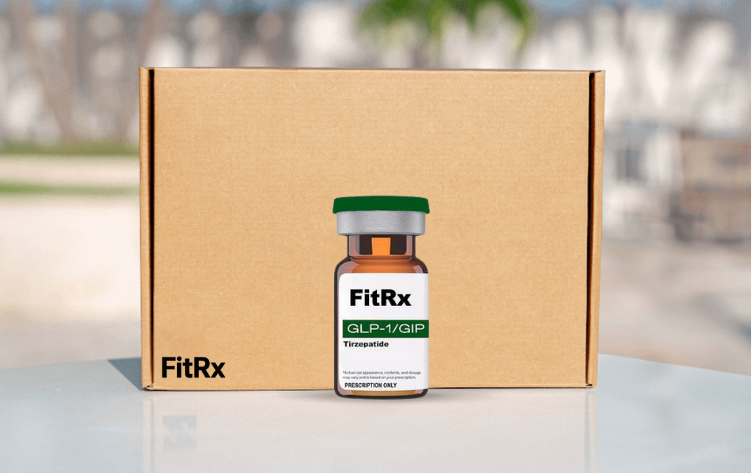
Your label comes first. The concentration is printed on your vial, and the unit amount for your dose is on your prescription label. Those override this chart. FitRx does not publish a vial concentration for compounded tirzepatide, so there is no FitRx chart here: if your prescription comes through FitRx, use the numbers on your own vial and label.
Why a compounded vial needs this math
Zepbound’s strengths and volumes are fixed by a label the FDA has reviewed.2 Compounded tirzepatide is not FDA-approved and has no approved label behind it, so the vial in your hand is the only reliable source for its concentration. The FDA says compounded drugs should only be used by patients whose medical needs cannot be met by an FDA-approved drug.1 A licensed provider decides whether that applies to you. Our tirzepatide page compares the two routes.
How do you convert tirzepatide mg to units?
The converter has two inputs. Select the dose on your prescription, from 2.5 mg to 15 mg, and enter your vial’s concentration in mg/mL. It returns the number of units on a U-100 insulin syringe, plus the volume in mL.
On a U-100 insulin syringe
– units
- Volume–
Enter a concentration. You will find it on your vial label, in mg per mL.
This converts numbers. It does not tell you what dose to take. Use the dose and the unit amount printed on your own prescription label, and ask your pharmacy or provider if the two do not match.
The concentration box starts empty on purpose: there is no safe number to assume. You will see a warning in three situations:
- More than 100 units. That does not fit in a 1 mL insulin syringe. Check the concentration you typed, then call your pharmacy or provider.
- Fewer than 5 units. Amounts that small are hard to measure accurately.
- Not a whole number of units. Do not round on your own.
Units are displayed to two decimal places, so 6.25 units appears as 6.25.
The formula
Units on a U-100 syringe = dose (mg) ÷ concentration (mg/mL) × 100
The division gives you a volume in mL. The 100 is there because a U-100 syringe packs 100 units into every mL.
Worked example 1: a whole number
The prescribed dose is 5 mg and the vial says 10 mg/mL.
- 5 ÷ 10 = 0.5 mL
- 0.5 × 100 = 50 units
Worked example 2: an in-between number
The prescribed dose is 7.5 mg and the vial says 20 mg/mL.
- 7.5 ÷ 20 = 0.375 mL
- 0.375 × 100 = 37.5 units
That lands between 37 and 38. Here you stop doing math and read the amount on your prescription label.
Reverse the sum to check it
Dose in mg = units ÷ 100 × concentration. For the second example: 37.5 ÷ 100 = 0.375, and 0.375 × 20 = 7.5 mg. If the reverse sum does not return the dose on your prescription, stop and call your pharmacy.
Milligrams, milliliters and units: what does each one measure?
Three measurements sit between your prescription and your syringe, and each answers a different question.
| Measurement | What it tells you | Where you see it |
|---|---|---|
| Milligrams (mg) | The medicine itself. Doses are written in mg. | Your prescription |
| Milliliters (mL) | Liquid volume | The vial |
| mg/mL | Strength of the liquid: mg of tirzepatide in every mL | The vial label |
| Units | Lines on an insulin syringe. They measure volume too: 100 units fill 1 mL on a U-100 syringe. | The syringe barrel |
A unit measures liquid, not medicine
Insulin syringes borrow their scale from insulin dosing. Filled with tirzepatide, each line on a U-100 syringe marks off 0.01 mL of liquid and says nothing about how many milligrams are inside. The vial decides that.
| Vial concentration | Units that hold 1 mg | Tirzepatide in 10 units | Tirzepatide in 50 units |
|---|---|---|---|
| 5 mg/mL | 20 units | 0.5 mg | 2.5 mg |
| 10 mg/mL | 10 units | 1 mg | 5 mg |
| 20 mg/mL | 5 units | 2 mg | 10 mg |
| 40 mg/mL | 2.5 units | 4 mg | 20 mg |
The same 50-unit line holds eight times as much tirzepatide in the bottom row as in the top row: 20 mg, which is more than the 15 mg weekly maximum on the Zepbound label.2 “How many units?” has no answer until you know the concentration.
Where is the concentration on your vial?
Look for a figure ending in mg/mL. If the label instead pairs a total amount with a total volume, the concentration is the amount divided by the volume: a made-up label reading 30 mg in 3 mL works out to 30 ÷ 3 = 10 mg/mL. Not sure which number is which? Do not guess. Ask the pharmacy that filled the prescription.
What is the tirzepatide dosing schedule for weight loss?
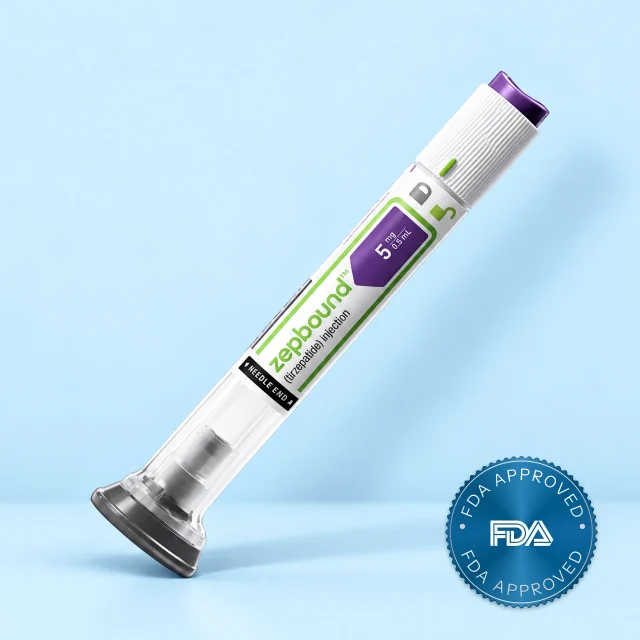
The approved reference point is the label for Zepbound, the tirzepatide product the FDA has approved for weight management. (Mounjaro is the same molecule, approved for type 2 diabetes and not for weight loss.)2,3 The label starts at 2.5 mg once a week for 4 weeks, then moves to 5 mg. After that the dose may go up in 2.5 mg steps, each after at least 4 weeks on the current dose.2
| Weekly dose | Earliest point under the label | Role on the label |
|---|---|---|
| 2.5 mg | Weeks 1 to 4 | Starting dose, not a maintenance dose |
| 5 mg | Week 5 | Maintenance option |
| 7.5 mg | Week 9 | Step |
| 10 mg | Week 13 | Maintenance option |
| 12.5 mg | Week 17 | Step |
| 15 mg | Week 21 | Maintenance option and maximum |
Zepbound prescribing information.2 Week numbers are arithmetic from the rule of at least 4 weeks per dose. They show the earliest a step could happen, not when it should.
Your prescriber sets your schedule. The label says the dose may be raised after 5 mg, not that it must be. Whether you move up, when, and where you settle are decisions for the provider who knows your history. With compounded tirzepatide, the dose and timing on your prescription are the ones to follow.
Missed doses and side effects
The Zepbound label says to take a missed dose as soon as possible within 4 days (96 hours), and to skip it if more than 4 days have passed. You can change your injection day if the two doses are at least 3 days (72 hours) apart.2 If you take compounded tirzepatide, ask your prescriber how to handle a missed dose before it happens.
Stomach side effects such as nausea are the most common ones on the Zepbound label.2 Our guide to GLP-1 side effects covers what is common and what is serious.
A new vial can mean a new number
Refills are not guaranteed to match. Say one vial is 10 mg/mL and the next is 20 mg/mL: 5 mg from the first is 50 units, while 7.5 mg from the second is 37.5 units. A bigger dose, a smaller number on the syringe. Treat every new vial as a new calculation and start from its label.
How do you measure tirzepatide units in a syringe?
This section is about reading the syringe, nothing more. For how to prepare and give the injection, follow the instructions from your pharmacy and prescriber.
Confirm it is a U-100 insulin syringe
The chart and the converter only hold true on a U-100 syringe, the kind with 100 units to the mL. Other scales exist, and some syringes are marked only in mL. If yours did not come from your pharmacy, ask before using it.
Check that your dose fits
A 1 mL U-100 syringe tops out at 100 units, and smaller ones hold less. Your whole dose has to fit in a single draw.
Count what one line stands for
Line spacing differs from one syringe to the next. Count the gaps between two printed numbers before you draw.
Check the label before the barrel
Each time, read the drug name, the mg/mL figure and your unit amount off the label first. Only then look for that number on the syringe.
Read from the correct plunger edge
The plunger tip has two edges. The one that counts is the edge closer to the needle.
If anything does not match, call the pharmacy before you inject, not after.
What the FDA says about multi-dose vials
The FDA’s advice on injectable GLP-1 products that are not FDA-approved includes three handling points:1
- Use a new sterile needle and syringe for each dose.
- Discard a multi-dose vial 28 days after first use, even if medicine remains.
- Do not use an injectable GLP-1 that arrives warm or without enough refrigeration.
What are the most common tirzepatide dosing mistakes?
The FDA has issued an alert about dosing errors with compounded injectable semaglutide. It describes reports of adverse events, some of which put people in the hospital, that may be related to those errors: patients who measured the wrong dose and clinicians who miscalculated one.4 Semaglutide is a different medication, but the setup is the same: a vial, a dose in mg and a syringe marked in units.
For compounded tirzepatide, the FDA had received more than 730 adverse event reports as of May 31, 2026. The agency notes that such events are underreported and that the cause cannot always be determined.1
Confusing mg, mL and units
Take a 2.5 mg dose from a 10 mg/mL vial: the right amount is 25 units. Treat the 2.5 as units and you draw 0.25 mg, a tenth of the dose. Slip a decimal the other way, reading 7.5 units as 75, and you draw ten times too much.
Using a chart made for a different concentration
Every units chart has a concentration baked in, whether it says so or not. Borrow one from a forum, a friend or an old prescription and you inherit that number. With the examples here, 50 units is 5 mg at 10 mg/mL but 10 mg at 20 mg/mL: the same line, twice the dose. Semaglutide numbers do not transfer either. Our Ozempic dosage guide covers that drug, which is approved for type 2 diabetes, not weight loss.
Using the wrong syringe size
Too small, and the dose will not fit, which tempts people to split it across two draws. On a scale other than U-100, the printed numbers no longer mean what this page assumes. Ask your pharmacy before substituting.
Changing the dose or the pace yourself
The FDA has also received reports tied to doses beyond the approved label or to faster dose increases.1 Dose changes go through your prescriber.
If you think you measured or injected the wrong amount, contact your prescriber or pharmacy right away, and do not adjust your next dose on your own. Get urgent medical care for severe symptoms. The medication guides for these drugs single out severe stomach-area pain that will not go away, with or without vomiting, as a warning sign.2
Do Zepbound vials and pens use units?
No. Zepbound comes in strengths and volumes fixed by its label, and none of its forms asks you to count units.2
| Zepbound form | What it holds | What you measure |
|---|---|---|
| Single-dose pen | One dose (2.5 to 15 mg) in 0.5 mL | Nothing. The pen delivers its fixed dose. |
| Single-dose vial | One dose in 0.5 mL | 0.5 mL, drawn up with a syringe |
| Multi-dose vial | Four doses in 2.4 mL | 0.6 mL per dose, drawn up with a syringe |
| KwikPen (single-patient-use) | Four doses in 2.4 mL, 0.6 mL per dose | No syringe. The dose comes from the pen. |
Zepbound prescribing information.2
The syringe the label gives as an example for the vials is a 1 mL one able to measure 0.5 mL or 0.6 mL. The label also says the KwikPen is not recommended for self-injection by people who are visually impaired, and that a KwikPen should never be shared.2
Zepbound handles dose changes by changing the liquid, not the amount you draw. Every multi-dose vial and KwikPen dose is 0.6 mL, at concentrations that climb from 4.17 mg/mL for 2.5 mg to 25 mg/mL for 15 mg.2 A compounded vial measured in units works the other way: one concentration, different volumes. Hence the conversion.
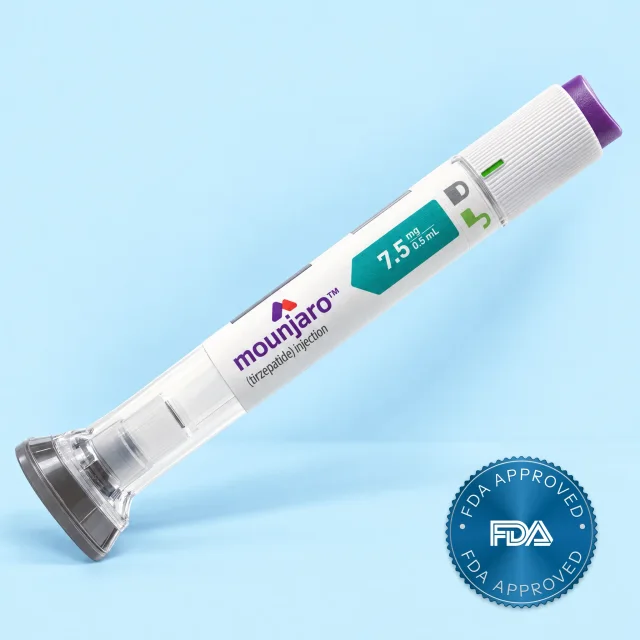
Mounjaro comes in the same forms.3 It is approved for type 2 diabetes, not for weight loss.
Where compounded tirzepatide fits
A compounded vial is made up by a state-licensed compounding pharmacy to fill one person’s prescription. Compounded tirzepatide is not FDA-approved: no FDA review of its safety, effectiveness or quality takes place, it is not a generic of Zepbound or Mounjaro, and the brand-name trials did not test it.1 A licensed provider decides whether it is appropriate for you. Our guide to finding tirzepatide near you covers the FDA’s red flags for sellers.
Through FitRx, as of November 18, 2026, compounded tirzepatide starts at $216 a month with a 3-month supply. That is for medication only, on top of membership, with shipping included. Prices change, so confirm the current terms when you sign up.