TL;DR
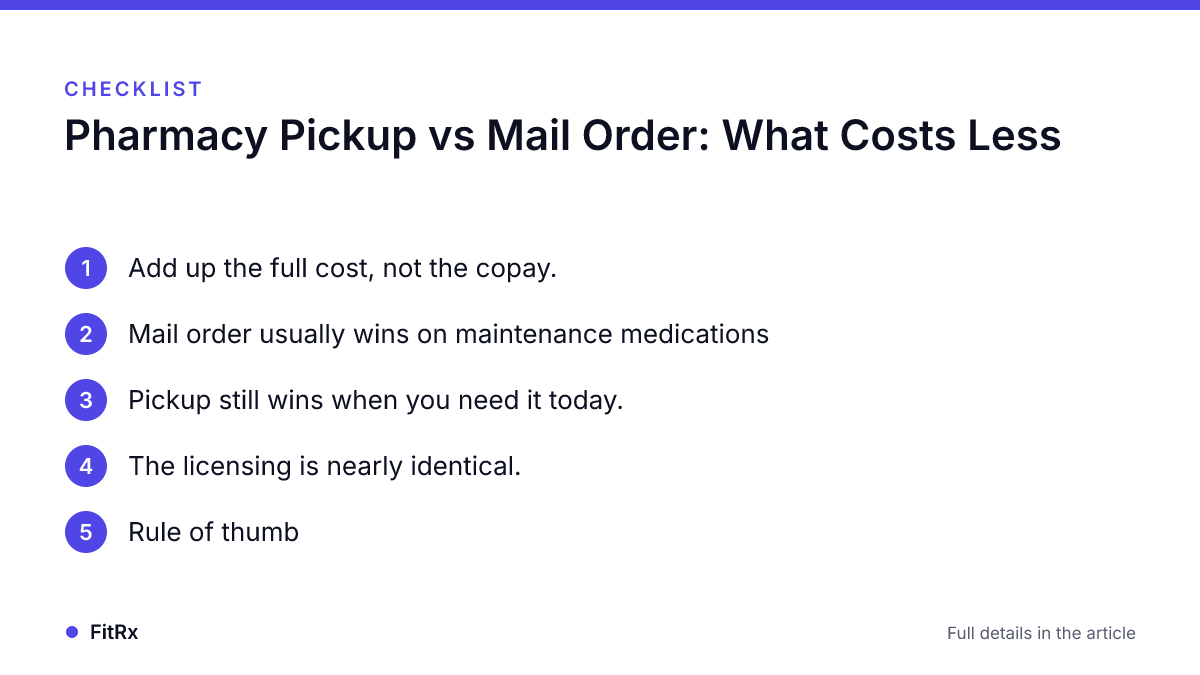
- Add up the full cost, not the copay. Gas, parking, and 30 minutes of your day turn a "cheap" $15 pickup into something closer to $35 per fill once you price your own time.
- Mail order usually wins on maintenance medications (birth control, blood pressure, GLP-1s, enclomiphene) because a 90-day supply means one transaction instead of three trips.
- Pickup still wins when you need it today. Mail order is a planning tool, not an emergency one. Budget several business days from prescription to doorstep.
- The licensing is nearly identical. Online pharmacies answer to the same state boards of pharmacy and the same FDA rules as a storefront. The pharmacist verifying your script just isn't standing in front of you.
- Rule of thumb: if your mail-order price is less than about $20 per month higher than your pickup copay, mail order is still the cheaper option for most people once driving and waiting are counted.
If you've ever stood in a CVS pharmacy line behind someone arguing about a $40 copay, you already know the sticker price isn't the real price. It's the gas, the 25 minutes of your lunch break, and the second trip after they tell you it's "still processing." Mail order and telehealth-based pharmacy delivery strip most of that out. Often the medication costs less too.

Table of Contents
- Pharmacy Pickup vs Mail Order: Which Actually Costs Less?
- How Do Online Pharmacies Differ From Traditional Pharmacies in Safety and Licensing?
- What Happens Between Prescription and Doorstep?
- What Do People Get Wrong About Mail-Order Costs?
- How Do Online Pharmacies Handle Controlled Substances and Insurance Verification?
- Frequently asked questions
Pharmacy Pickup vs Mail Order: Which Actually Costs Less?
For most maintenance medications, mail order comes out cheaper once you count everything, not just what rings up at the register. A 90-day supply picked up as three separate 30-day trips means three copays, three drives, and three chances to hit a stockout. The same 90 days shipped from a telehealth-connected pharmacy is typically one order, one price, and no drive.
| Cost factor | Chain pharmacy pickup | Telehealth mail order |
|---|---|---|
| What you pay at checkout | Copay, or full retail cash price if uncovered | Flat cash price quoted before you confirm |
| Trips per 90-day supply | Usually three | One shipment |
| Travel cost | Gas, parking, mileage on the car | None |
| Time per fill | Drive plus counter wait, often 20 to 40 minutes | About five minutes to place the order |
| Refills | You call or tap, then wait for a text | Auto-ship on a set cycle |
| Same-day need | Yes, if it's in stock | No, plan several days out |
| Hours | Many counters close evenings and weekends | Order at 11 p.m. if you want |
Run the math on your own prescription
Here's the formula nobody at the counter is going to walk you through:
True annual cost = (copay × fills per year) + (round-trip miles × cost per mile × trips) + (minutes per trip ÷ 60 × your hourly rate × trips)
An illustrative scenario, using plausible numbers you should swap for your own:
Monthly pickup at a chain pharmacy. $15 copay, 12 fills a year, a 9-mile round trip, roughly $0.50 per mile for gas and wear, 35 minutes door to door, and your time valued at $28 an hour.
- Copays: $15 × 12 = $180
- Driving: 9 × $0.50 × 12 = $54
- Time: (35 ÷ 60) × $28 × 12 = $196
- Total: $430 a year
Quarterly mail order. $30 per 90-day supply, four shipments, free shipping, five minutes to reorder.
- Prices: $30 × 4 = $120
- Time: (5 ÷ 60) × $28 × 4 = $9
- Total: $129 a year
That's a $301 gap on a medication whose copay looked cheap at the register.
Now flip it into a threshold you can actually use. The driving and waiting in that scenario cost $250 a year across 12 fills, which works out to about $21 per fill. So mail order can charge you up to roughly $20 more per month than your pickup copay and still be the cheaper choice. If the gap is bigger than that, drive.
Pro tip: if your insurance doesn't cover a GLP-1 like Zepbound or Wegovy, don't treat the chain pharmacy cash price as the ceiling of your options. Ask a telehealth provider what cash-pay routes exist for your situation before you pay retail. In our experience that conversation is worth having before the first fill, not after six of them.
How Do Online Pharmacies Differ From Traditional Pharmacies in Safety and Licensing?
Less than most people assume. Both answer to state boards of pharmacy and to FDA manufacturing and labeling rules. The difference is operational, not regulatory.
A CVS or Safeway counter has a pharmacist physically verifying your prescription and handing you the bag. An online pharmacy has a licensed pharmacist doing the same clinical review remotely, after which a U.S.-based, FDA-regulated fulfillment pharmacy fills and ships it.
The people doing that work come out of the same pipeline either way. Programs like the University of Rhode Island's College of Pharmacy train pharmacists for clinical verification regardless of whether it happens across a counter or in a dispensing queue (URI College of Pharmacy). Formal oversight roles matter in centralized, high-volume dispensing operations for the same reasons they matter in a single retail store (PubMed).
Intern and technician licensing is documented at the state level too, with training requirements and change-of-status paperwork that applies to every setting. Connecticut's pharmacy intern notification form shows how granular that gets (Connecticut DCP).
One real difference worth knowing: centralized mail-order pharmacies run tighter, more standardized protocols than a busy retail counter, because they're dispensing into every state and can't improvise. The flip side is that a retail pharmacist can look at you, notice you're slurring or sweating, and ask a question that never makes it onto an intake form. Both setups have a blind spot. Pick the one that matches how you actually use medication.
What Happens Between Prescription and Doorstep?
Six steps, and the slow ones are rarely where people expect.
- Consultation and prescribing. A licensed provider reviews your intake or runs a video visit, then writes the prescription if it's clinically appropriate. Same step whether you sat in an exam room or completed a free consultation through FitRx. The prescription doesn't know where it was written.
- Insurance or cash-pay routing. If you're insured, the pharmacy runs a real-time benefits check, exactly like the register at a Walgreens pharmacy. If you're paying cash, which is common for GLP-1s, the price is quoted upfront instead of appearing as a surprise total.
- Pharmacist verification. A licensed pharmacist checks dose, interactions, and appropriateness. Usually hours, not days, unless something needs a callback to your prescriber. This is the step that quietly eats a day when a provider is between clinic sessions.
- Fulfillment at a licensed pharmacy. Pulled, counted, labeled, and packed at a U.S.-based, FDA-regulated facility that gets inspected like any retail location. Not a warehouse with a pill counter in the corner.
- Shipping. Most orders leave within a business day or two of verification. Injectables ship cold-chain with insulated liners and gel packs, which is also why those orders sometimes hold over a weekend rather than sitting on a truck Saturday and Sunday.
- Refill and follow-up. Auto-ship means you're not the one remembering, which matters because "I'll call tomorrow" is the single most common reason people end up at a counter with an expired prescription.
Pro tip: set a calendar reminder for 10 days before you run out, even with auto-refill on. That buffer is what saves you when a prior authorization comes back needing a signature, or your provider wants a lab before approving the next cycle. Prior auth is the delay that burns people, and it has nothing to do with shipping.
What Do People Get Wrong About Mail-Order Costs?
Two assumptions cause most of the regret: that mail order is automatically cheaper, and that pickup is automatically faster.
- They compare the copay, not the total. A $15 copay beats a $45 monthly price on paper. It stops beating it the moment you count four drives, one wasted trip for a script that wasn't ready, and leaving work early.
- They expect controlled substances to move like everything else. They don't, and they shouldn't. Extra identity and clinical verification is federal, not a telehealth quirk, and it's a safety feature.
- They never check the hours. Plenty of chain counters close at 6 p.m., shut down for a lunch break, and run reduced weekend hours. Check cvs pharmacy hours or Safeway pharmacy hours for your specific store before you call pickup "instant."
- They ignore what's bundled in. A retail pharmacy fills the script and the relationship ends at the register. A telehealth platform with provider messaging, dose adjustments, and lab follow-up is doing more work for the same money.
- They assume the local store always has it. Stockouts on popular doses are routine. A 20-minute drive to be told "Tuesday" costs more than a shipment that was scheduled three weeks ago.
If you're deciding whether to skip the in-person visit entirely, our breakdown of walk-in clinic versus telehealth visits worth skipping covers which appointments genuinely need hands on you and which don't.
How Do Online Pharmacies Handle Controlled Substances and Insurance Verification?
Controlled substances require additional identity verification, a documented clinical rationale, and often a live conversation with the prescriber before anything ships. That's federal law, not a telehealth policy, and it applies the same way at a retail counter. Insurance verification works as it does in-store: a real-time eligibility check confirms coverage and your out-of-pocket amount before the order goes out, so you're not learning the price when the box arrives.
Pharmacy technicians do a lot of the groundwork in both settings, matching dose, quantity, and plan details before a pharmacist signs off. It's the same job whether someone's working the queue at a Walmart pharmacy counter or supporting a centralized mail-order operation (Walmart Pharmacy Technician listing). For a deeper look at how telehealth platforms structure that oversight differently from chains, our guide on in-house versus outsourced telehealth providers gets into it, and our CVS pharmacy vs. online prescription delivery comparison covers the retail side.
And if your actual problem is refill delays rather than price, our piece on avoiding Walgreens pharmacy refill delays is a faster read than this whole comparison.
Frequently asked questions
Can I use my insurance with an online pharmacy the same way I would at CVS?
Usually, yes. Telehealth platforms partnered with licensed pharmacies run insurance the same way a retail counter does. Many also publish cash-pay pricing, which matters if you're uninsured or your plan excludes a medication like a GLP-1.
Will my medication look or work differently if it comes from a mail-order pharmacy?
No. Dispensed by a U.S.-based, FDA-regulated pharmacy, the formulation, manufacturer, and dose are the same as what you'd get across the counter at Walgreens or Safeway. Packaging and delivery are the only differences, though the pill imprint can change if the pharmacy stocks a different generic manufacturer. That happens at retail too.
What if I need my prescription the same day?
Mail order isn't built for that. If you need something today, local pickup is the faster option for that one fill, even if it costs more over a year. Our guide to getting prescriptions without a clinic visit explains how to plan refills so you're rarely in that spot.
Pull your last 12 months of pharmacy receipts, count the trips, and run the formula above with your own copay and hourly rate. Then get a cash price quote from a licensed provider online and compare the two totals. Most people are surprised by which number is bigger.


.svg)
