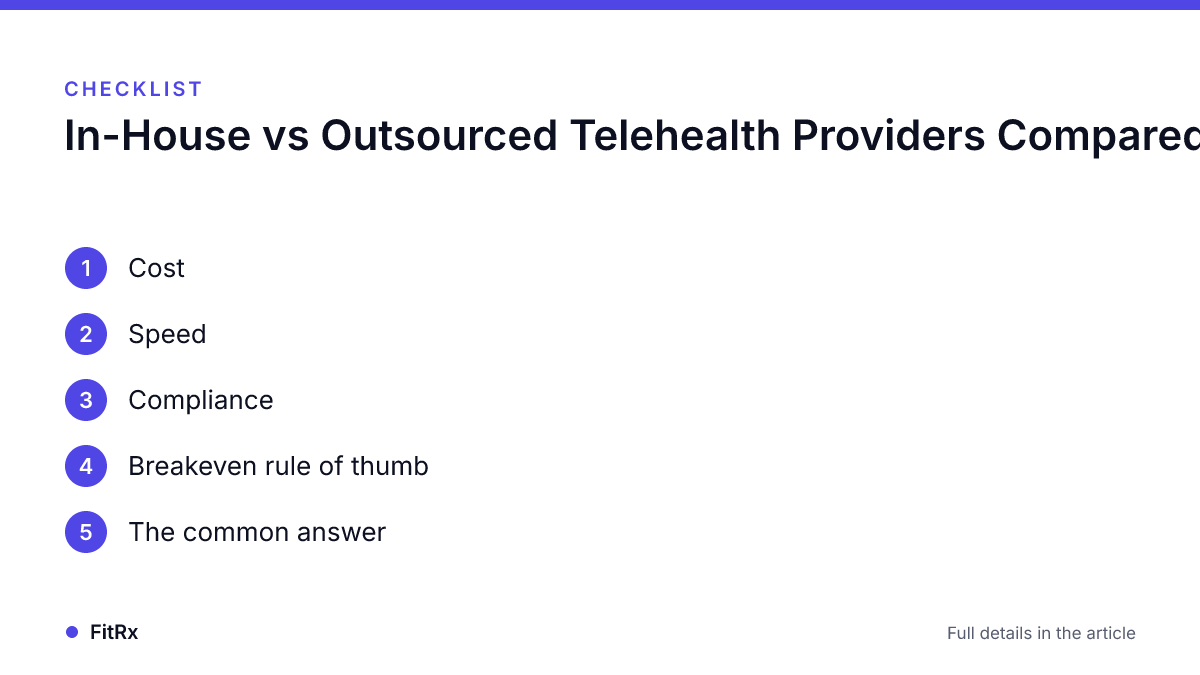
TL;DR
- Cost: In our experience, standing up an in-house telehealth program lands in six figures in year one once you add salaries, per-state credentialing, malpractice, and a compliant platform. Contracting an existing provider network usually costs a fraction of that in year one.
- Speed: Multi-state in-house builds we've watched take the better part of a year, mostly because of state license processing. Plugging into an already-licensed network can be weeks.
- Compliance: W-2 providers mean you own every license, renewal, malpractice policy, and corporate-practice-of-medicine question. Contracting shifts most of that to the partner and hands you misclassification risk instead.
- Breakeven rule of thumb: Divide your all-in annual in-house cost by your projected annual visits. If that per-visit number beats your best outsourced quote, build. If it doesn't, contract.
- The common answer: Most programs end up hybrid, with a small in-house clinical core and an outsourced bench for overflow states, nights and weekends, and specialties they don't staff.
The decision usually gets framed as control versus cost. That's close, but it misses the thing that actually forces the answer: how many states you need licensed providers in, and how soon. Everything else is negotiable. State medical boards are not.
Table of Contents
- What's the real difference between in-house and outsourced telehealth staffing?
- How much does it cost to build an in-house telehealth program versus outsourcing?
- What's the checklist for deciding between in-house and outsourced telehealth?
- What do people miss when comparing in-house vs hiring a telehealth provider?
- What are the compliance differences between hiring employees and contracting telehealth providers?
- How long does each option actually take to launch?
- Frequently asked questions
What's the real difference between in-house and outsourced telehealth staffing?
In-house means you employ or directly contract the clinicians, you own the tech stack, and you carry the compliance burden in every state where a patient sits down for a visit. Outsourced means you pay a staffing agency or an established telehealth company for providers who are already licensed and credentialed, priced per visit or per provider per month, and that partner absorbs most of the licensing and malpractice overhead.
That distinction matters more than it sounds. Telehealth isn't one regulatory category. It's medicine practiced across state lines, and every state board has its own licensing rules, corporate-practice restrictions, and prescribing limits. The hardest operational problem in the whole model is boring: matching a provider's active licenses to where the patient physically is, in real time, at the moment of booking. Entire staffing businesses exist because of that single matching problem (CHG Healthcare).

How much does it cost to build an in-house telehealth program versus outsourcing?
In-house costs more upfront because you pay for people, licenses, and software before a single patient books. Outsourcing converts most of that into a variable cost that moves with volume.
Here's a worked scenario. These are illustrative figures, not a quote from any contract. Swap in your own.
Say a mental health practice wants to treat anxiety and depression patients across 20 states within a year.
In-house, year one:
- Two full-time NPs or physicians at a fully loaded cost of roughly $220,000 each (salary, benefits, payroll taxes): $440,000
- HIPAA-compliant video plus EHR, licensed or built: $100,000–$150,000
- State licensing and credentialing at roughly $2,500–$3,500 per state × 20 states: $50,000–$70,000
- Malpractice for two providers across that footprint: $30,000–$50,000
Low end: $440,000 + $100,000 + $50,000 + $30,000 = $620,000 High end: $440,000 + $150,000 + $70,000 + $50,000 = $710,000
Outsourced, same year: at $10,000–$15,000 per provider per month for a credentialed clinician already licensed in the states you need, two providers for twelve months runs $240,000 to $360,000. No separate licensing, credentialing, or malpractice lines, because those sit with the partner.
Now the number that actually decides it. Take your in-house total and divide by projected annual visits:
$620,000 ÷ 7,000 visits = $88.57 per visit
If your best outsourced quote comes in at $85 per visit, you need more than 7,294 visits a year ($620,000 ÷ $85) to justify building. That's roughly 30 visits every business day, sustained, from month one. Most programs don't hit that in year one. That's the whole argument in a sentence.
The math flips at scale. Run 30-plus providers for several years and the fixed costs amortize, the per-visit number keeps falling, and owning the stack starts paying you back. Under a dozen providers, or with a launch window shorter than a year, outsourcing wins on cost per visit almost every time.
| Factor | In-house telehealth | Outsourced telehealth |
|---|---|---|
| Year-one cost (illustrative: 2 providers, 20 states) | ~$620,000–$710,000 | ~$240,000–$360,000 |
| Cost structure | Mostly fixed, paid before first visit | Mostly variable, scales with volume |
| Time to first patient | Most of a year for multi-state | Weeks, if the partner already holds the licenses |
| Multi-state licensing | You apply, track, and renew each one | Partner already holds licenses in most states |
| Malpractice coverage | You purchase and maintain it | Typically baked into the partner's rate |
| Clinical control | Full control of protocols, branding, hiring | Shared, governed by contract terms and SLAs |
| Best fit | Large, long-horizon programs | Fast launches, single specialties, overflow coverage |
What's the checklist for deciding between in-house and outsourced telehealth?
Work these in order. Skipping to "just hire someone" or "just sign the contract" is how organizations end up with a compliance mess or a program that never launches.
- Define the exact scope of care. GLP-1 weight loss, birth control refills, therapy, and primary care each carry different prescribing rules, controlled-substance requirements, and follow-up cadences. Scope drives every downstream cost, so settle it before you price anything.
- Map every state you'll treat in, not where your office sits. A provider licensed in Texas cannot treat a patient physically sitting in California. Your headquarters address is irrelevant to the board.
- Price true in-house cost, not salary. Add per-state credentialing, malpractice premiums, video and EHR licensing, lab integration, and the admin person whose actual job becomes chasing renewal deadlines. That last one gets left off every first draft budget I've seen.
- Get real quotes, and ask the right three questions. How many states do your providers already hold active licenses in? What's your credentialing turnaround for a new state? Is pricing per visit or per provider per month, and what happens if volume drops? A walkthrough like how to hire a telemedicine provider is a good source of additional questions before you sign.
- Decide employment classification early. W-2 gives you control and adds payroll tax, benefits, and workers' comp obligations in every state where a remote clinician works. Contractors onboard faster and carry misclassification risk if you dictate schedules and clinical decisions.
- Pilot before you commit. Run one model at low volume in three to five states for 60 to 90 days. Slow lab turnaround, refill delays, and patient drop-off all show up in a pilot. They also all scale with you if you don't look.
- Write the hybrid or exit plan now. Decide upfront whether outsourcing is a bridge to in-house or a permanent second lane. Retrofitting that decision after you've hired is where the money goes.
Pro tip: Compare pharmacy fulfillment with the same rigor you compare provider cost per state. A program can have flawless licensure and still lose patients because prescriptions sit at a retail counter for four days. Our breakdown of Walgreens pharmacy refill delays and how to avoid them is a useful gut-check on what patients actually experience when fulfillment isn't wired into the visit.
What do people miss when comparing in-house vs hiring a telehealth provider?
Cost and control are the obvious factors. The quiet ones do more damage.
- Turnover is asymmetric. When a W-2 physician covering nine states resigns, you don't lose one hire. You lose nine licenses, and the replacement starts the application clock over in every one of them. Meanwhile those patients need refills. I've seen a single resignation freeze an entire state's patient panel for a quarter. Outsourced networks carry bench depth specifically for this, and it's worth asking a partner exactly how they cover a mid-treatment provider swap.
- Prescribing rules and licensing rules are two different things. A clinician can hold a perfectly valid license in a state and still be restricted from prescribing certain medications over a video visit under that state's telemedicine statute. Check the prescribing rule for your specific drug class, in each state, separately from the license.
- Pharmacy integration gets treated as an afterthought. Whoever writes the script still needs a pharmacy that fills and ships fast. Compare retail dependence against a dedicated online pipeline before you lock in a staffing model. Our CVS pharmacy vs online prescription delivery comparison covers that tradeoff.
- Partner quality varies enormously, and the gap shows up in follow-up. Two networks can quote nearly identical per-visit rates and deliver completely different programs: one automates refills and chases lab results, the other answers the visit and disappears. Our comparison of the best telehealth providers in the US is worth reading from the buyer side, because it shows what operational "good" actually looks like.
What are the compliance differences between hiring employees and contracting telehealth providers?
W-2 makes you responsible for state licenses, CME, malpractice, and employment law in every state where a clinician is physically sitting while treating patients. That includes overtime rules, benefits, and state payroll registration. Hire a nurse practitioner who relocates from Ohio to Colorado and you've just acquired a Colorado employment footprint you didn't plan for.
Contracting shifts licensing and malpractice to the agency or independent provider, and hands you misclassification exposure in exchange. The IRS and Department of Labor both look at behavioral and financial control. If you're setting their hours, mandating your tools, and directing clinical decisions, the contractor label gets thin fast.
Corporate-practice-of-medicine laws sit on top of all of it. Several states bar non-physician-owned entities from employing physicians at all, which is why so many telehealth companies run a management services organization alongside a physician-owned professional corporation rather than hiring doctors outright. The MSO handles marketing, tech, and billing support. The PC holds the clinical relationship. Getting that structure reviewed by health care counsel before you hire costs a few thousand dollars. Unwinding it after you've signed twelve clinicians costs considerably more.
How long does each option actually take to launch?
In-house multi-state builds we've been close to run most of a year from decision to first visit. The bottleneck is almost never the technology. It's state license applications, which can sit with a board for months and move at wildly different speeds depending on which state you're waiting on, plus credentialing and malpractice underwriting on top.
Contracting an established network compresses that to weeks in a lot of cases, because you're renting infrastructure instead of building it. The providers are licensed, credentialed, and already working on a compliant platform.
Pro tip: If your launch window is under six months, outsourcing isn't only cheaper, it's usually the only path that exists. Licensing lead times alone will consume your runway before you see a patient. Build later, once volume has proven the model.
Frequently asked questions
Can a small practice outsource telehealth without losing its brand identity?
Yes. Most outsourced arrangements can be white-labeled or co-branded, so patients see your practice name and interface while the partner supplies the clinical talent behind it. Ask directly whether white-labeling is included and what it costs. Some partners charge for it, some don't mention it unless you bring it up.
Do outsourced telehealth providers cost more per visit long-term?
Usually not, unless your volume is high and sustained. Outsourced per-visit pricing tends to hold flat or improve at renewal, while in-house salaries, benefits, and license renewals climb every year whether patients show up or not. Run the breakeven division above annually, not once.
What happens to continuity if you switch from outsourced to in-house later?
Plan on 60 to 90 days of both structures running in parallel. Patients mid-treatment, a GLP-1 titration schedule or ongoing therapy, need uninterrupted refills and ideally the same clinician through the handoff. The transitions that go well stagger patients by treatment type instead of cutting everyone over on the same date.
Your next step: pull your projected visit volume for the next twelve months, divide your all-in in-house estimate by it, and put that number next to a real outsourced quote. If you can't produce the visit projection with a straight face, you're not ready to build. Contract, pilot for a quarter, and let the data make the call.


.svg)
