TL;DR
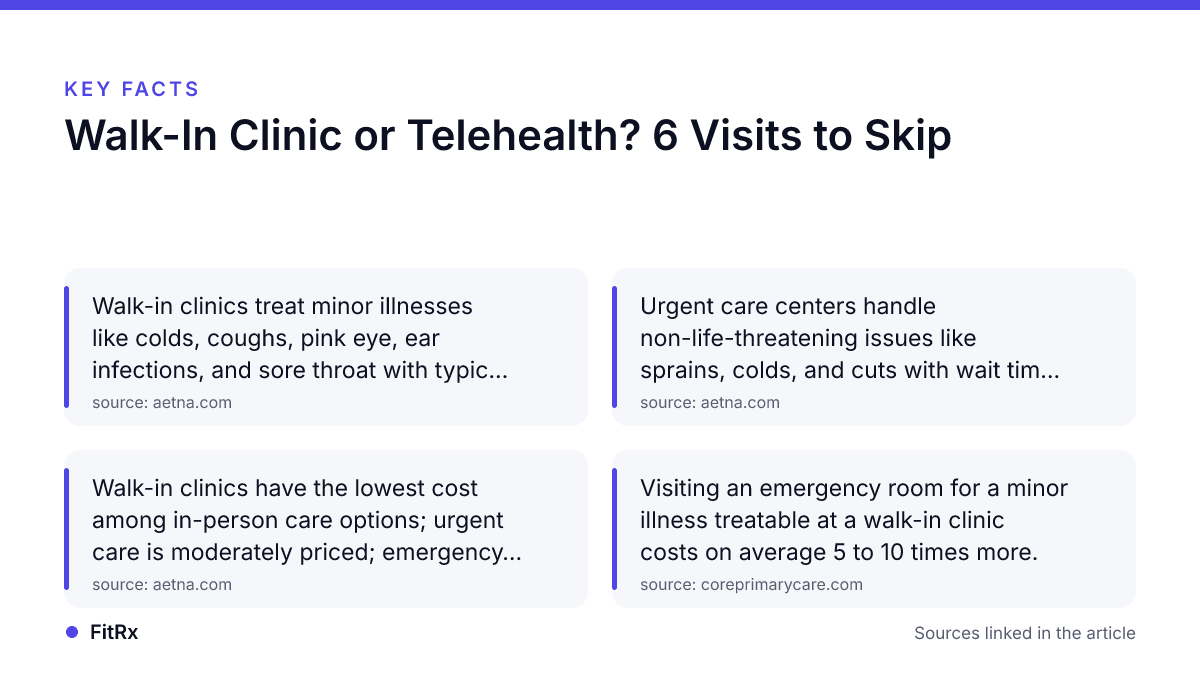
- Walk-in clinics handle minor, non-emergency illness (colds, pink eye, ear infections, sore throats) with typical wait times of 15 to 30 minutes.
- Walk-in clinics are the cheapest in-person option, urgent care sits in the middle, and the ER tops the list. An ER visit for something a walk-in clinic could treat runs 5 to 10 times more.
- Neither setting is built to manage ongoing prescriptions like GLP-1s, enclomiphene, or birth control. They're drop-in acute care, not a titration schedule.
- Telehealth skips the waiting room for prescriptions you already know you need, with free consultations, U.S.-licensed providers, and automatic refills instead of a monthly appointment.
- Most walk-in clinics and urgent care centers take insurance, but coverage still varies by plan, which matters if you're paying cash for weight loss or hormone treatment anyway.
An ER visit for something treatable at a walk-in clinic costs 5 to 10 times more than the walk-in visit. That gap exists for one reason: people go wherever the lights are on, not wherever the problem belongs.
The same habit drives a lot of the care adults quietly put off. Testosterone symptoms. A birth control refill. Thinning hair. An anxiety med that ran out two weeks ago. People assume a clinic visit is the only road to a prescription. For a long list of common conditions, it isn't anymore.

Table of Contents
- What is a walk-in clinic vs urgent care?
- How much does it cost at a walk-in clinic?
- Is it cheaper to go to urgent care or the doctor?
- What can a walk-in clinic prescribe, and what can't it?
- How do wait times and availability compare to telehealth?
- 6 visits you can skip with telehealth instead
- At a glance: walk-in clinic vs urgent care vs telehealth
- Frequently asked questions
What is a walk-in clinic vs urgent care?
A walk-in clinic, sometimes called a retail clinic, is the small exam room tucked inside a pharmacy or grocery store. It treats colds, coughs, pink eye, ear infections, and sore throats, with wait times around 15 to 30 minutes. Urgent care is a step up in capability. It takes non-life-threatening but messier problems (sprains, cuts, infections), runs X-rays and labs on-site, and posts wait times of 15 to 60 minutes.
The practical difference is equipment and scope. Walk-in clinics are usually staffed by a nurse practitioner working from a posted list of conditions they're allowed to treat. If your issue isn't on that list, you get sent somewhere else, and you still paid for the visit. Urgent care centers typically have a physician on-site plus the imaging to call a fracture or close a laceration.
What neither one does well: hold onto you. Both are designed to solve one problem today and discharge you. There's no chart being built over six months, no one watching your A1C drift, no provider who remembers what dose made you nauseated in March.
Pro tip: If you're searching "minute clinic near me" for something you already know the answer to, like restarting a medication you've taken for years, you're paying for a visit to confirm what you already told them. That's the appointment telehealth exists to replace.
How much does it cost at a walk-in clinic?
Walk-in clinics are the lowest-cost option among in-person care settings. Urgent care lands in the middle. The ER sits at the top, and it isn't close. Exact dollars shift by clinic, state, and plan, but the ranking holds everywhere: walk-in clinic < urgent care < ER.
Here's the math worth running. Use an illustrative example: say your local walk-in clinic charges $120 out of pocket for a sore throat visit, strep swab included. Treat that same sore throat in an ER on a Sunday night because the clinic closed at 5, and you're looking at 5 to 10 times more:
- $120 × 5 = $600
- $120 × 10 = $1,200
Same swab. Same amoxicillin. The formula to reuse on your own bill is walk-in clinic price × 5 to 10 = likely ER price for the same minor issue. Pull up the last ER statement you got and work it backward. The number that should have been on it is almost always under $200.
The threshold we'd give you: if the problem doesn't involve chest pain, trouble breathing, head injury, uncontrolled bleeding, or an obviously broken bone, the ER is the wrong door. And if the problem isn't new at all, if it's a refill rather than a diagnosis, even the walk-in clinic is the wrong door.
Is it cheaper to go to urgent care or the doctor?
Your regular doctor or a walk-in clinic will almost always beat urgent care on price, because urgent care sits in the middle of the pricing tiers. Urgent care earns its premium when you need something same-day that a standard office visit can't deliver: imaging for a possible fracture, stitches, or care at 8 p.m.
That answer assumes you can actually get a doctor's appointment. Often you can't. When your primary care office is booked three weeks out and your prescription runs dry Thursday, urgent care wins by elimination, not by value. We hear a version of this constantly from people starting with FitRx: they'd already paid for an urgent care visit, been told the provider doesn't manage long-term hormone therapy, and been handed a referral to a clinic with its own three-week wait. Two co-pays, zero prescriptions.
That's the gap telehealth fills. A licensed provider, same day, without the urgent care markup. Our guide on getting prescription services without a clinic visit covers which conditions qualify and what the process looks like start to finish.
What can a walk-in clinic prescribe, and what can't it?
Walk-in clinics can prescribe a short course of something for the acute problem in front of them: an antibiotic for an ear infection, antihistamines for allergies, a prednisone taper for poison ivy. What they generally won't start is a medication that needs lab monitoring and dose adjustment over months. A nurse practitioner seeing you once for 15 minutes has no mechanism to follow your testosterone levels in week six or your tolerance at the next GLP-1 step-up.
That line is exactly where FitRx picks up:
| Condition / medication type | Walk-in clinic | Telehealth (FitRx) |
|---|---|---|
| GLP-1 weight loss (Zepbound, Wegovy) | Not typically offered or monitored | Ongoing provider support, lab testing, and coaching |
| Birth control (new start or refill) | Limited, often sends you elsewhere | Prescribed and auto-refilled online |
| Erectile dysfunction | Rarely addressed in a walk-in setting | Private online visit, shipped to your door |
| Low testosterone / enclomiphene | Needs lab work and specialist follow-up | Lab testing plus ongoing dose management |
| Hair loss (finasteride, minoxidil) | Not a typical walk-in service | Prescribed with refills built in |
| Anxiety or depression | Usually referred out | Ongoing mental health care online |
Both settings accept most insurance plans, though coverage for these specific conditions varies wildly, and plenty of people end up paying cash regardless, especially for GLP-1s. If that's you, compare weight loss options with or without insurance before assuming a walk-in clinic can help at all.
How do wait times and availability compare to telehealth?
Walk-in clinics run 15 to 30 minute waits and keep standard business hours, with some extending into the evening. Fine if your schedule is flexible. Rough if you work nights, drive for a living, or refuse to spend a lunch break confirming a prescription you've taken for four years.
Also worth knowing: that posted 15 to 30 minutes is the wait to be seen, not the time you're there. Add parking, intake forms, and the pharmacy fill time afterward, and a "quick" retail clinic stop routinely eats 90 minutes.
Telehealth runs on your clock instead. A free consultation can happen the same day from your couch. For medications you're stable on, the difference compounds, because automatic refills mean nothing shows up on your calendar, only on your doorstep. Anyone who's dealt with a Walgreens pharmacy refill delay or spent 20 minutes on hold with a CVS pharmacy knows what a missed refill actually costs in time.
Pro tip: Weighing a retail pharmacy counter against delivery? Our breakdown of CVS pharmacy vs online prescription delivery lays out the real tradeoffs in cost, speed, and convenience, not just which one's closer to your house.
6 visits you can skip with telehealth instead
These get booked out of habit:
- The GLP-1 refill visit. Once your dose is established and tolerated, sitting in a waiting room monthly adds nothing. Coaching and lab monitoring both work online.
- The birth control renewal. A pill that's worked fine for six years doesn't need an in-person recheck every time the pack count hits zero.
- The "I think it's ED" visit. The most postponed conversation in men's health, mostly because of who else is sitting in that waiting room. Telehealth deletes the awkward part.
- The low-T workup. Enclomiphene therapy needs lab testing and follow-up. Neither requires an exam table.
- The hair loss consult. For most patients, finasteride and minoxidil decisions come down to photos and a questionnaire. Nobody needs to touch your scalp.
- The anxiety or depression check-in. Follow-ups are conversation. Video handles conversation.
Pro tip: Menopause symptom relief belongs on this list too. If FitRx isn't the right fit for a specific need, ask whichever telehealth service you're considering two questions before you pay: does a provider hold a license in your state, and who fills the prescription. The goal is getting the prescription, not brand loyalty.
Comparing telehealth providers against each other rather than against in-person care? Our side-by-side on the best telehealth providers in the US and our look at in-house vs outsourced telehealth providers both cover the two things that actually separate good from mediocre: whether providers hold a license in your state, and whether prescriptions ship from accredited U.S. pharmacies.
At a glance: walk-in clinic vs urgent care vs telehealth
| Point | Details |
|---|---|
| Best for | Walk-in: minor acute illness. Urgent care: sprains, cuts, X-rays. Telehealth: ongoing prescriptions and chronic care |
| Typical wait | Walk-in: 15–30 min. Urgent care: 15–60 min. Telehealth: often same-day, no waiting room |
| Relative cost | Walk-in lowest, urgent care moderate, ER highest (Aetna) |
| Hours | Walk-in: standard business hours, some evenings. Telehealth: book your own consult |
| Insurance | Both accept most plans, coverage varies |
| Refill management | In-person: a new visit each time. Telehealth: automatic refills built into the plan |
Frequently asked questions
Can a walk-in clinic treat something like a UTI or allergic reaction?
Usually yes. Walk-in clinics handle quick-turnaround problems like mild allergic reactions, minor rashes, and straightforward infections that don't need imaging or specialist follow-up. If symptoms are severe, spreading fast, or involve any trouble breathing, go to urgent care or the ER instead.
Do I need a referral to switch from in-person care to telehealth?
No. You can start a consultation directly for the conditions FitRx treats: weight loss, birth control, ED, hair loss, low testosterone, skincare, and mental health. No in-person provider has to sign off first.
What happens if my local CVS or Walgreens pharmacy doesn't stock my medication?
More common than people expect, particularly with high-demand GLP-1s. Telehealth providers working with dedicated fulfillment pharmacies can route around local shortages, because your prescription isn't tethered to one retail counter that happens to be out.
Skip the next refill appointment. Start a free FitRx consultation and have a licensed provider tell you in minutes whether you're a candidate, without the drive, the waiting room, or the guesswork about pharmacy hours.


.svg)
