TL;DR
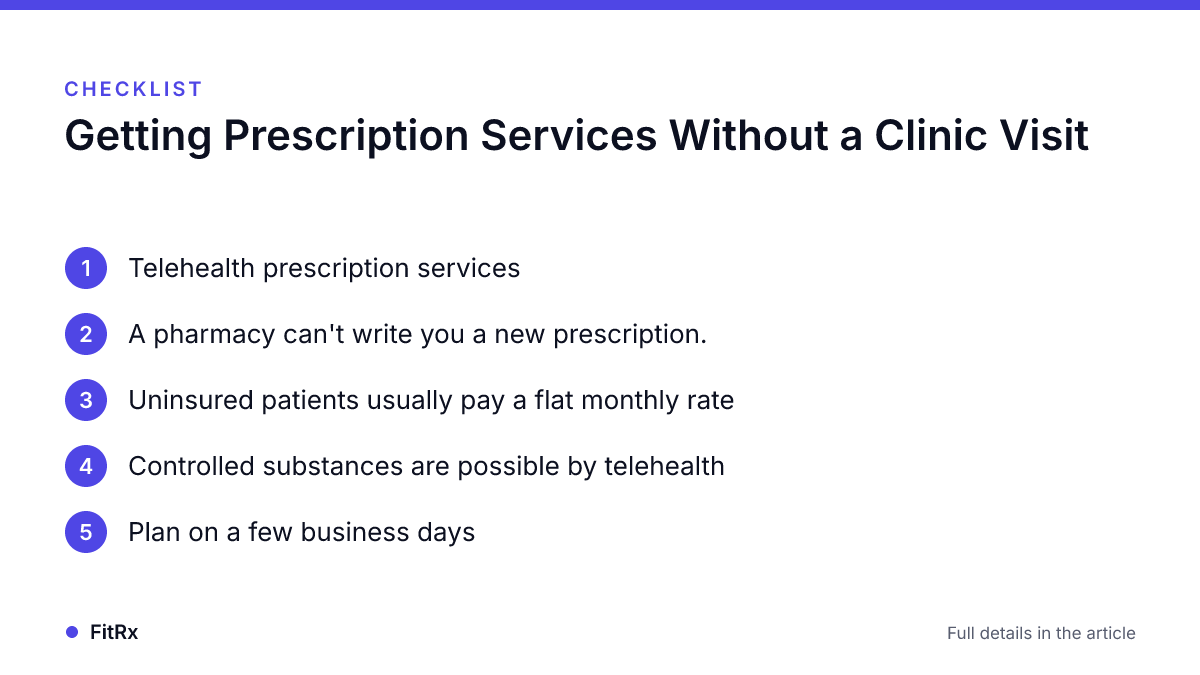
- Telehealth prescription services put a licensed provider between you and the pharmacy without a waiting room. You complete a health intake online, the provider reviews it, and treatment can be approved the same day.
- A pharmacy can't write you a new prescription. "No doctor needed" only applies to refills of scripts you already have, plus a short list of items pharmacists can dispense under their own authority in some states.
- Uninsured patients usually pay a flat monthly rate for the consultation and treatment instead of cash price at a retail counter, which makes the monthly number predictable.
- Controlled substances are possible by telehealth but carry extra hoops: identity verification, sometimes a live video visit, and shorter refill windows. Enclomiphene sidesteps most of that, which is why it's popular for testosterone support.
- Plan on a few business days from intake to a box on your doorstep for standard prescriptions, longer if labs have to come back first.
"Prescription services" now describes two completely different things. One is the mail-order arm of a retail chain, where CVS or Walgreens ships the refill a doctor already authorized. The other is a telehealth platform where a licensed provider evaluates you online, writes a brand-new prescription, and a licensed U.S. pharmacy fills and ships it.
Both put medication in your mailbox. Only the second one lets you start something new, like GLP-1 weight loss treatment, low testosterone support, or birth control, without sitting in a walk-in clinic reading a three-year-old magazine. FitRx handles the consultation, the prescription, the labs when they're needed, and the shipping.
Table of Contents
- How do telehealth prescription services differ from a walk-in clinic or pharmacy?
- Can I get a prescription from a pharmacy without seeing a doctor?
- What does an online prescription actually cost without insurance?
- Does telehealth work for controlled substances and restricted medications?
- How long does it take to get a prescription delivered?
- Which online prescription service is best?
- Frequently asked questions
How do telehealth prescription services differ from a walk-in clinic or pharmacy?
The medical decision happens in a different place. A pharmacy dispenses what someone else already decided. A walk-in clinic handles acute problems in person: a UTI, strep, a sinus infection that won't quit. Neither is designed to manage a treatment you'll be on for a year.
Telehealth moves the evaluation itself online. You complete a health history, upload recent labs or photos if the condition calls for it, and a provider either approves treatment or comes back with questions.
That distinction matters most for the conditions you don't finish in one visit. Hair loss, ED, birth control, low testosterone, and weight loss all need dose adjustments and follow-up, not a single script. Here's what that looks like in practice: a man starting enclomiphene gets baseline labs, begins a dose, and repeats bloodwork a couple of months in. If his total testosterone barely moved, the dose changes. If estradiol climbed too far, the plan changes. Nobody catches that if the prescription just reships on autopilot.
FitRx pairs you with a provider who stays in the loop on dosage, follow-up labs, and refills, so you're not calling a pharmacy every 30 days hoping for a callback. If you're comparing your options broadly, our breakdown of the best telehealth providers in the US walks through how different platforms structure that provider relationship.

Can I get a prescription from a pharmacy without seeing a doctor?
No. A pharmacy cannot write you a new prescription. Only a licensed provider can do that: a physician, nurse practitioner, or physician assistant, whether the visit happens in an exam room or over video and secure chat.
What a pharmacy can do without a fresh doctor visit is refill a prescription already on file. Some states also let pharmacists dispense a narrow list of things under their own authority, commonly hormonal birth control, naloxone, and certain vaccines. That's the source of most of the confusion. People search for a way to skip the medical step entirely, and it isn't available, because somebody with training has to confirm the drug is safe for your history, your labs, and everything else you're taking.
Telehealth doesn't remove that step. It compresses it. On FitRx, "seeing a doctor" is a written intake plus a message or video exchange with your provider when your case needs one, which typically resolves in a day rather than the two or three weeks a new-patient clinic slot takes.
What does an online prescription actually cost without insurance?
Most telehealth prescription services separate the consultation and membership fee from the medication, which makes your monthly cost easier to predict than cash pricing at a retail counter. GLP-1 medications like Zepbound and Wegovy sit at the top of the range because the drug itself is expensive. Enclomiphene, birth control, ED medication, and hair loss treatment land far lower.
Here's how to run the math on your own situation. This is an illustrative scenario, not FitRx pricing.
Say you're uninsured and pursuing testosterone support locally. The urologist's office visit is $150 and pretreatment bloodwork is $90, so you're $240 in before a single pill. Add two follow-up visits over six months at $150 each, plus a $70 monthly cash price at the pharmacy:
$240 + ($150 × 2) + ($70 × 6) = $960 for six months
Now the telehealth path with the consultation free, labs bundled, and a flat $100 monthly treatment fee:
$100 × 6 = $600 for six months
Swap in your own quotes and the formula holds: (visit fees + lab fees + monthly cash price × months) versus (monthly membership × months). The rule of thumb: once your medication needs more than two provider touchpoints a year, the bundled monthly model usually wins, and the gap widens every time a dose change forces another office visit.
| Cost factor | Walk-in clinic + retail pharmacy | Telehealth prescription service |
|---|---|---|
| Initial visit fee | Roughly $100–$250 uninsured | Often a free consultation |
| Lab testing | Billed separately by the lab | Frequently bundled into the monthly fee |
| Medication pricing | Full cash price at the counter | Flat or negotiated monthly rate |
| Refill process | Manual call-ins, subject to stock delays | Automatic refills where clinically appropriate |
| Dose adjustments | Another billable visit | Included in ongoing provider messaging |
| Time to treatment | Days to weeks for an open appointment | Often same-day provider review |
Pro tip: if you're filling through a chain pharmacy and hitting delays, read our guide on Walgreens pharmacy refill delays before you switch stores. Half the time the problem is how the prescription is managed, not where it's filled.
Does telehealth work for controlled substances and restricted medications?
Sometimes, with more friction. Federal rules layer extra safeguards onto controlled substances, which covers injectable testosterone, certain anxiety medications, and stimulants. Depending on the drug and your state, that can mean a live video visit instead of a questionnaire.
This is exactly why enclomiphene took off in telehealth. It's not a controlled substance, so the verification burden is lighter and the refill cadence is simpler, and plenty of men use it for testosterone support rather than going straight to TRT. Mail-order operations like PPS Prescription Delivery play by the same controlled-substance rules. Ordering online changes how verification happens, not whether it happens.
What to expect if your medication falls into this category:
- Extra identity verification, usually a photo ID upload plus a live video check with the provider.
- State-specific limits. A handful of states still want an initial in-person exam for certain controlled substances no matter what's allowed elsewhere.
- Shorter refill windows. Controlled prescriptions can't be set to open-ended auto-refill, so expect a check-in before each fill.
- Signature-confirmation shipping rather than a package left on the porch.
- Pharmacy stock reality. Controlled substances go on backorder more often than you'd think, and the fix is usually asking your provider to route the script to a second pharmacy rather than waiting it out.
How long does it take to get a prescription delivered?
For standard prescriptions, most patients we work with see medication arrive within a few business days of their intake. The sequence looks like this: provider review the same day or the next, the prescription transmits electronically to a licensed U.S. pharmacy within hours of approval, then standard shipping.
Lab-dependent treatment runs longer. If a provider needs baseline bloodwork before finalizing a dose, which is common with testosterone-related treatment and some GLP-1 protocols, add the time it takes you to get to a draw site plus the lab's turnaround. Booking that draw the same day you complete your intake is the single biggest thing you can do to shorten the wait.
If you're weighing whether delivery beats picking up locally, our comparison of CVS pharmacy versus online prescription delivery breaks down the time and cost tradeoffs side by side.
Which online prescription service is best?
There's no universal winner. A platform that's excellent at birth control refills can be mediocre at GLP-1 titration, because one is a logistics problem and the other is a clinical one.
Four questions separate the good services from the checkout pages with a stethoscope on them:
- Who reviews your intake, and can you message them again later? If the answer is a faceless queue, dose adjustments will be painful.
- Are follow-up labs included or billed? Bundled labs at the two-to-three-month mark signal the platform expects to change your dose.
- What happens when you plateau? A service that only reships the starting dose isn't managing anything.
- Can they route a prescription to a different pharmacy on request? That single piece of flexibility solves most backorder problems.
FitRx is built for the conditions that need an ongoing relationship: weight loss, low testosterone, hair loss, ED, birth control, mental health, and primary care, with consultations, lab testing, coaching, and automatic refills included rather than sold as upsells. If your needs sit outside that, compare a couple of platforms directly. Smaller telehealth brands serve overlapping but slightly different patients, and pharmacy roundups from sites like Clearway Health are a reasonable starting shortlist. Checking two or three against each other beats picking blind off a search page.
The real test isn't the logo. It's whether anyone changes your treatment after month one.
Frequently asked questions
Do I need a referral from my primary care doctor to use a telehealth prescription service?
No. You create an account, complete the health intake, and a licensed provider on the platform evaluates you directly. There's no gatekeeping through an existing doctor.
What happens if the provider decides I'm not a good candidate for the medication I requested?
You aren't charged for medication you can't receive. Most services either propose an alternative treatment or send you to in-person care if your case needs a physical exam or imaging that can't be done remotely.
Can I switch from local pharmacy pickup to home delivery mid-prescription?
Usually, yes. Your provider can send a new prescription or request a transfer to a mail-order pharmacy. Controlled substances often require a fresh prescription instead of a transfer, so confirm with your provider before your current supply runs low.
Pull your last lab report and your pharmacy's cash price for whatever you're taking, run both numbers through the formula above, then start a free consultation with a FitRx provider and see which path actually costs less over the next six months.


.svg)
