TL;DR
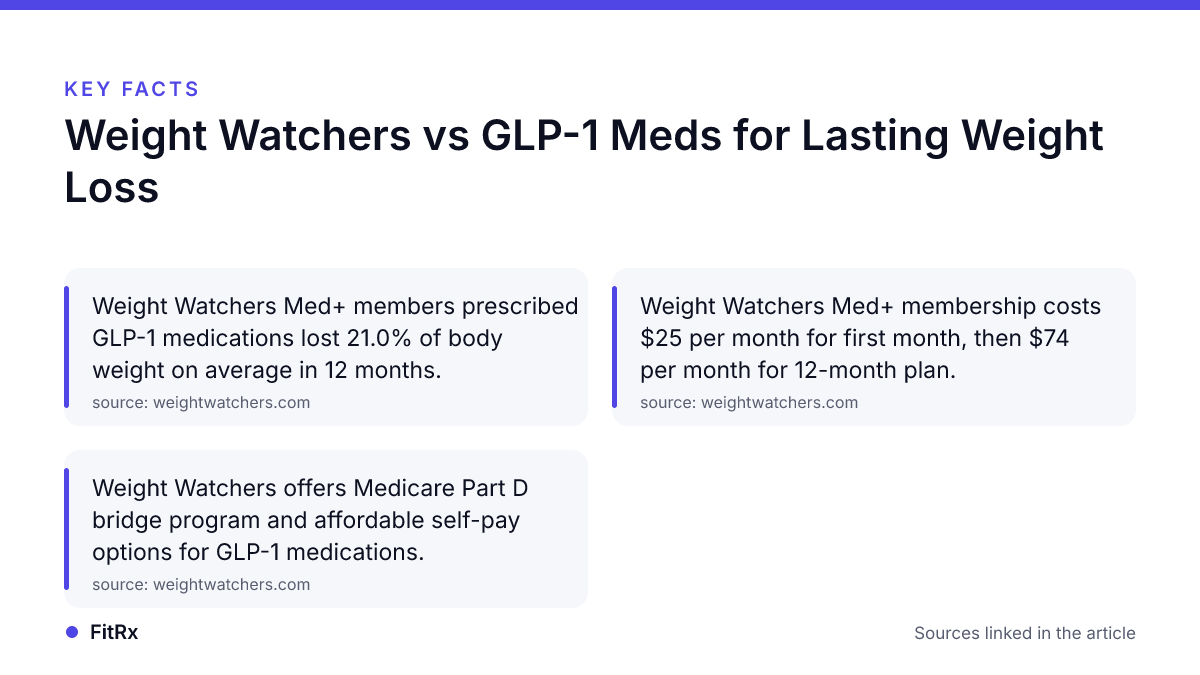
- Weight Watchers Med+ members prescribed GLP-1 medications lost an average of 21% of body weight over 12 months, according to Weight Watchers' own clinical results data.
- Membership runs $25 for the first month, then $74 per month on a 12-month plan. That's separate from whatever you pay for the medication.
- Weight Watchers offers a Medicare Part D bridge program and self-pay options, but doesn't publish a list of accepted private insurance plans. Eligibility gets checked during signup.
- The real downside isn't the medication, it's the stacked cost: a diet-app subscription sitting on top of a prescription you could get through a dedicated telehealth provider with less overhead.
- Telehealth GLP-1 providers like FitRx skip the subscription layer entirely, with free consultations, licensed providers, and prescriptions shipped from U.S.-based pharmacies, with or without insurance.
Weight Watchers isn't just a points app anymore. It runs a clinical arm, Weight Watchers Med+, that writes prescriptions for GLP-1 medications like Zepbound and Wegovy. So the question people are actually typing into Google isn't whether Weight Watchers "works." It's whether paying for a membership-based weight loss program on top of a prescription beats going straight to a provider built around the medication.
Here's the direct answer: Weight Watchers' Med+ program reports that members prescribed GLP-1 medications lost an average of 21% of their body weight over 12 months. Membership costs $25 for the first month, then $74 per month on a 12-month plan, and the company offers a Medicare Part D bridge program plus self-pay options for members whose insurance doesn't cover these drugs. That fee sits on top of the medication itself, and that's where people get caught off guard.

Table of Contents
- What is the downside of Weight Watchers?
- How long will it take to lose 20 lbs on Weight Watchers?
- Does Weight Watchers' GLP-1 program really cost less because it's "just an app"?
- Can you get GLP-1 medication through Weight Watchers without insurance?
- How does Weight Watchers compare to telehealth GLP-1 providers like FitRx?
- What should you actually look for in a GLP-1 provider?
- Next step
- Frequently asked questions
What is the downside of Weight Watchers?
Cost stacking, mainly. Not effectiveness.
You pay a monthly membership fee for coaching, tracking, and app access, then pay separately for the prescription. Your real monthly spend is the medication cost plus $74. Over a 12-month commitment, the membership alone comes to $25 + ($74 × 11) = $839 before you fill a single prescription. If your medication runs, say, $300 a month out of pocket, your true annual outlay is $839 + $3,600 = $4,439. Swap in your own medication number and the formula holds: (membership total) + (monthly med cost × 12).
The second downside predates GLP-1s entirely. Weight Watchers built its model on behavioral tracking and points, and independent discussion of whether Weight Watchers actually works has gone back and forth for years on whether results come from the program's structure or from basic calorie awareness that any tracking method produces. Add a GLP-1 to that mix and the medication is doing the heavy lifting. The app is riding along.
Third: the 12-month plan structure. Plenty of people want to try a GLP-1 for three months to see how their body handles it before committing to a year of anything. In our experience, the first four to six weeks are when people decide whether they can tolerate the drug at all, because that's when nausea, fatigue, and the appetite drop hit hardest. A 12-month membership asks you to commit well before you have that information. Most telehealth-only prescribers let you pause or cancel month to month because there's no bundled coaching subscription holding the door shut.
Pro tip: before signing up for any 12-month weight loss membership, ask one question in writing: "If I stop the medication after month one, what do I owe?" A provider that hedges is telling you the answer is "a lot."
How long will it take to lose 20 lbs on Weight Watchers?
Use Weight Watchers' reported 21% average over 12 months and you can estimate your own timeline. Multiply your starting weight by 0.21 to get projected 12-month loss, then divide by 12 for a rough monthly pace.
Example: a 190-lb person loses roughly 190 × 0.21 = 39.9 lbs over 12 months, or about 3.3 lbs per month. Hitting 20 lbs takes 20 ÷ 3.3 ≈ 6 months at a steady pace. Real GLP-1 weight loss isn't steady, though. It's front-loaded in the first few months and flattens as you approach maintenance, so 20 lbs often arrives closer to month four or five, and the back half of the year yields less.
A lighter starting point shifts the math. Someone starting at 160 lbs loses about 160 × 0.21 = 33.6 lbs in a year, or 2.8 lbs per month, so 20 lbs lands nearer 7 months. Same percentage, slower pounds-per-month.
Rule of thumb: divide your target loss in pounds by (your current weight × 0.0175) to estimate months. The 21%-over-12-months figure works out to about 1.75% of body weight per month.
Does Weight Watchers' GLP-1 program really cost less because it's "just an app"?
No. In most cases it costs more, because you're buying two things instead of one. The $25 first month and $74 thereafter cover coaching and app access. The medication is billed on top. Across a full year the membership alone totals $839, whether your prescription is insured or self-pay.
The misconception sticks because Weight Watchers spent decades positioning itself as the affordable option, so people assume the clinical arm inherited that pricing DNA. It didn't. Med+ is a medical telehealth service with a subscription wrapper around it. If what you want is the prescription, provider access, and pharmacy fulfillment, and you have no interest in logging meals, you're renting features you won't open.
Most dedicated GLP-1 telehealth platforms, FitRx included, don't charge a recurring membership on top of the prescription. Consultations are free, follow-up provider support is included, and pharmacy fulfillment is the main line item. For a broader look at how traditional pharmacy pricing compares to online prescription delivery, our guide on CVS pharmacy vs online prescription delivery breaks down the real differences.
Can you get GLP-1 medication through Weight Watchers without insurance?
Yes, though the terms don't become clear until you're inside the signup flow. Weight Watchers says members may be eligible for special self-pay offers on select medications, and it runs a Medicare Part D bridge program for patients with coverage gaps. What it doesn't publish is a plain list of accepted private insurance plans. You submit your details during intake and learn your out-of-pocket number afterward.
That's standard across GLP-1 telehealth, not a Weight Watchers quirk. But it does mean you can't comparison-shop by plan the way you can for a generic at a retail counter. If pricing opacity bothers you, read how Mark Cuban's Cost Plus Drugs pharmacy handles transparent pricing and what it won't fill, because GLP-1 availability varies widely by pharmacy model.
Self-pay matters most for two groups: people whose plans cover GLP-1s only for type 2 diabetes, and people facing a prior authorization. Prior auth usually means your provider documents BMI, comorbidities, and often a prior attempt at supervised weight management, then waits on the insurer. Two to four weeks is typical, and denials on a technicality (a missing BMI reading from the right date range, for instance) are common enough that it's worth asking your provider's staff whether they handle appeals or hand that back to you.
How does Weight Watchers compare to telehealth GLP-1 providers like FitRx?
| Factor | Weight Watchers Med+ | Telehealth GLP-1 providers (e.g., FitRx) |
|---|---|---|
| Consultation cost | Bundled into $25 first-month fee | Free initial consultation |
| Ongoing cost | $74/month membership plus medication cost | Medication cost only, no separate membership fee |
| 12-month membership total | $839 before medication | $0 in membership fees |
| Minimum commitment | 12-month plan structure | Month-to-month in most cases |
| Insurance handling | Submit info at signup; no published plan list | Options with or without insurance, cost shown upfront |
| Coaching included | Yes, app-based tracking and coaching | Varies by provider; FitRx includes coaching support |
| Prescription fulfillment | Through Weight Watchers' pharmacy network | U.S.-based, FDA-regulated pharmacies, free shipping |
| Refill process | Managed through app subscription | Automatic refills where appropriate |
The trade-off is simple. Weight Watchers bundles a diet and coaching app with your prescription, which is genuinely useful if you want structured daily tracking and will actually open the app. A dedicated GLP-1 provider strips that layer out, which lowers your total monthly spend if coaching isn't something you'll use.
Compare beyond Weight Watchers, too. Our breakdown of the best telehealth providers in the US covers pricing, provider access, and medication selection across platforms, and our piece on in-house vs outsourced telehealth providers explains why some use salaried clinicians and others contract out. That distinction decides whether you get a same-week dose adjustment or wait in a queue. If your needs extend past weight loss, say menopause symptom relief or other hormone-related care, some telehealth brands handle those adjacent conditions and can run alongside a GLP-1-focused provider.
What should you actually look for in a GLP-1 provider?
Weight Watchers, FitRx, anyone else: the decision comes down to a handful of concrete things.
- Transparent total cost: Ask for the all-in monthly number, medication plus any membership or coaching fee, before you enter a card. Not after your first billing cycle.
- Flexible commitment: Any provider locking you into 12 months before you've taken a single dose is pushing risk onto you for no clinical reason.
- Responsive dose management: Standard titration steps up roughly every four weeks, and a good provider will hold you at a lower dose if side effects are rough instead of advancing on autopilot. Ask how you reach a clinician between scheduled check-ins and how fast they respond.
- Pharmacy reliability: U.S.-based, FDA-regulated fulfillment with tracked, temperature-controlled shipping matters enormously once a refill slips, since GLP-1s need refrigeration. Our guide on Walgreens pharmacy refill delays covers how common delays are and how to avoid them.
- No-visit convenience: If you work full-time or live far from a clinic, confirm the whole process (consult, any lab work, refills) happens online. Our overview of getting prescription services without a clinic visit walks through it end to end.
Pro tip: ask what happens if the starting dose doesn't agree with you. Do they adjust, switch medications, or keep billing you at the same rate? The answer tells you whether you've found a clinical program or a subscription business.
Next step
Run your own numbers before you choose. Add 12 months of Weight Watchers membership ($839) to your expected medication cost, then compare that total against a provider that charges for the prescription alone. If you won't open a coaching app daily, that $839 is the clearest money you can cut. FitRx offers free consultations with licensed providers, prescriptions filled by U.S.-based pharmacies, and free shipping with automatic refills, with or without insurance, so you see your real monthly cost before committing to anything.
Frequently asked questions
Does Weight Watchers prescribe Ozempic, or only Zepbound and Wegovy?
Med+ focuses on medications approved specifically for weight management, which generally means Zepbound and Wegovy rather than Ozempic, since Ozempic is FDA-approved for type 2 diabetes. Your options depend on your provider's assessment during clinical intake.
Can you keep your Weight Watchers Med+ membership if you stop taking the medication?
Yes. Membership and prescription are billed separately, so you can keep using the app's coaching and tracking tools after you and your provider pause or stop the GLP-1. You'll still owe the standard monthly membership fee either way.
Do you need a minimum BMI to qualify for a GLP-1 prescription?
Most GLP-1 weight loss prescriptions, through Weight Watchers or any other telehealth provider, require a BMI of 27 or higher with a weight-related health condition, or 30 or higher without one, following FDA-approved labeling. A licensed provider confirms eligibility during your consultation based on your health history.


.svg)
