Personalized anxiety care means tailoring treatment to your specific symptoms, history, personality, and preferences rather than applying the same protocol to everyone with an anxiety diagnosis. A systematic review of 34 studies defines it as the systematic adaptation or differentiation of treatment strategies based on individual characteristics to optimize outcomes. That is the clinical version. In plain terms: your care is built around you, not around a diagnostic category.
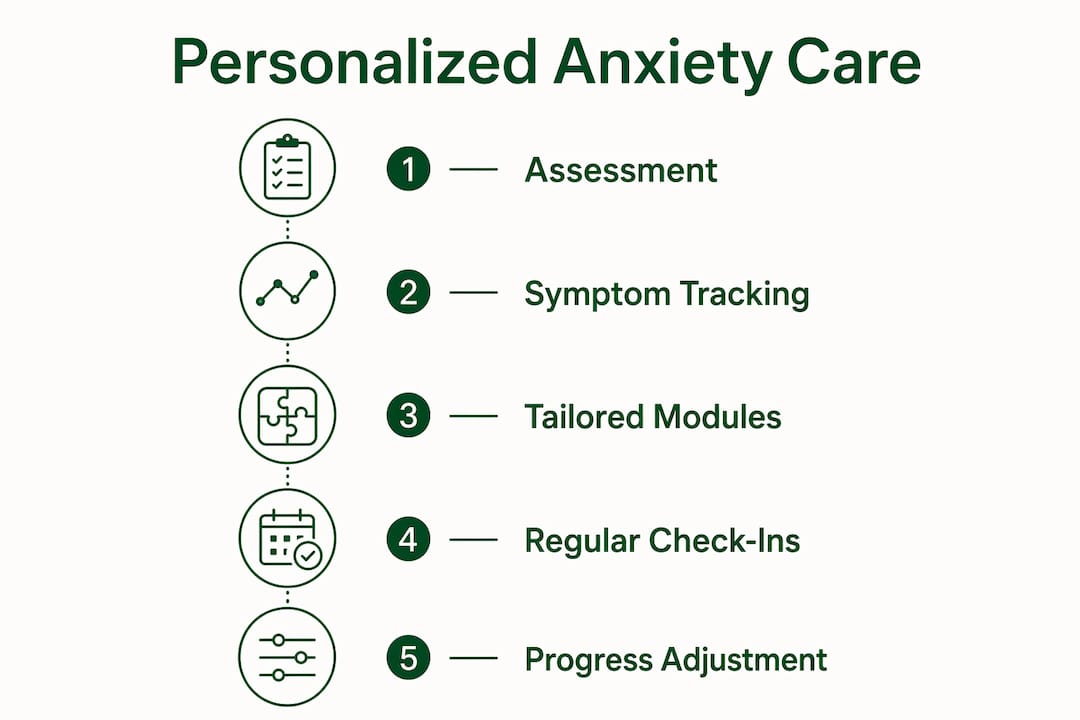
The core components of this approach include:
Standard anxiety treatment typically means one of two things: a fixed course of cognitive behavioral therapy (CBT) or a medication like an SSRI, chosen based on your diagnosis alone. Both are effective on average. The problem is that anxiety disorders are not average conditions.
Personalized care changes the logic entirely:
A study of modular CBT found that a personalized modular course using fewer sessions can achieve symptom improvement comparable to a longer standard course. That is not a minor efficiency gain. It cuts the time commitment in half while keeping outcomes intact, which matters enormously for people who cannot afford months of weekly appointments.
The clinical evidence is specific enough to be worth quoting directly. A trial of personalized modular treatment for mood and anxiety disorders showed large clinical effect sizes achieved with an average number of treatment sessions.
A broader meta-analysis of randomized controlled trials found a statistically significant advantage for personalized treatment over standardized treatment, which remained after adjusting for study bias.
Key clinical finding: Personalized psychological treatment produces statistically significant better outcomes than standardized care across a population of thousands of patients, with effect sizes that remain meaningful even under conservative analysis.
Beyond symptom scores, the practical benefits include:
Anxiety disorders are highly heterogeneous. Two people with generalized anxiety disorder (GAD) can present so differently that the same therapy works well for one and poorly for the other. This is why broad diagnostic categories alone are not enough to guide treatment.

The Personalized Advantage Index (PAI) is one of the most studied tools for solving this problem. It uses statistical modeling to identify which treatment a specific patient is most likely to benefit from, based on pre-treatment characteristics. Research shows that using the PAI more than doubles the explained variance in treatment outcomes compared to standard care assignment. That is a meaningful jump in predictive accuracy.
Clinicians also use idiographic analysis, which involves tracking an individual’s symptoms daily over time and modeling how those symptoms interact with each other. This creates a map of your personal anxiety network rather than a generic profile. Dynamic factor modeling then identifies which symptoms are driving others, so treatment targets the right entry points.
Pro Tip: Before your first appointment, keep a daily log of your anxiety symptoms, triggers, sleep quality, and mood for two weeks. This kind of pre-treatment data is exactly what clinicians use to build a personalized plan, and arriving with it already documented can accelerate the process significantly.
Treating anxiety as a checklist of symptoms to eliminate misses most of what makes someone anxious. Personalized care accounts for the full picture:
The goal is not just to reduce anxiety scores on a questionnaire. It is to build the kind of durable coping capacity that holds up when life gets difficult.
FitRx approaches personalized anxiety care through a digital platform that connects patients with licensed providers for online consultations, then builds individualized treatment plans combining medication and lifestyle support.
| Feature | What FitRx provides |
|---|---|
| Licensed provider consultations | Online appointments with credentialed clinicians who assess your specific anxiety profile |
| Personalized medication plans | Doctor-trusted medications selected for your symptom pattern, shipped directly to you |
| Holistic lifestyle guidance | Nutrition, activity, and sleep recommendations integrated into your care plan |
| Continuous digital support | Ongoing access through the app to track progress and adjust your plan |
| Mental health focus | Dedicated anxiety care pathway within a broader health optimization platform |
Patients using FitRx report reduced anxiety symptoms, better overall mental health, and higher satisfaction with care compared to their prior treatment experiences, reflecting the platform’s commitment to individualized support rather than generic protocols.
The process starts before the first therapy session. Clinicians gather a detailed picture through structured interviews, standardized questionnaires, and often daily symptom tracking over one to two weeks. They assess not just what symptoms you have, but how severe they are, what triggers them, how they interact, and what comorbid conditions might be shaping the picture.
From that data, a clinician identifies which treatment modules are most relevant, whether medication is indicated and which class fits your profile, and what intensity of care is appropriate. Someone with mild symptoms and strong coping resources might start with a digital intervention; someone with severe, treatment-resistant anxiety might need a more intensive multimodal approach. The clinical characterization framework developed for anxiety disorders maps out domains including symptom severity, comorbidities, biological factors, and patient preferences as the foundation for this kind of individualized planning.
The plan is then implemented in stages, with regular check-ins to measure progress and adjust course. Treatment is not considered finished when symptoms drop below a threshold. It continues until the patient has the skills and resilience to maintain gains independently.
Several validated instruments are commonly used to build a personalized anxiety profile:
The combination of standardized scales and individualized tracking is what separates a genuinely personalized plan from one that simply uses a different questionnaire at intake.
Personalized anxiety care is not universally available, and the barriers are real. Clinicians trained in modular, data-driven approaches are still a minority. The assessment process takes time and requires patient engagement before treatment even begins. Insurance coverage for longer or more intensive assessments is inconsistent across U.S. plans.
Digital platforms have expanded access considerably, but algorithm-based matching is only as good as the data it is trained on. The PAI and similar tools have strong evidence behind them, yet they are not yet standard practice in most outpatient settings. Cost remains a barrier for patients without adequate coverage, even when personalized programs are ultimately more efficient.
You do not have to wait for your provider to raise the topic. Specific questions open the door:
Telehealth platforms have made personalized care more accessible than it was five years ago. Many now offer intake assessments detailed enough to inform genuine treatment matching, connect you with licensed providers who specialize in anxiety, and deliver medication directly to your home when appropriate.
Most people dealing with anxiety have tried the generic route: a standard referral, a waiting list, a protocol that was not built for them. FitRx offers a different starting point.

Through FitRx’s digital mental health platform, you connect with licensed providers who assess your specific anxiety profile and build a treatment plan around it, not around a diagnosis code. Medication is prescribed based on your symptom pattern and shipped directly to you. Lifestyle guidance on sleep, nutrition, and activity is woven into the plan from day one. The app keeps your care active between appointments so adjustments happen in real time, not at your next quarterly check-in.
If you are ready to move from a one-size-fits-all approach to care that is actually built for you, start with FitRx and see what a personalized plan looks like for your situation.
Personalized anxiety care consistently outperforms standardized treatment in clinical trials, with the strongest gains coming from matching treatment modules and methods to each individual’s specific symptom profile and characteristics.
| Point | Details |
|---|---|
| Core definition | Personalized anxiety care systematically adapts treatment to individual needs, preferences, and traits to optimize outcomes. |
| Efficiency advantage | A personalized modular CBT course, typically consisting of around 6 sessions, can achieve symptom improvement comparable to a standard 12-session course. |
| Clinical effect sizes | Personalized modular treatment achieved Hedges g of 1.62 for anxiety with a large clinical effect in approximately 6–10 sessions, fewer than standard treatment. |
| Science behind matching | The Personalized Advantage Index more than doubles explained variance in treatment outcomes versus standard assignment. |
| FitRx approach | FitRx connects patients with licensed providers for personalized anxiety plans combining medication, lifestyle guidance, and continuous digital support. |


.svg)