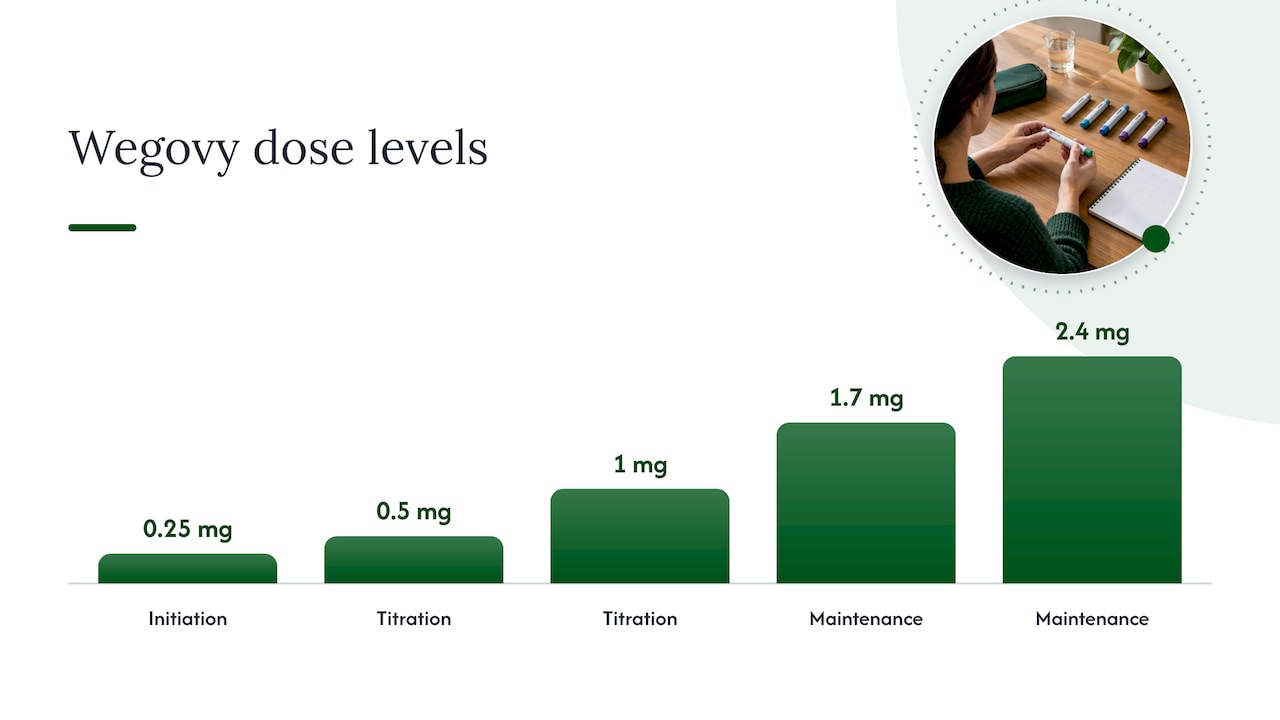
Wegovy starts at 0.25 mg injected once weekly for four weeks, then increases every four weeks through 0.5 mg, 1 mg, and 1.7 mg before reaching a maintenance dose of either 1.7 mg or 2.4 mg weekly, according to the official prescribing information. The lower strengths exist only to build tolerance and are never meant for long-term use. Always follow your prescriber’s specific instructions, since they may adjust timing based on how you respond.
TL;DR:
- Your prescriber can hold a dose step for four extra weeks if side effects persist, rather than increasing automatically on schedule.
- At maintenance, 2.4 mg is recommended for greatest weight reduction, while 1.7 mg is an approved alternative when the higher dose is poorly tolerated.
- Take a missed dose when your next injection is more than 48 hours away; otherwise, skip it and contact your provider after missing two consecutive doses.
- Inject once weekly into your abdomen, thigh, or upper arm, rotate sites, and allow at least two days between doses when changing injection days.
- Contact your provider immediately about severe or persistent vomiting, dehydration, or signs of dangerously low blood sugar.
The label lays out a fixed 16-week escalation path before you reach a maintenance dose. Each step holds for four weeks, giving your body time to adjust before the next increase, as described in the FDA prescribing information.
| Weeks | Dose | Status |
|---|---|---|
| 1 to 3 | 0.25 mg once weekly | Initiation (not for maintenance) |
| 4 to 7 | 0.5 mg once weekly | Titration |
| 8 to 11 | 1 mg once weekly | Titration |
| 12 to 15 | 1.7 mg once weekly | Titration or maintenance |
| 17 and beyond | 1.7 mg or 2.4 mg once weekly | Maintenance |
The 0.25 mg, 0.5 mg, and 1 mg doses are stepping stones only. They help your digestive system adjust to semaglutide before you reach a dose strong enough to support meaningful weight loss. Taking a maintenance-level dose without working through these steps raises the chance of severe nausea and vomiting, which is exactly what the gradual schedule is designed to prevent.
Once you reach week 17, your prescriber will typically keep you at 1.7 mg or move you to 2.4 mg, depending on how you’ve tolerated treatment and your weight-loss response. An updated version of the FDA label also notes that a clinician may consider a higher dose beyond 2.4 mg in specific circumstances, but only after a patient has tolerated 2.4 mg for at least four weeks and additional weight reduction is clinically indicated. This higher-dose option is not a standard step for most patients and is directed entirely by a prescriber.
Wegovy comes in prefilled single-dose pens matched to each strength on this schedule, so the pen itself changes as your dose increases. Your pharmacy will supply the pen that matches your current step, which removes any guesswork about measuring a dose yourself.
Wegovy is injected subcutaneously, meaning just under the skin, once a week for the entire course of treatment. You can use the abdomen, thigh, or upper arm, and rotating sites with each injection helps prevent irritation at any one spot.
A few timing rules make the weekly routine easier to manage:
Before your first self-injection, a provider should walk you through the pen mechanics: priming, needle insertion angle, and how to confirm the full dose has been delivered. The manufacturer’s Instructions for Use document that comes with each pen covers these steps in detail, and reviewing it alongside hands-on training reduces the odds of a partial or missed dose.
Pro Tip: Set a recurring weekly phone alarm for your injection day and log each dose in a notes app so you can track exactly where you are in the titration schedule.
Missing an occasional dose doesn’t require restarting treatment, but the right response depends on how close you are to your next scheduled injection. The FDA label spells out two scenarios:
As an example, if your regular injection day is Monday and you forget until Wednesday, that’s within the 48-hour window, so you’d take it right away. If you don’t remember until the following Sunday, you’re closer to your next Monday dose, so you’d skip the missed one and stay on schedule. The reasoning behind the two-dose rule is straightforward: your tolerance can drop after a longer gap, and resuming at a dose your body is no longer adjusted to raises the risk of significant nausea or vomiting.
The slow, four-week step pattern exists specifically to limit gastrointestinal side effects like nausea, vomiting, and diarrhea, which tend to be most noticeable right after a dose increase. Clinical review literature on GLP-1 receptor agonists points to this same pattern: slower titration generally improves how well patients tolerate semaglutide-based treatment.
A dose does not need to increase on schedule if your body needs more time. The label allows for several adjustments when a step isn’t tolerated:
Severe or persistent vomiting, signs of dehydration, or symptoms of dangerously low blood sugar are medical situations, not side effects to wait out. If you experience these, contact your provider immediately or call Poison Help at 1-800-222-1222 for guidance on next steps.
Not every patient ends up on the same maintenance dose, and that’s by design. Your prescriber weighs several factors before settling on a long-term dose:
The 2.4 mg dose is the one studied and recommended for the greatest degree of weight reduction, but 1.7 mg is a fully approved maintenance option for patients who don’t tolerate the higher strength well. Neither choice is a compromise. Both are sanctioned endpoints on the label, and your prescriber can move you between them based on how you respond over time.
In rare cases where a patient tolerates 2.4 mg well but hasn’t reached their weight-loss goal after a sustained period, a clinician may discuss a higher labeled dose under the conditions outlined in the 2026 label update. This path is clinician-directed and not something patients self-select.
Starting a 16-week titration schedule is easier with someone checking in at each step, which can support a weight loss program. Patients may begin with a virtual consultation with a licensed prescriber who reviews your health history and sets an initial dosing plan that matches the official escalation schedule.
From there, medication can be shipped directly to your home at each strength, so separate pharmacy visits as your dose changes may not be necessary. Between appointments, an app may let you log symptoms, ask questions, and flag anything that feels off, so adjustments like a delayed escalation or a dose reduction can happen quickly rather than waiting for your next scheduled visit. Over the first 16 weeks, that typically means an initial consult, a clear dosing calendar, and check-ins timed around each dose increase.
Before you start, a short conversation with your provider can prevent most problems down the line. Here’s what’s worth confirming upfront:
A log like this makes it much easier for your provider to tell whether a symptom is temporary adjustment or a sign that your dose needs to change.
— Bryan
Working through a 16-week titration schedule is more manageable with a licensed prescriber adjusting your plan as you go instead of guessing on your own. Our weight loss program pairs virtual evaluations with licensed providers, home delivery of each dose strength as you progress, and app-based support for tracking side effects and asking questions between visits.

If you’re considering Wegovy or already have a prescription and want more consistent follow-up, you can start with a virtual evaluation through our weight loss page to see how a supervised plan fits your schedule and health history.
This article is general information, not a substitute for advice from a qualified doctor. Consult a qualified healthcare professional about your own circumstances before acting on anything here.
Wegovy starts at 0.25 mg injected once weekly for the first four weeks. This dose is for initiation only and is not intended to produce significant weight loss on its own, according to the official label.
The full escalation schedule involves several steps before reaching a maintenance dose, each lasting multiple weeks, as described in the FDA prescribing information.
If your next dose is more than 48 hours away, take the missed dose as soon as you remember and continue your normal schedule. If it’s less than 48 hours away, skip the missed dose and resume on your next scheduled day; missing two or more doses in a row means you should contact your provider before injecting again.
Neither is universally better. The FDA label lists 2.4 mg as the dose studied for the greatest weight reduction, while 1.7 mg is an approved alternative for patients who don’t tolerate the higher strength.
Our weight loss program connects you with licensed prescribers for virtual evaluations, ships each dose strength to your home, and provides app-based support for tracking side effects throughout your titration.


.svg)
