Yes, but the details matter more than the headline. Medicare covers a wide range of telehealth visits through December 31, 2027, with standard Part B cost-sharing. Private insurance is a patchwork: many states require plans to cover virtual visits, but only some require insurers to pay the same rate they’d pay for an in-person visit. Before booking, call your insurer, confirm the provider is in-network, and ask what you’ll owe.
TL;DR:
- Medicare covers a wide range of telehealth visits at standard Part B cost-sharing until December 31, 2027, but the coverage is primarily limited to services that do not require physical examination or equipment.
- Only 43 states and D.C. have enacted coverage parity laws, but roughly half also require payment parity, meaning reimbursement rates can differ and affect provider availability.
- Out-of-network providers, services not covered by your plan, and coding errors can lead to unexpected bills during telehealth visits.
- Self-funded employer plans are governed by federal ERISA rules and are not bound by state telehealth parity laws, potentially limiting coverage and reimbursement.
- Confirm your telehealth benefits, network status, and billing procedures with your insurer before scheduling a visit to avoid surprises.
Original Medicare covers telehealth services delivered from nearly any location in the country, including a beneficiary’s own living room, through December 31, 2027. That date matters because it marks the current expiration of a pandemic-era flexibility that Congress and CMS have repeatedly extended rather than made permanent.
Coverage applies broadly to office visits, mental health counseling, and many follow-up appointments that would otherwise happen in person. A psychiatrist checking in on medication side effects, a primary care doctor reviewing lab results, or a follow-up after a minor procedure all typically qualify. What’s usually excluded: services that require hands-on examination or equipment a screen can’t replicate, like certain imaging or physical therapy assessments.
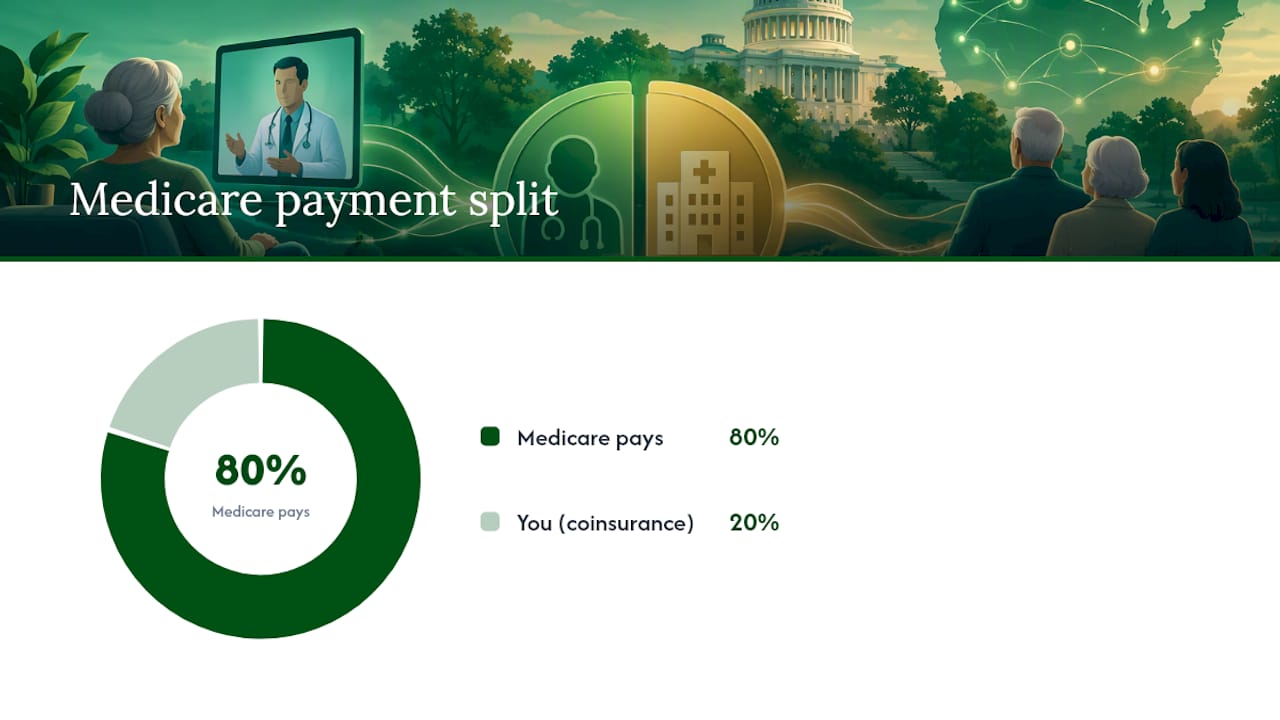
Billing works the same way it does for in-person Medicare visits. Here’s the sequence:
A quick reality check: that 20% coinsurance applies whether the visit happened over video or in an exam room. Telehealth doesn’t create a special discount tier under Original Medicare, and it doesn’t add a surcharge either.
One detail worth asking about directly: providers must use the correct billing codes and modifiers to flag a visit as telehealth. If your doctor’s office bills it incorrectly, you could see a denial or an unexpected charge. Ask upfront whether they bill Medicare directly for virtual visits and how often they do it. Practices that rarely bill telehealth are more prone to coding mistakes than ones that run video visits daily.
Private insurance coverage for telemedicine depends on two separate legal concepts that get confused constantly: coverage parity and payment parity. Coverage parity means an insurer has to cover a telehealth visit if it would cover the same service in person. Payment parity means the insurer has to reimburse that virtual visit at the same rate as an in-person one. A state can require one without the other, and most do.
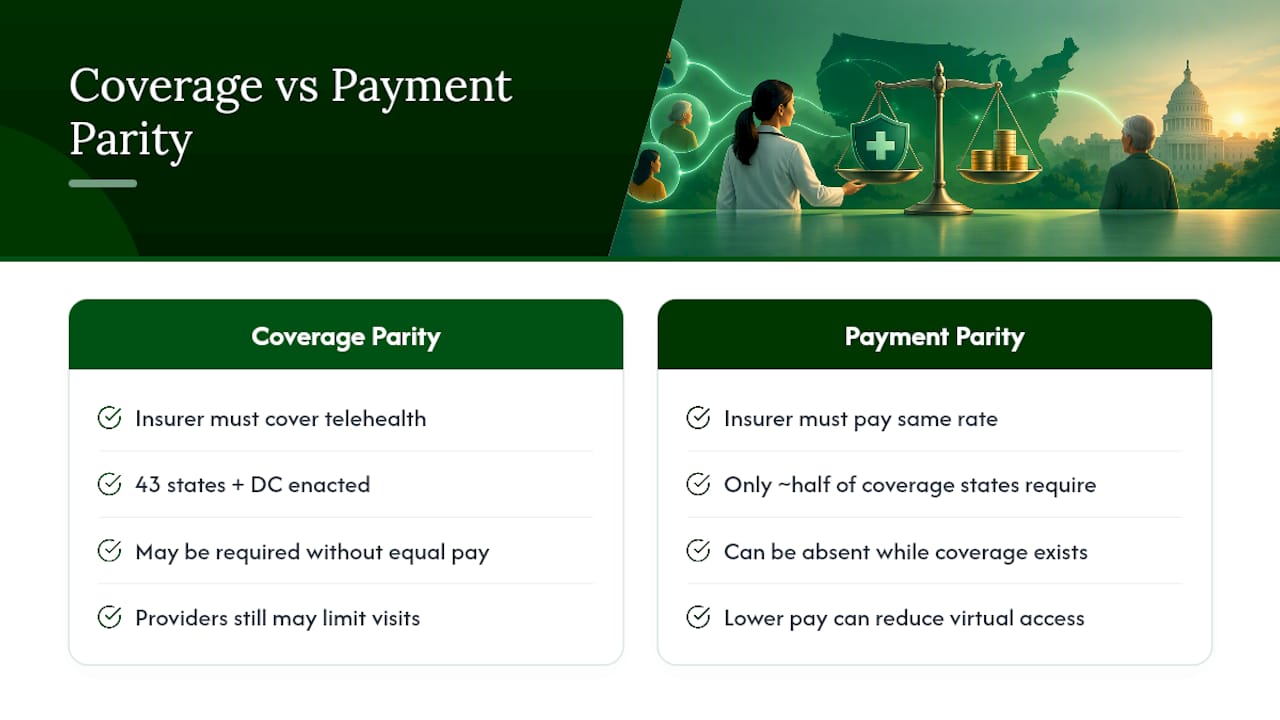
According to the National Conference of State Legislatures, 43 states plus the District of Columbia have enacted coverage parity laws. Only about half of those states go further and mandate payment parity. That gap is the source of most patient confusion: your plan might be legally required to cover a video visit with your therapist, yet the insurer can still reimburse the provider less than they’d get for an office visit.
That payment gap has a real downstream effect. When insurers pay telehealth claims at a lower rate, some providers limit how many virtual appointments they’ll take, or they decline specific insurance plans for video visits altogether. Patients get caught in the middle, sometimes billed the difference.
There’s another wrinkle that state law can’t touch. Roughly 65% of covered workers are enrolled in self-funded employer plans governed by federal ERISA rules rather than state insurance law. Those plans aren’t bound by state parity mandates at all, so your employer’s plan document, not your state’s statute, determines what’s covered.
Pro Tip: Ask your HR department or benefits administrator whether your plan is “self-funded” or “fully insured.” That one word changes which rulebook applies to your telehealth benefit.
Network rules still apply to virtual care exactly as they do to in-person visits. A telehealth appointment with an out-of-network doctor is billed as out-of-network, parity law or not.
Most telehealth bills follow a predictable order. You meet your deductible first, if you haven’t already for the year. Then you owe either a flat copay or a percentage coinsurance, depending on your plan design. Under Medicare, that’s the Part B deductible followed by 20% coinsurance. Under a private PPO, it might be a $25 copay with no deductible involved at all.
Several situations can push your costs higher than you expect:
Subscription or membership fees charged by some telehealth platforms sit outside all of this. Insurers generally don’t reimburse platform access fees, even when they cover the medical visit itself, because those fees aren’t classified as a medical service. That’s an out-of-pocket cost regardless of your coverage.
If a claim gets denied, don’t assume it’s final. Request the explanation of benefits, ask your provider’s billing office to confirm the codes submitted, and file a written appeal with your insurer if the denial looks like an error. Most plans give you 180 days to appeal, and state insurance departments can intervene when insurers mishandle telehealth claims covered under parity law.
The December 31, 2027 extension isn’t a permanent fix. It’s the latest in a string of regulatory waivers that CMS and Congress have renewed repeatedly rather than writing into permanent statute. That distinction matters for anyone relying on telehealth for ongoing care.
If lawmakers don’t act again before the deadline, several flexibilities could revert at once, a scenario often called the telehealth policy cliff:
Watch HHS’s telehealth policy updates page and the Federal Register for the physician fee schedule notices that actually implement these changes. Medicare Advantage plans and state Medicaid programs set their own telehealth rules independent of Original Medicare, so a national extension doesn’t automatically apply to every public program. If you rely on telehealth for chronic care management, plan conservatively and confirm your specific plan’s status each year rather than assuming the 2027 date covers you automatically.
Confirming coverage takes about ten minutes and saves you from a surprise bill later.
Pro Tip: Screenshot or print your insurer’s answer if you get it through a chat portal. A written record is far more useful in an appeal than “someone told me on the phone.”
If the insurer’s answer contradicts what you’re later billed, that documentation is your strongest tool for an appeal or a complaint to your state insurance department.
FitRx delivers personalized care through online consultations with licensed providers, then ships prescribed medications directly to patients. Every visit runs under a documented Consent to Telehealth process that lays out how virtual care, prescribing, and follow-up support work within FitRx’s platform. The approach pairs medical treatment with nutrition, activity, and sleep guidance rather than a one-off prescription. Insurance coverage still depends on your specific plan and state, so verifying benefits beforehand remains the patient’s responsibility.
The extension through 2027 makes telehealth easier to rely on, but easier access isn’t the same as guaranteed reimbursement. I’d push anyone managing an ongoing condition to build a simple one-page summary of their coverage: deductible met, coinsurance rate, network status, prior authorization rules. Check it against CMS or HHS updates once a year, not just when a bill surprises you.
— Bryan
Figuring out what your insurer will actually pay for a virtual visit shouldn’t take longer than the visit itself. Telehealth platforms often feature online consultations with licensed providers, personalized treatment plans based on labs and health profiles, and medications shipped directly to patients, supported by ongoing app-based care rather than isolated appointments.

FitRx works across weight loss, anxiety and depression care, primary care, birth control, and hair loss treatment, each handled through its own dedicated online visit and treatment plan. Every patient completes the same telehealth consent process before starting care, so you know exactly how your visit and prescriptions are documented. If insurance coordination is part of what you’re trying to sort out, reach out to FitRx support to talk through your plan before you book, or browse current plans and pricing directly on the FitRx homepage to see what fits your situation.
Policy details shift as CMS finalizes new rules each year, so bookmark the primary sources instead of relying on secondhand summaries:
This article is general information, not a substitute for advice from a qualified doctor. Consult a qualified healthcare professional about your own circumstances before acting on anything here.
Yes. Medicare covers a broad range of telehealth visits through December 31, 2027, and most private insurers cover telehealth too, since 43 states plus D.C. require coverage parity. Coverage still varies by plan, so confirming benefits before your visit is worth the phone call.
Yes, Medicare telehealth coverage extends through December 31, 2027 under the current federal extension. Beneficiaries pay the standard Part B deductible followed by 20% coinsurance, the same cost-sharing structure as in-person visits.
Telemedicine generally spans several categories: live video visits, phone consultations, remote patient monitoring, store-and-forward image review, e-consults between providers, behavioral health counseling, and asynchronous messaging follow-ups. Coverage and reimbursement rules can differ by category, so a plan covering live video visits won’t necessarily cover remote monitoring the same way.
Yes, Medicare’s at-home telehealth access is extended through December 31, 2027, though this extension works as a renewed regulatory waiver rather than permanent law. Congress or CMS could adjust the flexibilities before that date arrives, so it’s worth checking HHS updates periodically rather than assuming the rules are locked in.
Not necessarily. If your employer plan is self-funded, which covers roughly 65% of workers with employer coverage, it falls under federal ERISA rules instead of state parity laws. Ask your HR department whether your plan is self-funded or fully insured to know which rules actually apply to your telehealth benefit.


.svg)
