A licensed telehealth provider in any U.S. state can order the lab tests your visit calls for. After your appointment, you’ll get an electronic requisition and a choice of where to complete it: a retail lab location, a mobile phlebotomist who comes to you, or an at-home kit. Confirm your insurance and any prior authorization before you show up so the visit isn’t wasted.
TL;DR:
- Most insurance providers process telehealth-ordered labs similarly to in-person visits, but prior authorization may be required for certain tests, adding 50 to 150 dollars in out-of-pocket costs.
- In-lab networks like Labcorp and Quest offer the broadest test options and easier insurance acceptance, making them ideal for complex or insurance-heavy panels.
- Mobile phlebotomy provides convenient home or office specimen collection within days, but coverage varies and additional fees may apply unless covered by insurance.
- At-home kits suit specific tests like STI or hormone panels for self-pay, especially when usability outweighs the need for complex venous draws or tight handling.
- Results typically arrive within 24 to 72 hours after testing, with follow-up actions depending on provider review and ongoing treatment plans.
The process starts the moment your provider decides a test is medically necessary. They document the clinical reasoning, then submit the order electronically to a lab network rather than handing you a paper slip. This is standard practice across the industry: Labcorp’s own telemedicine workflow has physicians order tests online, patients schedule their own appointment, and results land in a patient app. Quest and other national networks follow a similar pattern.
Here’s what happens after your virtual visit ends:
One thing patients skip that slows everything down: upload recent lab results before your visit if you have them. It stops the provider from duplicating a test you already had, and it speeds up how fast they can act on your case.
You have three real options, and the right one depends on the test, your mobility, and how much you want to pay out of pocket.
Which one fits your situation comes down to what the test actually requires and what your plan will cover, as comparisons of collection methods make clear: in-lab draws suit complex or insurance-heavy panels, mobile phlebotomy suits patients who can’t easily travel, and at-home kits suit narrow, self-pay use cases.
Before you show up anywhere, bring a photo ID, your insurance card, and the order number. Follow any fasting or medication pause instructions exactly, and ask about the sample’s stability window if you’re shipping it yourself.
Pro Tip: Take a photo of your order confirmation screen before you leave the telehealth portal. If the lab’s front desk can’t pull up your requisition, you have a backup instead of starting the whole process over.
Most insurers process a lab ordered through telehealth similarly to one from an in-person visit, though coverage details still depend on your specific plan and state. The order itself doesn’t usually trigger different rules just because a virtual provider wrote it.
Prior authorization is the friction point that trips people up most often. If your plan flags a test for review, ask your provider to include a clear diagnosis code and a short medical necessity note when they submit the order. That documentation is what speeds up approval on the payer’s end.
A few things worth confirming before your appointment at the lab:
Skipping the in-network check is the single most common way people end up with a surprise bill for something that should have been fully covered.
Telehealth providers routinely order the panels that make up most of primary and preventive care. That includes a complete blood count, basic and comprehensive metabolic panels, a lipid panel, thyroid function tests, HbA1c for diabetes monitoring, common vitamin panels, and STI screens. MedlinePlus keeps plain-language descriptions of what each of these tests measures and how to prepare, which is worth a look before your appointment.
Some tests don’t fit neatly into remote ordering. Certain cultures, specialty serologies, and coagulation monitoring often need venous draws with tight processing windows or specific handling that a walk-in retail lab can’t guarantee. If your provider suspects something that needs a physical exam, imaging, or urgent evaluation, they’ll refer you to in-person care rather than trying to solve it with a lab order alone. Diabetes screening is a good example of a condition where CDC testing guidance spells out exactly when and how testing should happen, which telehealth providers lean on when deciding what to order.
Results follow a predictable path: the lab processes your sample, sends it to your provider’s portal, and then it becomes visible to you through a patient portal or email, typically within 24 to 72 hours for standard panels.
Pro Tip: If your results haven’t shown up by the expected window, call the lab first, not just your provider. Specimen issues and stuck prior authorizations both show up on the lab’s end before anyone else notices them.
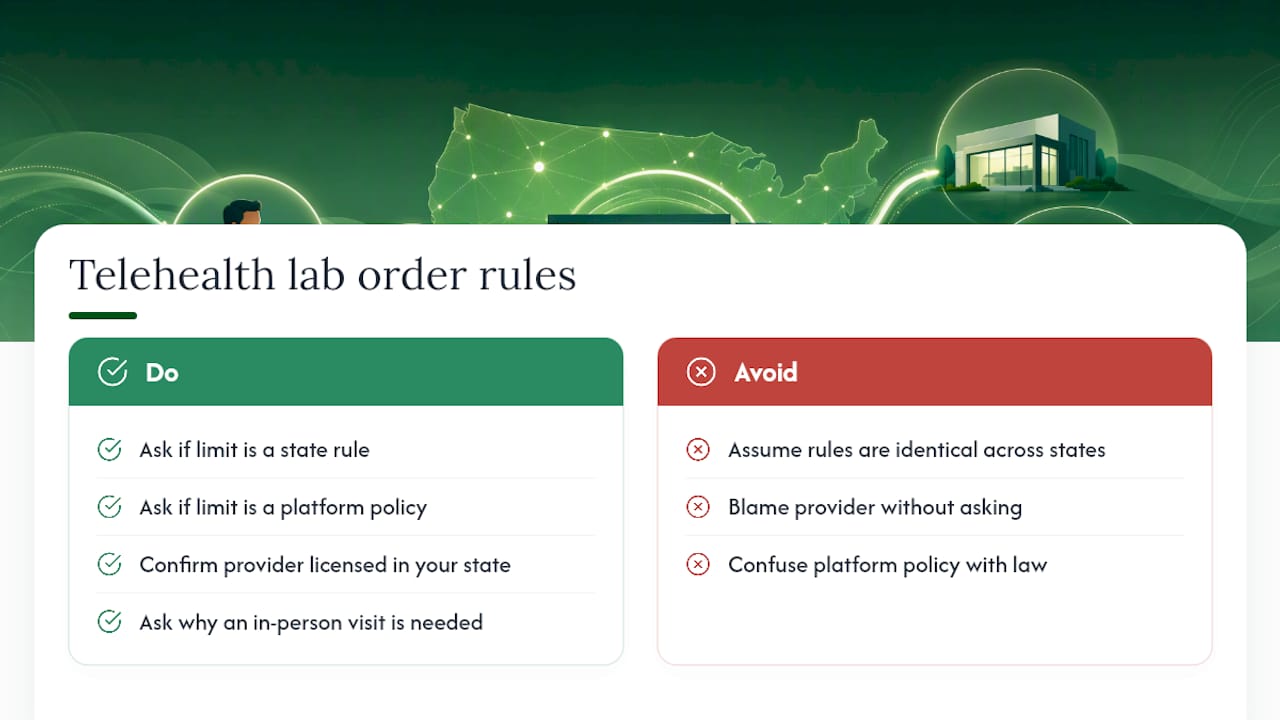
Yes, but the rules governing how a telehealth visit can lead to a lab order aren’t identical everywhere. States set their own standards for what counts as an adequate virtual exam before a provider can order testing, and licensing boards can differ on whether a provider needs to be licensed in the patient’s state, their own state, or both.
Most states now allow a fully virtual visit to justify routine lab work, provided the provider documents a legitimate clinical reason. Where things get more restrictive is with controlled substances and certain diagnostic pathways that some state medical boards still require an in-person component for, at least at some point in the care relationship. This isn’t universal, and it shifts as telehealth regulation evolves year to year.
The practical takeaway for patients: your telehealth provider is responsible for knowing their own state’s rules and their licensing requirements. If a provider tells you they can’t order a specific test or need an in-person visit first, that’s usually a compliance issue on their end, not an arbitrary hurdle. Ask directly if you’re unsure whether a limitation is a state rule or a platform policy, because the two get conflated more often than they should.
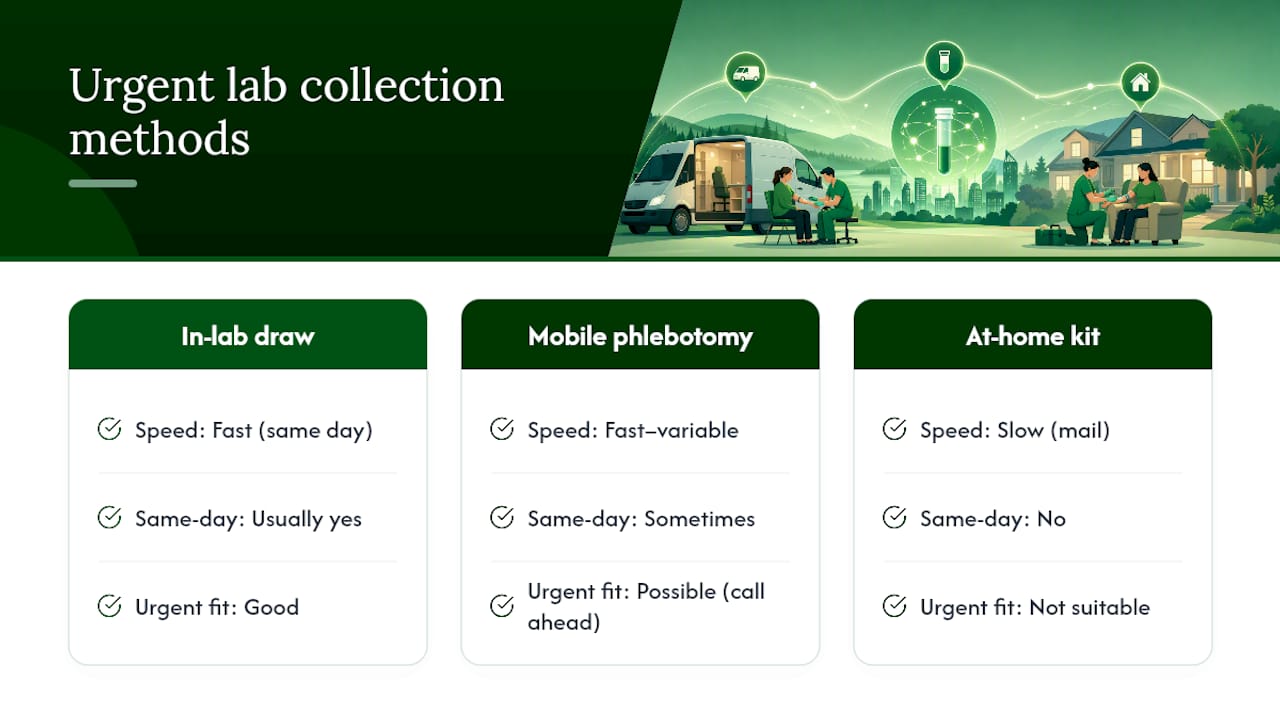
Telehealth can initiate an urgent order, but it can’t shortcut the physical reality of getting a sample collected and processed fast. If your provider flags something as stat, they’ll mark the requisition accordingly and point you toward the nearest lab location that can process it same day rather than routing you to a mail-in kit.
Speed depends entirely on the collection method you choose. In-lab draws at a retail location are almost always faster for urgent needs since results can be flagged for priority processing once they hit the lab’s system. Mobile phlebotomy can work for urgent cases too, but same-day slots aren’t guaranteed everywhere, so it’s worth calling ahead rather than assuming availability. At-home kits are the wrong choice for anything urgent. Mail time alone can eat up the window that makes a result clinically useful.
If your symptoms suggest something that can’t wait for standard turnaround, an emergency room or urgent care center is still the right call over any telehealth lab order, no matter how quickly the requisition gets submitted. Telehealth is built for coordinating care, not for replacing acute in-person evaluation when minutes matter.
Electronic lab requisitions move through HIPAA-covered systems, the same privacy framework that governs any health record in the U.S., whether it started online or in a doctor’s office. Your provider’s platform, the lab network, and the patient portal you use to view results are all required to meet the same security standards as a traditional in-person practice.
The weak point isn’t usually the transmission itself. It’s patient-side habits, like using a weak portal password or checking results over public Wi-Fi. Confirm your telehealth platform uses encrypted messaging for portal communications, and be cautious about any lab result or order number sent over plain email rather than a secure portal login.
One detail worth knowing: standing orders and recurring labs mean your data sits on file longer than a one-time test would. Ask your provider or lab network how long they retain order history and whether you can request it be updated or removed if you switch care providers. It’s a reasonable question, and any legitimate lab network should have a straightforward answer.
Costs break into three separate pieces, and conflating them is where most billing confusion starts: the telehealth visit itself, the lab test, and the collection method.
Your telehealth visit is billed the way any virtual consult is, through a co-pay, a subscription fee, or a per-visit charge depending on your provider’s model. The lab test is billed separately by whichever lab processes your sample, and that’s the charge your insurance evaluates for coverage. The collection method adds its own line item on top: in-lab draws are typically bundled into the lab’s standard fee, mobile phlebotomy tends to add $50 to $150 when it’s not covered, and at-home kits post a flat self-pay price upfront.
Ask for an itemized estimate before you commit to a collection method, especially mobile phlebotomy, since that’s where surprise fees show up most often. If a specific panel needs prior authorization, get that confirmed before scheduling collection rather than after. A denied authorization after the sample’s already drawn means you’re paying the full self-pay rate for a test your insurer might have covered with a bit more paperwork upfront.
Ordering a test is the easy part. What matters more is what happens with the number once it comes back, and that’s where a lot of telehealth experiences fall short. A one-off consult that orders a lab and never follows up on the result isn’t really coordinated care. It’s a transaction.
The providers worth sticking with are the ones who treat lab work as a checkpoint in an ongoing plan, not a box to check. Tracking a biomarker over months tells you whether a treatment is actually working in a way that a single snapshot never can, whether that’s a lipid panel after starting a new medication or thyroid labs during a dosage adjustment. Some telehealth providers build visits around the logic that providers order the labs a treatment plan calls for, review results against an ongoing plan, and adjust medications or next steps based on what the numbers actually show, not just what the initial visit assumed.
*— Bryan
FitRx exists for the reader who wants a telehealth visit and the follow-up work to happen in the same place, rather than juggling a separate lab network, a separate insurance call, and a separate provider portal on your own.

When a telehealth provider determines a lab test supports your treatment plan, whether that’s monitoring a medication, checking thyroid function, or tracking a metric tied to your care, they submit the electronic order and walk you through your collection options. Results route back through the provider’s app or portal, where your provider reviews them and adjusts your plan directly rather than sending you off to interpret a PDF alone. A new patient can expect the same visit, order, and follow-up loop to repeat for as long as the treatment plan calls for monitoring, without starting from scratch each time.
If you’re curious whether your situation calls for lab-supported monitoring, start with FitRx and get matched with a provider who can tell you exactly what testing your plan needs.
This article is general information, not a substitute for advice from a qualified doctor. Consult a qualified healthcare professional about your own circumstances before acting on anything here.
Yes. Licensed telehealth providers can order lab tests when the visit supports a clear clinical reason, and the order gets submitted electronically to a lab network for you to complete.
Telehealth policy, including Medicare telehealth flexibilities, has been extended repeatedly through short-term legislative action in recent years. Check Medicare’s telehealth coverage page for the current status, since these extensions are tied to ongoing congressional action rather than a permanent rule.
Major telehealth platforms, including large national providers, can order blood labs through partnerships with national lab networks like Labcorp or Quest, following the same electronic requisition process described throughout this guide.
Teladoc Health is generally recognized as one of the largest telehealth companies in the U.S. by patient volume, though the market includes many providers, including FitRx, each structured around different specialties and care models.
Standard panels typically return within 24 to 72 hours after your sample is collected, though turnaround depends on the specific test and the lab processing it.
Ask your provider to submit a clear diagnosis code and medical necessity documentation with the order, since that’s the detail that most often speeds up an insurer’s approval.


.svg)