Buspirone tends to work best for people with generalized anxiety disorder who want to avoid sexual side effects and dependence risk, while SSRIs cover more ground: depression, panic disorder, social anxiety, PTSD, and OCD, usually with a bigger drop in symptoms. Neither is a universal answer. The right pick depends on your specific diagnosis, what side effects you can tolerate, and what a licensed clinician sees in your history.
TL;DR:
- Buspirone is most suitable for generalized anxiety disorder patients seeking to avoid sexual side effects and dependency, but it has a narrower approval scope limited to GAD.
- SSRIs are generally more effective for a wider range of conditions like depression, panic disorder, and OCD, with symptom reduction typically larger than buspirone but with more side effect-related dropouts.
- While SSRIs often cause sexual dysfunction and withdrawal symptoms, buspirone has a lower risk of sexual side effects but can still cause dizziness, nausea, and rare sleepwalking.
- The onset of action for both buspirone and SSRIs typically requires 2 to 6 weeks of consistent use; buspirone cannot be used effectively as a quick-acting, as-needed medication.
- Treatment choices should be personalized based on diagnosis, side effect tolerance, and personal history, ideally under clinical supervision that considers lifestyle factors and potential drug interactions.
Buspirone and SSRIs treat anxiety through completely different biological routes, and that difference shows up in almost everything else: how fast they work, what they’re approved for, and what side effects you’ll actually deal with.
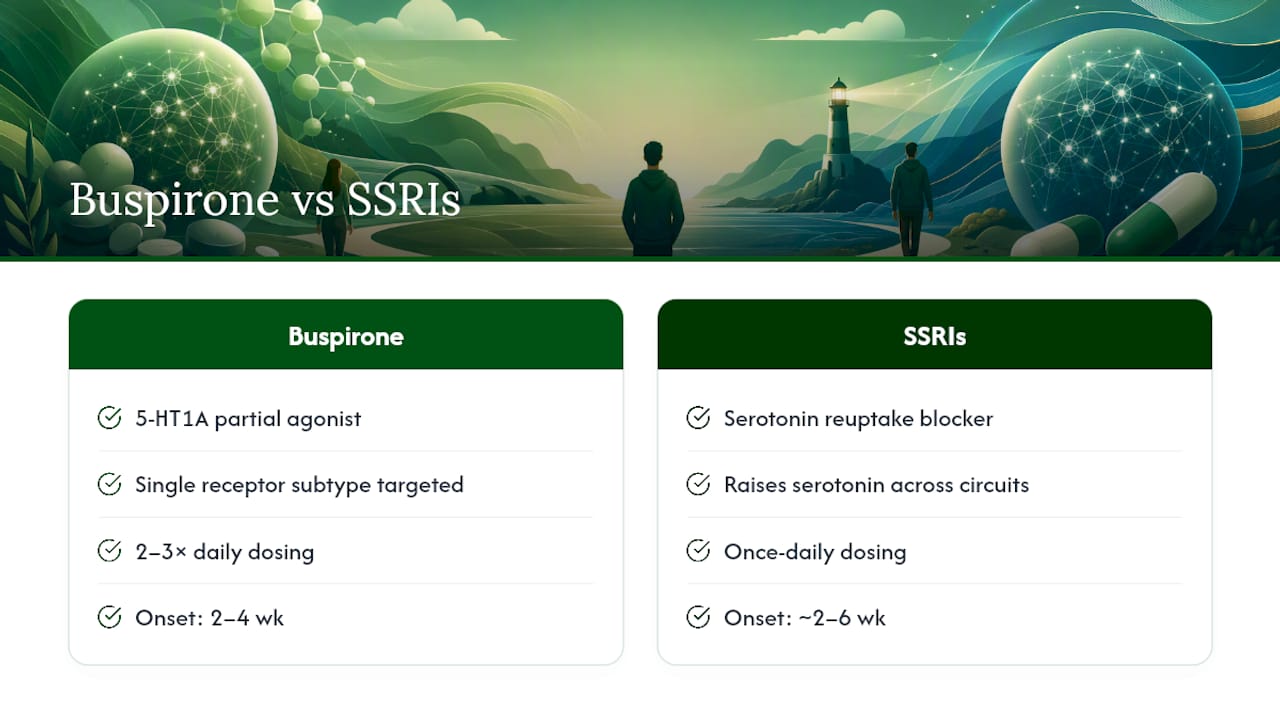
Buspirone acts as a partial agonist at the 5-HT1A serotonin receptor, a narrower and more targeted mechanism than SSRIs use. That specificity is likely why its FDA-labeled evidence centers almost entirely on generalized anxiety disorder rather than the wider net of conditions SSRIs treat. It doesn’t touch GABA pathways, which explains both its low dependence risk and why it can’t work as a fast-acting, as-needed medication the way a benzodiazepine can.
SSRIs work by blocking the reuptake of serotonin at the synapse, which raises serotonin availability across multiple circuits in the brain rather than a single receptor subtype. That broader action is exactly why SSRIs carry labeled indications spanning major depression, generalized anxiety disorder, panic disorder, social anxiety disorder, PTSD, and OCD, with specific approvals varying by drug.
The dosing schedules reflect the pharmacology. Buspirone’s shorter half-life pushes most prescribers toward two or three daily doses, while SSRIs’ longer half-lives support once-a-day dosing. On effect onset, buspirone needs 2 to 4 weeks of steady use before benefits show, and it’s explicitly not useful taken sporadically or on an as-needed basis. SSRIs run on a similar timeline, though full antidepressant effect sometimes takes closer to six weeks.
The honest answer is “it depends on what you’re measuring,” and the trial data backs that up. A Cochrane systematic review found antidepressants, including SSRIs, more effective than placebo for generalized anxiety disorder, with high-certainty evidence behind that conclusion. That same review also found antidepressants caused more adverse-effect withdrawals than placebo, meaning more people stopped treatment because side effects outweighed the benefit.
Buspirone’s evidence tells a narrower story. A separate Cochrane review of azapirones covering 36 trials found buspirone-class drugs superior to placebo in short-term trials for GAD. What the same review couldn’t establish clearly is whether buspirone actually outperforms antidepressants head-to-head. The comparative evidence there stays inconclusive, not because buspirone fails but because the trials weren’t designed or powered to settle that specific question.
Here’s the practical read: SSRIs generally produce larger symptom reductions in the data, but that comes bundled with a higher chance of quitting treatment over side effects. Buspirone’s edge isn’t raw efficacy. It’s tolerability for people with straightforward GAD who never got that far with an SSRI because the side effects got in the way first. Clinicians weighing this aren’t chasing a single “winner.” They’re judging a benefit-versus-burden trade-off using validated anxiety scales and dropout rates, not marketing claims or star ratings on a website.
This is usually where the real decision gets made, because most people don’t choose a medication based on a Cochrane review. They choose based on which side effects they’re willing to live with.
SSRIs are well known for causing sexual dysfunction, which shows up often enough that it’s one of the top reasons people ask to switch or stop. Add early nausea, diarrhea, and sometimes a jittery, activated feeling in the first couple of weeks, and you get a side-effect profile that’s manageable for many but a dealbreaker for others. Stopping an SSRI suddenly can also trigger discontinuation symptoms: dizziness, brain “zaps,” irritability, and flu-like sensations.
Buspirone carries a notably lower sexual side-effect burden than SSRIs, which is a major reason it gets considered as an alternative. Dizziness and nausea are common in the first days. Akathisia (an inner restlessness) and, rarely, sleepwalking have been reported. People with underlying cardiac conditions should also be screened for QT-related risk before starting.
Pro Tip: Keep a simple side-effect log for the first four weeks on any new medication. Note the day, the symptom, and severity. That timeline is often more useful to your prescriber than trying to remember “it started sometime last week.”
Talk to a licensed clinician before making any change, but knowing the usual decision logic helps you have a sharper conversation.
Buspirone is sometimes added on top of an SSRI when the SSRI alone isn’t fully controlling symptoms. This augmentation approach can help some patients, but it requires monitoring for added side effects rather than assuming more serotonin support automatically means better results.
Switching from one to the other needs a plan, not a cold stop. SSRIs generally require a taper to avoid discontinuation symptoms, and a clinician will often design an overlap period so you’re not left without coverage while the new medication takes hold. Before adding or switching anything, disclose every medication and supplement you take, including MAOIs, St. John’s wort, and migraine triptans, since combinations with serotonergic activity raise the risk of serotonin syndrome. Watch for agitation, rapid heartbeat, sweating, and muscle twitching as early warning signs, and separately for the dizziness, irritability, and flu-like symptoms that mark SSRI discontinuation syndrome.

The buspirone-versus-SSRI decision isn’t really about which drug wins on paper. It’s about matching pharmacology to a specific diagnosis and a specific person’s tolerance for side effects, which is exactly why FitRx builds its anxiety care around a real clinician assessment rather than a generic protocol. Medication selection works better paired with lifestyle monitoring: sleep, activity, and follow-up through the app to catch side effects early and adjust before a minor issue becomes a reason to quit treatment altogether.
— Bryan
FitRx cuts out the guesswork of picking between buspirone and an SSRI on your own by putting a licensed clinician in the loop from the start, with plans from $39 a month for anxiety and depression medication.

The process is simple: complete an online intake describing your symptoms and history, get evaluated by a licensed provider, and if a prescription is clinically appropriate, it ships to your door with ongoing app-based follow-up to track side effects and adjust the plan. No treatment gets prescribed without that live clinical assessment, because a diagnosis this personal deserves more than a generic form. If you’re ready to find out which option fits your situation, visit the FitRx anxiety and depression medication page to get started.
Verify the clinical claims here directly: Cochrane’s antidepressant review, Cochrane’s azapirone review, NCBI’s StatPearls entry on buspirone, and Mayo Clinic’s GAD guidance.
This article is general information, not a substitute for advice from a qualified doctor. Consult a qualified healthcare professional about your own circumstances before acting on anything here.
Neither is universally better. Lexapro (escitalopram) tends to produce larger symptom reductions and covers more diagnoses, while buspirone often wins on tolerability, particularly for people who want to avoid sexual side effects, and its evidence base is strongest specifically for generalized anxiety disorder.
Sertraline (an SSRI) has broader FDA-labeled coverage across depression, panic disorder, PTSD, and OCD, and trial data show antidepressants generally outperform placebo with high certainty. Buspirone is a reasonable alternative when anxiety is the primary issue and sexual side effects or dependence risk are major concerns.
Buspirone takes 2 to 4 weeks to build up to an effective level and doesn’t work as a fast, as-needed anxiety reliever. It also has a narrower approval, limited to generalized anxiety disorder, so it won’t address coexisting depression or panic disorder the way an SSRI can.
Many clinicians reach for SSRIs first because the comparative evidence versus antidepressants remains inconclusive, even though buspirone beats placebo. SSRIs also treat overlapping conditions like depression and panic disorder that frequently show up alongside GAD, giving them broader practical value in one prescription.
FitRx’s anxiety and depression medication program matches patients to appropriate treatment, including SSRIs, based on a licensed clinician’s evaluation of your specific diagnosis and history. Pricing starts from $39 a month, and any prescription decision follows a real consult rather than a generic questionnaire.


.svg)
