Yes, better sleep helps weight loss, and the effect is measurable, not theoretical. Short or inconsistent sleep raises hunger hormones, slows fat oxidation, and pushes people toward higher-calorie food choices, while controlled trials show restricted sleep can substantially reduce fat loss during dieting. The practical fix is straightforward even if it’s not easy: protect 7 to 9 hours a night on a consistent schedule, and treat that as seriously as your calorie target or your workout plan.
TL;DR:
- Short sleep, especially less than 7 hours per night, increases hunger hormones and promotes cravings for high-calorie, carbohydrate-rich foods.
- Sleep deprivation impairs fat oxidation and insulin sensitivity, leading to less effective fat burning and greater lean mass loss during dieting.
- Irregular sleep schedules and variability in sleep timing independently predict weight regain and higher body fat, regardless of total sleep duration.
- Improving sleep habits by targeting 7 to 9 hours, maintaining consistent wake times, and optimizing the sleep environment can significantly support weight loss efforts.
- Medical conditions like sleep apnea may require clinical diagnosis and treatment, as they can sabotage weight loss despite good habits and need to be addressed for meaningful progress.
Sleep is not downtime for your metabolism. It’s an active state where your body recalibrates the hormones that tell you when to eat, how much, and what you crave. Cut that process short, and the wiring misfires in a very specific direction: toward more food, particularly the kind you’re trying to avoid.
Two hormones do most of the work here: ghrelin and leptin. Ghrelin signals hunger, leptin signals fullness, and sleep loss pushes both in the wrong direction. Ghrelin rises, leptin falls, and the combination doesn’t just make you hungrier. It changes what you’re hungry for, tilting cravings toward energy-dense, high-carbohydrate foods rather than the roasted vegetables sitting in your fridge, according to research on sleep, circadian rhythms, and metabolism.
That same research points to a second effect that’s easy to underestimate: sleep deprivation heightens the brain’s reward response to junk food. Your prefrontal cortex, the part of your brain responsible for impulse control and weighing long-term consequences, gets less efficient when you’re tired. Meanwhile, the reward centers that light up at the sight of a burger or a doughnut get more responsive. You’re not just hungrier after a bad night’s sleep. You’re worse at saying no.
Sleep loss doesn’t just affect appetite. It changes what your body does with the calories you do or don’t eat. Short sleep is linked to reduced fat oxidation and lower insulin sensitivity, meaning your body becomes less efficient at burning fat for fuel and less responsive to the insulin that manages blood sugar. During active calorie restriction, this can cause your body to protect fat stores and sacrifice lean muscle instead. If your only feedback loop is a bathroom scale, this can look like progress even as your body composition moves in the wrong direction.
Quick stat: Experimental sleep restriction has been shown to increase daily calorie intake by about 308 kcal per day, enough to erase a meaningful chunk of most people’s deficit, while also driving increased abdominal fat accumulation over just two weeks.
The mechanisms above cover eating. But sleep loss also undercuts the other half of weight loss: activity. Poor sleep makes you more sedentary, both because you’re physically more fatigued and because motivation to exercise drops when your brain is running on empty. The combined effect creates a squeeze from both directions:
None of this means sleep replaces diet or exercise. It means sleep is the variable that determines how well your diet and exercise plan actually performs.
The evidence here isn’t a single study people cite out of context. It spans tightly controlled inpatient trials, real-world crossover diet studies, and large population data, and all three point the same direction.
In a randomized inpatient study, participants whose sleep was experimentally restricted ate roughly 308 more calories per day than when they were well-rested, and the excess wasn’t distributed evenly across meals. Much of it showed up as snacking on energy-dense foods, and over 14 days, the sleep-restricted participants also gained more visceral fat, the metabolically active fat around the abdomen linked most closely to cardiovascular and diabetes risk. That’s a controlled setting where food access, activity, and environment were tightly managed, which makes the calorie increase harder to dismiss as coincidence.
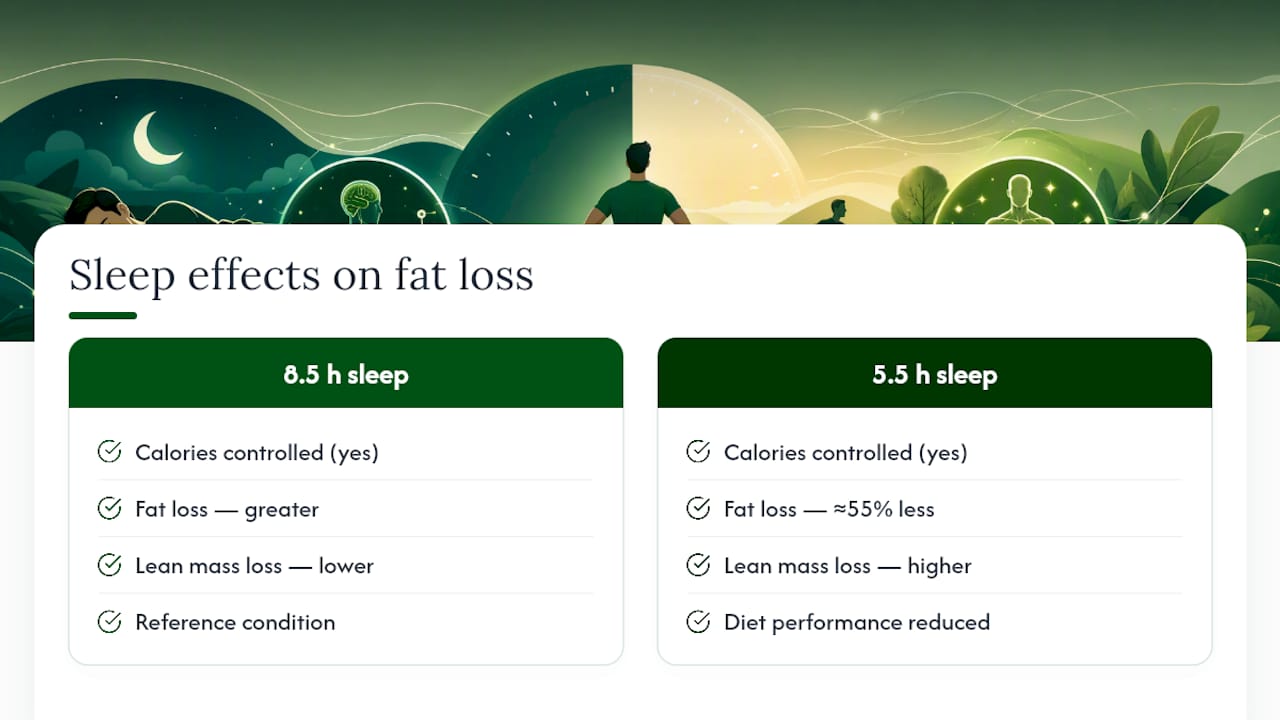
The more clinically relevant question for anyone actively losing weight is what happens to fat loss itself when sleep is cut during a diet. A crossover trial answered this directly: participants on an identical calorie-restricted diet lost about 55% less body fat when limited to 5.5 hours of sleep compared to 8.5 hours. The calories in and calories out were controlled. Sleep was the only variable that changed, and it cut fat-loss results roughly in half while shifting more of the weight lost toward lean muscle instead of fat.
A separate six-week study of milder, more realistic sleep restriction (about 80 minutes less per night) still found measurable consequences: participants gained close to a pound and became noticeably more sedentary, according to Columbia University Irving Medical Center’s research. That study matters because it wasn’t extreme sleep deprivation. It was the kind of shortfall most adults rack up during a busy work week, and even that modest amount moved the needle.
Zooming out from individual trials, cohort data consistently associates sleeping less than about seven hours a night with higher obesity risk, with pooled analyses showing meaningfully increased odds of obesity among short sleepers compared to those hitting recommended sleep ranges, according to a summary of the research on sleep and weight loss. Timing matters too, not just duration. The NoHoW trial found that high night-to-night variability in sleep onset, going to bed at wildly different times, predicted weight regain and higher body-fat percentage independent of how many total hours people slept.
Where the evidence is strongest: Controlled trials clearly show sleep restriction increases intake and impairs fat loss during dieting. Where it’s still uncertain: how much of the population-level obesity link is causal versus reflecting other factors like stress, shift work, or underlying health conditions that affect both sleep and weight independently.
Knowing the mechanism doesn’t fix the problem. You need a sequence of changes you can actually stick to, starting tonight and building over the next month.
Pro Tip: Track sleep and appetite side by side for two weeks before changing anything else about your diet. Most people are shocked to see how closely their worst cravings line up with their worst nights.
A sleep diary, even a basic notes app entry logging bedtime, wake time, and a 1 to 10 quality rating, gives you more useful data than most wearables in the first few weeks. It also makes patterns obvious: the Sunday-night bedtime slip that wrecks Monday’s food choices, the late workout that pushes bedtime back an hour. The Sleep Foundation’s guidance on weight loss and sleep backs up nearly every habit above as consistent with the trial literature, which is reassuring when you’re deciding what’s worth the effort and what’s just wellness noise.

Four metrics matter more than the rest: total sleep time, night-to-night timing variability, sleep efficiency (time actually asleep versus time in bed), and subjective quality, often measured with a tool like the Pittsburgh Sleep Quality Index (PSQI). Wearables are decent at total time and rough efficiency estimates but weak at true sleep-stage accuracy; a subjective questionnaire like the PSQI often captures how rested you actually feel better than a device does. If your wearable data and your felt experience keep disagreeing, trust how you feel and consider a clinical evaluation rather than the algorithm.
On the weight-loss side, track cravings intensity, hunger levels before meals, workout consistency, and body-composition trends rather than daily scale weight alone. A simple two-to-four-week experiment works well: extend sleep by 30 to 60 minutes, keep everything else constant, and log appetite, energy, and weight changes. Given that sleep-timing variability predicts weight regain independent of duration, log your bedtime consistency alongside hours slept, not just the hours themselves.
Some sleep problems won’t respond to better habits because they’re medical conditions, and obstructive sleep apnea is the one most likely to sabotage weight-loss efforts silently. Apnea repeatedly interrupts breathing during sleep, fragmenting rest even when total time in bed looks adequate, and it’s tightly linked to metabolic dysfunction, including insulin resistance and the same hormonal disruptions that drive weight gain.
Watch for these red flags:
Evaluation typically starts with a screening questionnaire, moves to a home sleep test if apnea is suspected, and proceeds to a referral to a sleep medicine specialist for anything more complex. Treatment for apnea, most often CPAP therapy, frequently removes a barrier that behavioral changes alone can’t touch, since fragmented sleep undermines the hormonal and metabolic pathways covered earlier no matter how disciplined you are with diet. The right approach combines medical treatment with the behavioral sleep changes and weight-loss plan you’re already building, not one instead of the other.
Sleep gets treated as an afterthought in most weight-loss conversations, and that’s a mistake I see play out constantly; new mothers especially benefit from following a New Mom Self-Care Checklist: Your Postpartum Guide to support sleep and recovery during this demanding period. Patients meticulously track macros and log every workout, then stay up until midnight scrolling and wonder why the scale won’t move.
In practice, integrating sleep into a weight-management visit doesn’t require a sleep lab. A few screening questions about snoring, timing consistency, and how rested someone feels catch most of the low-hanging fruit, and a short behavioral prescription (fixed wake time, a caffeine cutoff, a wind-down routine) often does more for someone’s plateau than another round of calorie-cutting. The patients who push through a plateau by fixing sleep instead of cutting calories further tend to keep the results longer, because they’re not fighting their own hormones the whole way.
That’s the model behind FitRx’s approach to medical weight management: sleep, nutrition, and activity assessed together, not sleep as an afterthought bolted onto a prescription. When a plan addresses all three, patients stop losing lean mass they wanted to keep and start losing the fat they came in for.
— Bryan
If you’ve tightened your sleep schedule and you’re still stuck, the missing piece might be clinical support rather than another habit change. FitRx builds sleep screening directly into its weight-management visits instead of treating it as a side note, so your plan accounts for how rested you actually are, not just your calorie target.

A telehealth platform can connect you with a licensed provider through a virtual consult, where sleep quality, activity, and nutrition all get folded into one personalized treatment plan. A plan that ignores sleep is working against itself before it starts.
This kind of integrated approach fits adults who want more than a generic meal plan. It suits people who’ve tried the willpower route and want a clinician actively adjusting their plan as sleep, weight, and medication response change over time. Getting started typically takes an online assessment and a virtual consult, after which a provider can determine whether a prescription weight-loss medication makes sense alongside sleep and nutrition adjustments, with ongoing follow-up through an app. If sleep problems and stalled weight loss have been running together for you, find out if a medically guided option could fit your situation.
This article is general information, not a substitute for advice from a qualified doctor. Consult a qualified healthcare professional about your own circumstances before acting on anything here.
Better sleep supports weight loss by lowering ghrelin, raising leptin sensitivity, and improving fat oxidation, but it works alongside diet and exercise rather than replacing them.
Most adults need 7 to 9 hours nightly; sleeping less than 7 hours is consistently linked to higher obesity risk in cohort research.
Yes. Short sleep alone reduces fat oxidation and can shift calorie burning toward storing fat and losing lean muscle, even when intake stays the same.
Timing consistency matters independently of total sleep hours. Research from the NoHoW trial links irregular sleep schedules to weight regain even among people getting adequate total sleep.
Seek evaluation if you have loud snoring, witnessed breathing pauses, severe daytime sleepiness, or chronic insomnia, since conditions like sleep apnea can block weight-loss progress until treated. A program like FitRx’s medical weight management can help coordinate that evaluation alongside your weight-loss plan.


.svg)