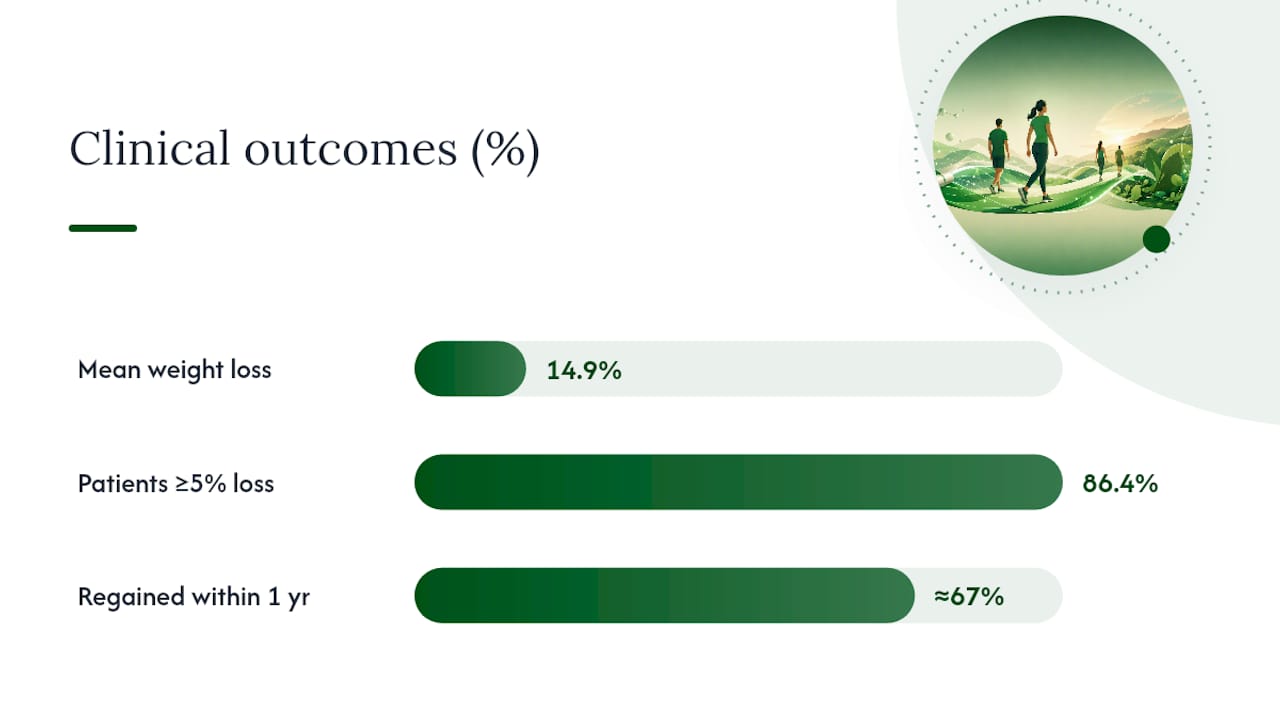
Semaglutide is an FDA-approved GLP-1 receptor agonist that produces clinically meaningful weight loss when combined with diet and exercise. At the 2.4 mg weekly subcutaneous dose (Wegovy), adults in the STEP 1 trial lost a mean of 14.9% of body weight at 68 weeks compared to 2.4% with placebo, and 86.4% of participants on semaglutide lost at least 5% of their baseline weight. Those are not modest numbers.
The medication is indicated for adults with a BMI of 30 or higher, or 27 or higher with at least one weight-related condition such as hypertension, type 2 diabetes, or dyslipidemia. It works best as part of a structured plan that includes nutrition support and regular follow-up, not as a standalone fix.
A few things to know before reading further:
| Point | Details |
|---|---|
| Clinical efficacy | Mean 14.9% weight loss at 68 weeks in STEP 1; 86.4% of patients lost at least 5% of body weight. |
| Dose escalation matters | The 16-week escalation to 2.4 mg weekly reduces GI side effects and improves long-term adherence. |
| Stopping leads to regain | Trial extension data show roughly two-thirds of lost weight returns within a year of stopping semaglutide. |
| Cost and access | Wegovy’s retail list price exceeds $1,300/month; manufacturer assistance and telehealth prior-auth support can reduce costs. |
| FitRx telehealth pathway | FitRx provides licensed clinician evaluation, individualized treatment plans, and home prescription delivery for eligible patients. |
Semaglutide mimics glucagon-like peptide-1 (GLP-1), a hormone your gut releases after eating. By binding to GLP-1 receptors in the brain, particularly in the hypothalamus and brainstem, it suppresses appetite and increases the feeling of fullness after smaller meals. At the same time, it slows gastric emptying, so food moves through your stomach more gradually, extending satiety.

The result is a significant reduction in calorie intake without requiring constant willpower. Semaglutide essentially lowers the “set point” at which your brain registers hunger, which is why patients often describe eating far less without feeling deprived.
Beyond weight, trials have documented improvements in waist circumference, fasting glucose, blood pressure, and lipid profiles. The SELECT trial extended this picture further, showing a 20% reduction in major adverse cardiovascular events in people with preexisting cardiovascular disease who took semaglutide over roughly four years.
The same mechanism that drives weight loss also explains the most common side effects. Slowed gastric emptying causes nausea and early satiety; the GI tract adjusts over weeks, which is exactly why dose escalation exists. Rushing to a higher dose before your body adapts is one of the most common reasons patients discontinue early.
Key mechanisms at a glance:
Three branded semaglutide products are on the U.S. market, and their FDA approvals are distinct. Mixing them up leads to real confusion about dosing, coverage, and clinical intent.
Wegovy (semaglutide 2.4 mg weekly injection) This is the only semaglutide formulation FDA-approved for chronic weight management. It is indicated for adults with a BMI of 30+, or 27+ with a weight-related comorbidity, used alongside a reduced-calorie diet and increased physical activity. Wegovy reaches a 2.4 mg weekly maintenance dose after a 16-week escalation schedule.
Ozempic (semaglutide 0.5 mg, 1 mg, or 2 mg weekly injection) Ozempic is FDA-approved for type 2 diabetes management and cardiovascular risk reduction in adults with T2D and established CVD. It is not approved for weight management, but clinicians sometimes prescribe it off-label for weight loss because it uses the same molecule at lower doses. Insurance coverage for off-label use is often denied, and the dosing ceiling is lower than Wegovy’s.
Rybelsus (semaglutide 3 mg, 7 mg, or 14 mg daily oral tablet) Rybelsus is approved for type 2 diabetes only. Clinical evidence shows weight loss as a secondary effect, but it carries no FDA weight-management indication. Oral bioavailability is lower than injectable formulations, and it must be taken on an empty stomach with a small amount of water, then followed by a 30-minute fast before eating or taking other medications.
Who qualifies for Wegovy specifically:
The escalation protocol exists for one reason: it dramatically reduces GI side effects and keeps patients on therapy long enough to see results. Skipping steps is the most common clinical mistake.
If GI side effects are significant at any step, your clinician may extend that dose level by four additional weeks before moving up. Tolerability matters more than speed.
Pro Tip: Set a weekly phone alarm for the same day and time each week. Consistency in timing reduces the chance of missed doses and helps you track any side effects that cluster around injection day.
The STEP trials are the primary evidence base for semaglutide weight loss at the 2.4 mg dose. STEP 1, published in the New England Journal of Medicine, enrolled 1,961 adults without diabetes and produced the headline numbers most clinicians cite.
Source: NEJM STEP 1 trial
Those responder rates are worth pausing on. For someone starting at 220 pounds, that is 33 pounds. For context, a 5–15% weight reduction produces measurable improvements in blood pressure, blood sugar, joint load, and sleep apnea severity.
The STEP 1 trial found that 86.4% of adults taking semaglutide 2.4 mg weekly lost at least 5% of their body weight at 68 weeks, compared with 31.5% on placebo. The NIH clinical review of the STEP program confirms these responder rates are consistent across the STEP trial series.
The SELECT trial followed adults with preexisting cardiovascular disease and obesity (no diabetes) for up to four years. The semaglutide group maintained a mean weight loss of 10.2% at 208 weeks, compared to 1.5% for placebo. That sustained loss over four years is clinically significant because most weight-loss interventions show substantial regain by year two.
A Cochrane systematic review covering 18 trials and 27,949 participants confirmed that semaglutide consistently outperforms placebo for weight loss over 6–24 months. The review also noted that unwanted events are more common with semaglutide and that evidence on long-term quality of life and hard clinical outcomes remains limited. That is an honest read of the data: the weight loss signal is strong; the full long-term safety picture is still accumulating.
GI symptoms are the most frequent adverse effects, and they are most intense during dose escalation. According to the Cleveland Clinic drug monograph, the primary adverse events are:
Most of these are mild to moderate and tend to subside as the body adjusts. Eating smaller meals, avoiding high-fat or spicy foods around injection day, and staying well hydrated all help.
Semaglutide carries FDA warnings for medullary thyroid carcinoma (MTC) and multiple endocrine neoplasia type 2 (MEN2). Rodent studies showed thyroid C-cell tumors at high doses; the relevance to humans is not established, but the contraindication stands. Patients should report any neck lump, hoarseness, or difficulty swallowing immediately. Additional serious risks include acute pancreatitis, gallbladder disease (cholelithiasis and cholecystitis), and acute kidney injury from dehydration secondary to severe vomiting or diarrhea.
Monitoring for these risks means:
Do not use semaglutide if you have:
Drug interactions to discuss with your clinician:
Pro Tip: Keep a simple symptom log during the first 16 weeks, noting nausea severity on a 1–10 scale after each injection. Sharing this log at follow-up appointments gives your clinician concrete data for deciding whether to extend a dose step or adjust the escalation pace.
Weight change begins earlier than most patients expect. Many people notice reduced appetite within the first one to two weeks, though measurable scale movement usually appears by week 4. Progress continues through roughly weeks 60–65 in trials before plateauing at maintenance dose.
A realistic progression looks like this:
Factors that influence response include baseline weight, adherence to lifestyle changes, dose tolerability, and metabolic history. Pairing semaglutide with structured nutrition support and physical activity consistently improves outcomes, as the STEP trials themselves required lifestyle intervention in both arms.
Pro Tip: Set a 12-week checkpoint with your clinician rather than tracking the scale daily. Short-term fluctuations are noise; the 12-week trend is the signal.
This is the part many patients are not told clearly enough. STEP extension data show that participants regained roughly two-thirds of their initial weight loss in the year after stopping semaglutide. The SELECT trial confirms that sustained weight loss requires sustained treatment.
This does not mean you are locked in forever, but it does mean stopping without a plan, including continued nutrition support and behavioral strategies, typically leads to significant regain. Treat it the way you would a chronic condition: stopping the medication without an alternative management strategy is not a neutral act.
Wegovy’s retail list price without insurance runs over $1,300 per month, making cost one of the biggest real-world barriers to access. Insurance coverage is inconsistent and often requires prior authorization, a documented BMI threshold, and evidence of failed prior weight-loss attempts.
Common coverage realities:
Ways to reduce cost:
Safe procurement:
Pro Tip: Before your first appointment, pull your most recent labs (fasting glucose, lipid panel, A1C if available) and check your insurance’s formulary for “anti-obesity medications.” Knowing your coverage status in advance saves time and prevents surprises at the pharmacy.
Semaglutide is most effective when it is one component of a structured plan, not the whole plan. The STEP trials required lifestyle intervention in every arm, and the gap between semaglutide plus lifestyle versus semaglutide alone is meaningful. Pairing medication with GLP-1 coaching and behavioral support consistently produces better adherence and outcomes.
Telehealth delivery covers most of this workflow effectively. A licensed clinician conducts the initial consultation via video, orders baseline labs through a standing lab order at a local draw site, reviews results, and issues a prescription shipped directly to your home. App-based check-ins handle ongoing symptom monitoring and dose escalation decisions between visits.
This model works well for patients who are otherwise healthy, have no complex comorbidities, and can reliably report symptoms through an app. It is not appropriate for everyone.
When in-person or specialist care is needed:
Pro Tip: Ask your telehealth clinician at the first visit: “What is the plan if I need to pause the dose escalation?” Having a clear protocol in advance prevents confusion if GI side effects become significant at week 8 or 12.
What gets less attention is the implication of the stopping data.
The two-thirds regain figure after discontinuation is not a failure of the medication. It is evidence that obesity functions like a chronic condition with a biological set point that semaglutide suppresses while you are on it. When the drug stops, the underlying physiology reasserts itself. That is not a reason to avoid semaglutide. It is a reason to enter treatment with a long-term plan rather than a 6-month mindset.
The patients who do best are the ones who treat the first year as a foundation-building phase: establishing new eating patterns, building activity habits, and working with a clinician on a maintenance strategy before they ever consider stopping. The medication makes the behavioral work easier by removing the constant hunger signal. The behavioral work is what makes the results stick if and when the medication is eventually tapered.
There is also a real conversation to have about cardiovascular benefit. For patients with obesity and established heart disease, that is a meaningful clinical argument for semaglutide beyond the number on the scale.
Getting semaglutide safely means starting with a real medical evaluation, not a form that auto-approves everyone. FitRx offers licensed clinician consultations via telehealth, individualized treatment plans, and prescription fulfillment shipped directly to your home, with ongoing app-based check-ins built into the process.

The intake process covers medical history, contraindication screening, and baseline lab coordination so your clinician has the information needed to prescribe appropriately and titrate safely. If semaglutide is right for you, your prescription ships to your door. If it is not, you get a clear explanation and alternatives to consider.
Find out if weight loss injections could be right for you and schedule your evaluation with a FitRx clinician today.
The key claims in this article are supported by the following primary sources:
This article is general information, not a substitute for advice from a qualified doctor. Consult a qualified healthcare professional about your own circumstances before acting on anything here.
Timeline varies by starting weight and individual response, but most patients reach meaningful weight loss by weeks 12–20 on the escalation schedule.
The most disruptive side effects are GI-related: nausea, vomiting, diarrhea, and constipation, which are most intense during dose escalation. Rare but serious risks include acute pancreatitis, gallbladder disease, and a black-box warning for medullary thyroid carcinoma based on rodent data; report severe abdominal pain, neck lumps, or persistent vomiting to your clinician immediately.
Yes, weight regain is common after stopping. STEP extension data show participants regained roughly two-thirds of their initial weight loss within a year of discontinuation, which is why clinicians frame semaglutide as a long-term treatment rather than a short course.
The fastest weight loss generally occurs after reaching the 1.7–2.4 mg maintenance range, which most patients hit around week 13–17. For a faster breakdown of early timelines, see how fast semaglutide works.


.svg)