Most prescriptions can be refilled online through one of three routes: your retail pharmacy’s portal or app, a mail-order pharmacy service, or a telehealth visit that ends with an e-prescription sent directly to your chosen pharmacy. For routine, stable medications, the pharmacy portal is usually the fastest path. Mail-order makes sense when you want a 90-day supply and lower per-dose costs. Telehealth is the right call when your medication needs a clinical check-in before the next refill, or when you’ve switched providers.
Two things to confirm before you start: the prescriber overseeing your refill must be licensed in your state, and your prescription should reach the pharmacy as a secure electronic order, not a verbal or paper relay.
Your quickest next step: log into your pharmacy’s app or portal and check if your medication is eligible for an online refill request. If it needs a clinical review first, book a telehealth visit.
Managing prescription refills online is most effective when you match the route to your medication type, clinical situation, and insurance coverage.
| Point | Details |
|---|---|
| Three main routes | Pharmacy portal, mail-order, and telehealth e-prescription each suit different needs. |
| Portal is fastest | Retail apps like CVS, Walgreens, Walmart, and Kroger process refill requests 24/7. |
| Mail-order saves money | 90-day mail-order fills often carry lower co-pays; allow 5–10 business days for delivery. |
| Controlled substances have limits | Federal and state rules often require an in-person visit before telehealth prescribing. |
| FitRx for clinical refills | FitRx provides licensed provider review, e-prescription delivery, and app-based ongoing support. |
There are three distinct mechanics, and they’re not interchangeable.
Retail pharmacy portals and apps are the most direct route. CVS, Walgreens, Kroger, and Walmart Pharmacy all offer 24/7 refill requests through their websites or mobile apps. You can check order status, transfer prescriptions from another pharmacy, and enroll in automatic refill programs without ever calling anyone. Walgreens, for example, lets patients request a refill by Rx number via Guest Express Refill without even creating an account. Kroger’s My Prescriptions portal adds online payment on top of refill requests and auto-refill enrollment.
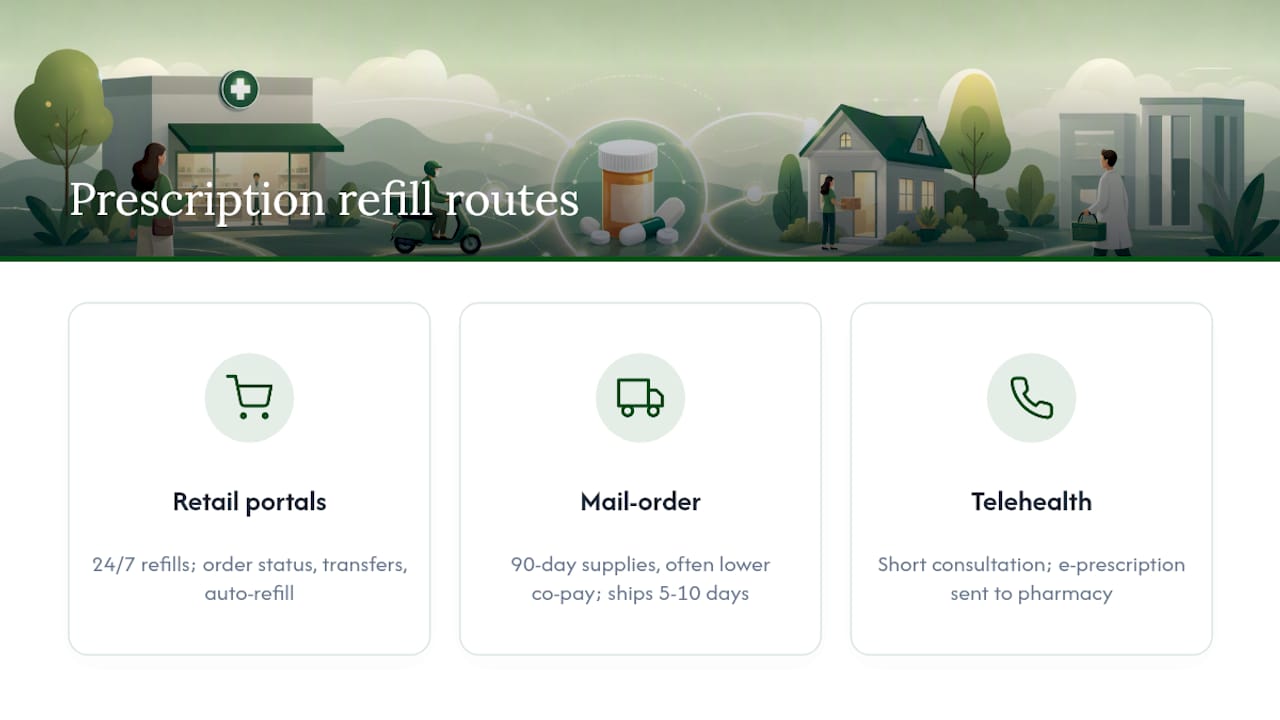
Mail-order pharmacy services work on a longer cycle. Most insurance plans cover 90-day supplies through mail-order, often at a lower co-pay than a 30-day retail fill. You submit your prescription and insurance information once, and the pharmacy ships to your door. Turnaround typically runs 5–10 business days, so this route rewards planning ahead.
Telehealth e-prescriptions involve a short virtual consultation with a licensed clinician. After the evaluation, the provider issues an electronic prescription that goes directly to your pharmacy for pickup or delivery. The telehealth refill workflow follows a structured sequence: patient request, clinical review, approval or denial, and secure e-prescribing to the selected pharmacy. One firm limit: controlled substances generally cannot be prescribed via telehealth without at least one prior in-person evaluation.
A note on identity verification: some government health portals have tightened security. VA My HealtheVet, for instance, now requires Login.gov or ID.me verification to access online prescription tools. Private pharmacy portals typically use standard account login, but expect identity checks to get stricter across the board.
Pro Tip: Before your first online refill request, locate your Rx number on the prescription label or your pharmacy receipt. Every portal route starts with it.
What to have on hand if the pharmacy asks: your insurance card, a photo ID, and the label from your previous prescription bottle. These resolve most verification hold-ups in minutes.
Telehealth works well for stable, ongoing conditions and maintenance medications, but it is not a substitute for in-person assessment when escalation or diagnostics are needed. Knowing the limits protects you.
| Situation | What’s required |
|---|---|
| New or worsening symptoms | In-person visit for physical exam and diagnosis |
| Medication requires lab monitoring | In-person labs before refill approval |
| Controlled substance (Schedule II–V) | Often requires prior in-person evaluation per federal/state rules |
| Procedure-related medications | Prescribing clinician must manage directly |
| Government portal access (e.g., VA) | Login.gov or ID.me identity verification required |
Controlled substances frequently require at least one in-person evaluation before telehealth prescribing, and ongoing refills may still be restricted with documented monitoring required. State rules vary significantly, so check your state’s telehealth prescribing laws if you’re unsure.
If a telehealth provider flags a concern during your refill visit, they’ll refer you to in-person care. That’s not a failure of the system; it’s the system working correctly.
Pro Tip: When booking a telehealth refill, mention upfront if your condition has changed. Providers can convert a refill visit into a more thorough evaluation without rescheduling, saving you time.
For prescription safety concerns related to controlled substances, resources on prescription drug safety can help you understand the risks and warning signs.
Auto-refill programs remove the mental load of tracking refill dates. Once enrolled, the pharmacy automatically processes your refill when it’s due and notifies you for pickup or ships it to you.
To enroll, log into your pharmacy account, navigate to your prescription list, and look for an “auto-refill” or “automatic refill” toggle next to each medication. Set your notification preference (text, email, or app alert) so you know when a fill is processing.
One risk worth knowing: if you stop a medication, cancel the auto-refill immediately. Pharmacies will keep filling and billing until you opt out, and unused fills can complicate insurance coverage for future prescriptions.
Pro Tip: Review your auto-refill list every time your provider changes a dose or discontinues a medication. A five-second toggle prevents a wasted fill and an awkward insurance conversation.
Cost and timing depend heavily on which route you use and what your insurance covers.
Prior authorization can delay any route. If your insurer requires it for a specific medication, the pharmacy or telehealth provider will flag it, and you may need to wait 1–3 business days for approval before the fill proceeds.
| Route | How to refill | Cost/insurance | Delivery vs. pickup | Auto-refill | Provider visit required? |
|---|---|---|---|---|---|
| Retail portal/app | App or website, 24/7 | Standard co-pay | Both options | Yes | No (existing Rx) |
| Mail-order | Portal or phone | Often lower 90-day co-pay | Delivery only | Yes | No (existing Rx) |
| Telehealth | Virtual consult | Consult fee + co-pay | Both options | Depends on pharmacy | Yes |
If a fill is delayed, contact pharmacy support directly through the app’s chat or call line. For telehealth delays, message your provider through the platform’s secure messaging tool.
Start with these questions:
Suggested decision path: check your pharmacy portal first. If the medication is eligible and your clinical situation is stable, request the refill there. If you want a 90-day supply and your plan supports it, switch to mail-order. If your condition needs a provider review, book a telehealth visit.
Red flags to avoid: any service that skips identity verification, doesn’t name a licensed prescriber, or asks for payment outside a secure platform. Legitimate prescription refill services always have clear clinician oversight.
Pro Tip: Before a telehealth refill visit, write down the exact name and dose of every medication you take, including over-the-counter supplements. Providers flag interactions faster when the list is complete.
FitRx is built for exactly the situation where a portal refill isn’t enough: when your medication needs a licensed provider’s eyes on it before the next fill.

Through FitRx, you schedule a virtual consultation with a licensed clinician who reviews your current treatment, checks for side effects or adherence issues, and determines whether your prescription is still the right fit. If the refill is approved, an e-prescription goes directly to your chosen pharmacy. FitRx covers a broad range of conditions, including weight loss, anxiety and depression, erectile dysfunction, birth control, hair loss, skincare, and primary care, so ongoing prescription management stays within one platform rather than scattered across multiple providers.
The FitRx primary care platform also integrates nutrition, activity, and sleep guidance alongside medication management, which matters for conditions where lifestyle factors affect how well a medication works.
To get started: book a telehealth consultation through FitRx, prepare your current medication list, and have your preferred pharmacy’s name ready. The provider handles the rest.
FitRx combines licensed clinician oversight with direct e-prescription delivery, so your refill is both medically reviewed and pharmacy-ready in one visit.
Telehealth is a tool for treatment stability, not escalation. Providers use refill visits to check whether a medication is still working, whether side effects have emerged, and whether any labs are overdue. Approving a refill is part of ongoing care, not a rubber stamp.
During a typical refill review, a provider will ask about adherence (are you taking the medication as prescribed?), side effects, and any changes in your health since the last visit. For some medications, they’ll want to see recent lab values before approving.
Two things that consistently speed up approvals: being honest about missed doses or side effects, and having your records ready. Providers can work with imperfect adherence; they can’t work with incomplete information.
For patients managing mental health medications, secure telehealth options that prioritize privacy and identity verification are worth seeking out specifically.
Retail portals handle the easy cases. When your medication needs a real clinical review, or when you want a single platform that manages prescriptions, delivery, and ongoing support together, FitRx is the stronger option.

FitRx connects you with a licensed provider for a virtual refill visit, sends the e-prescription directly to your pharmacy, and keeps your care continuous between appointments through the app. Whether you’re managing weight loss medications, anxiety treatment, birth control, or hair loss, the clinical workflow is the same: a real provider reviews your case before anything is prescribed. Start your telehealth visit at FitRx and have your medication list ready.
Yes, telehealth providers can refill most non-controlled prescriptions after a virtual clinical review. Controlled substances typically require at least one prior in-person evaluation before telehealth prescribing is permitted.
Log into your pharmacy’s app or website, enter your Rx number, and submit a refill request. CVS, Walgreens, Walmart Pharmacy, and Kroger all support this 24/7 for eligible, existing prescriptions.
Most mail-order pharmacies deliver within 5–10 business days for a first fill. Subsequent automatic refills are often faster once your profile and insurance are established.
You need your Rx number (from the prescription label), your insurance information, and a verified pharmacy account or guest access. For telehealth refills, also prepare your current medication list and any recent lab results.
Yes. After a licensed FitRx provider approves your refill during a virtual visit, an e-prescription is sent securely to your chosen pharmacy for pickup or delivery.


.svg)