Most people who take sildenafil, tadalafil, or a similar PDE5 inhibitor get off easy: a headache, some facial flushing, maybe an upset stomach that clears up within a few hours. But four symptoms change the calculus entirely. An erection lasting more than four hours, sudden vision loss, sudden hearing loss, or chest pain and fainting are not “side effects to monitor.” They’re reasons to stop the medication and get emergency care immediately. Everything else on the list is manageable, and usually not a reason to panic.
TL;DR:
- Serious adverse events like sudden vision loss, hearing loss, priapism, or chest pain require immediate emergency care and are far less common than mild side effects.
- Higher doses of PDE5 inhibitors increase the likelihood of side effects such as headache, flushing, and muscle aches, making low starting doses and gradual titration advisable.
- Combining PDE5 inhibitors with nitrates, recreational nitrites, or certain heart medications is extremely dangerous and can cause life-threatening blood pressure drops.
- People with recent heart attacks, uncontrolled blood pressure, or eye conditions like NAION should avoid PDE5 inhibitors or seek specialist guidance before use.
- Most side effects are temporary and manageable, but documenting dose timing and other medications helps healthcare providers respond quickly to any serious reactions.
Headache is the single most reported reaction to PDE5 inhibitors, and it isn’t close. A 2023 analysis of the World Health Organization’s pharmacovigilance database, drawn from nearly 32,000 case reports spanning almost four decades, found headache accounted for 10.4% of reported adverse reactions, with abnormal vision, flushing, and dyspepsia also among the most reported adverse reactions.
Those numbers come from spontaneous reporting data, not a controlled trial, so they skew toward whatever patients bothered to report. Still, they line up with what shows up consistently in prescribing information for both sildenafil and tadalafil.
The side effects you’re most likely to notice:
Statistic Callout: In the VigiBase analysis of 31,827 case reports covering four PDE5 inhibitors, headache, abnormal vision, flushing, and dyspepsia together made up nearly a third of all reported adverse reactions between 1983 and 2021.
Onset and duration depend on the drug. Sildenafil peaks in the bloodstream around 30 to 120 minutes after a dose and clears within about four to five hours, so side effects tend to arrive and resolve on a similar timeline. Tadalafil sticks around much longer, with a half-life of roughly 17.5 hours, which is why people on tadalafil sometimes report side effects that linger into the next day, especially back pain and muscle aches.
Dose matters more than most people assume. Higher doses of any PDE5 inhibitor produce more side effects, not just stronger effects. That’s the basic logic behind starting low and adjusting upward under medical supervision rather than jumping straight to the maximum approved dose.
A few practical adjustments make a real difference in how tolerable these medications feel day to day. Taking the dose without a high-fat meal helps sildenafil absorb more predictably. Cutting back on alcohol reduces the combined blood-pressure-lowering effect that makes flushing and lightheadedness worse. And if headache or flushing is disruptive at a given dose, that’s a legitimate reason to ask your prescriber about a lower dose rather than just pushing through it or quitting the medication altogether.
The vast majority of people never experience these. But because the consequences can be permanent, every PDE5 inhibitor label warns about them explicitly, and MedlinePlus lists priapism, sudden severe vision loss, and sudden hearing loss among the side effects requiring immediate medical attention.
Vision changes. Mild, temporary visual disturbances are actually fairly common with PDE5 inhibitors. A blue tinge to vision, increased light sensitivity, or blurring happens because these drugs don’t just block PDE5. They cross-react with PDE6, an enzyme active in the retina. A narrative review of ophthalmologic side effects found most visual effects are transient, resolving on their own as the drug clears the system.
Separate from that, and far more concerning, is non-arteritic anterior ischemic optic neuropathy, or NAION. This is sudden, usually painless vision loss in one eye caused by reduced blood flow to the optic nerve. Case reports have linked NAION to PDE5 inhibitor use, but the same review notes real uncertainty about causation, since NAION also occurs on its own in people with diabetes, high blood pressure, and cardiovascular disease. The overlap between the risk factors for NAION and the risk factors for erectile dysfunction makes it genuinely hard to untangle cause from coincidence. That uncertainty doesn’t change the guidance: sudden vision loss in one or both eyes means stop the medication and get evaluated the same day.
Hearing changes. Sudden hearing loss or ringing in the ears is rarer than the vision-related effects but carries the same urgency. MedlinePlus flags sudden decrease or loss of hearing as a reason to stop tadalafil and seek care right away, and the same guidance applies to sildenafil and other PDE5 inhibitors. Some cases resolve after stopping the drug; some don’t. Waiting to see if it passes is the wrong move.
Priapism. This is a prolonged, often painful erection unrelated to sexual stimulation that doesn’t resolve on its own. Clinically, anything lasting more than four hours is a urologic emergency, not something to wait out at home. Left untreated, the trapped blood can starve penile tissue of oxygen, and permanent damage, including erectile dysfunction, becomes a real risk within hours. Men with sickle cell disease, blood disorders that affect clotting, or certain anatomical conditions carry a higher baseline risk and should discuss this specifically before starting any PDE5 inhibitor.
Cardiac events. Reports of heart attack, irregular heartbeat, and stroke exist in the pharmacovigilance record, but the pattern that emerges is telling: these events cluster heavily among men who already had underlying cardiovascular disease, not healthy men who happened to take the medication. That’s exactly why cardiovascular screening before starting treatment matters so much, a point covered in detail further down.
Pro Tip: Keep a simple note on your phone with the time you took your dose and any symptom that felt “off.” If something serious happens, that timestamp helps an emergency provider connect the dots fast, and it’s one less thing you have to remember under stress.
Pharmacovigilance data adds one more layer worth understanding: statistical signal detection flagged both priapism and a small, disproportionate signal for melanoma in sildenafil and tadalafil reports. The absolute risk remains very low in both cases, and researchers are careful to note that a reporting signal shows association, not proof of cause.

One drug interaction in this category is genuinely life-threatening, and it’s the reason every PDE5 inhibitor label carries a black-box-level warning. Here’s what you need to know about mixing these medications with others.
Certain health conditions raise the stakes enough that a PDE5 inhibitor either shouldn’t be prescribed at all or needs careful specialist input first. This isn’t a list to self-diagnose against. It’s the kind of history a prescriber needs to hear directly from you before writing anything.
A responsible prescriber’s screening process looks less like a form and more like a conversation: a full medication list (including anything taken occasionally, like nitroglycerin for chest pain), a cardiovascular history, and, when red flags come up, a referral for cardiology or ophthalmology clearance before treatment starts.
Age and comorbidities shift the risk calculation, too. Drug information for tadalafil specifically flags that serious side effects tend to cluster in patients over 50 or those managing heart disease, diabetes, or high blood pressure, which is exactly the population where thorough screening earns its keep rather than being a bureaucratic hurdle.
Most of what you’ll experience falls into the “annoying but not dangerous” category, and there’s a clear, sensible way to handle both the minor stuff and the rare emergencies.
Pro Tip: Before you call your prescriber or walk into an ER, write down three things: the exact time you took the dose, the dose amount, and every other medication or supplement you’ve taken in the past 48 hours, including anything recreational. That single note can cut minutes off a diagnosis when minutes matter.
Documentation matters more than people realize. A clinician evaluating a sudden symptom needs to know the timeline, not just the symptom. When did you take the dose? How much? Have you taken anything else, including alcohol or another medication, in the hours before? That context often determines whether a symptom gets treated as a drug reaction, a coincidental medical event, or something else entirely.
Clinical trial data and pharmacovigilance data measure two different things, and mixing them up leads to bad conclusions. Trials track side effects among a defined group of participants over a set period. Pharmacovigilance databases like VigiBase collect voluntary reports from anyone, anywhere, over decades, which means they’re better at catching rare, serious events but worse at telling you a precise incidence rate.
That’s exactly the pattern in the WHO data: headache, abnormal vision, flushing, and dyspepsia dominate the top of the list, together making up close to a third of all reports among 31,827 cases filed between 1983 and 2021. Rare events like priapism and the melanoma signal show up too, but at far lower frequencies, and the analysis itself is careful to note that a statistical signal flags an association worth watching, not a proven cause.
Statistic Callout: Headache alone accounted for 10.4% of all adverse reaction reports across four decades of global PDE5 inhibitor use, more than twice as often as flushing.
Side effects scale with dose. That’s not a minor footnote, it’s the reason responsible prescribing starts low and adjusts up rather than defaulting to the strongest available option.
Most of the serious risks covered above share a common thread: they’re far more likely in people with unscreened cardiovascular disease, undisclosed medications, or conditions nobody asked about. That’s the gap a real medical review is supposed to close.
A thorough intake before prescribing a PDE5 inhibitor should include a full medication reconciliation (catching nitrate use before it becomes an emergency), a cardiovascular risk assessment, and, where relevant, lab-informed context about hormone levels or metabolic health that shapes the whole treatment picture. Personalized telehealth workflows that combine medication review, lab data, and scheduled follow-up have been shown to reduce inappropriate prescribing and catch adverse reactions earlier than a one-time prescription with no check-in.
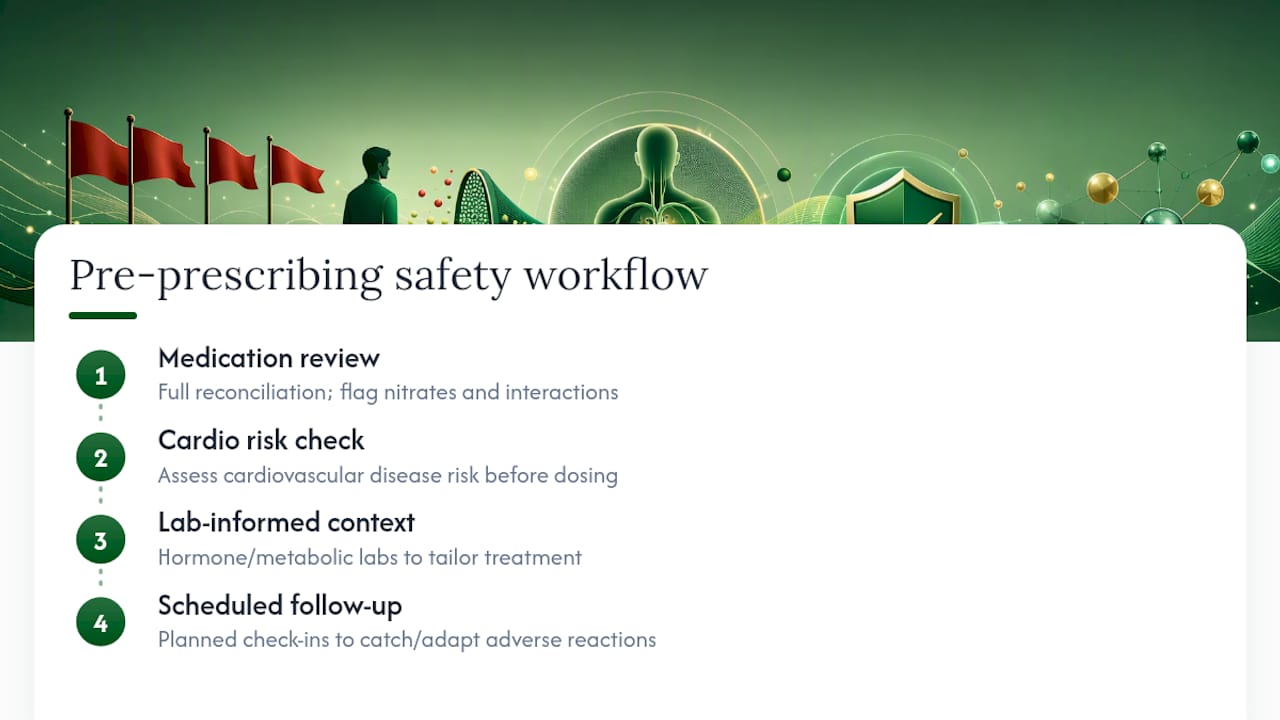
FitRx builds its ED care around that model: a licensed provider reviews your full health picture before prescribing, discusses how to take tadalafil safely alongside anything else you’re on, and stays reachable through the app if something feels off after you start. That follow-up loop, not just the prescription itself, is what actually catches a dose that needs adjusting before it becomes a bigger problem.
Most people taking a PDE5 inhibitor will deal with, at worst, a headache or some flushing that fades in a few hours. That’s the honest baseline, and it’s worth saying plainly instead of burying it under every rare complication on the label. The mild stuff is common. The dangerous stuff is not.
But “rare” isn’t the same as “impossible,” and the four red flags, priapism, sudden vision loss, sudden hearing loss, and chest pain or fainting, deserve to be memorized, not just skimmed once. Bring your full medication list to every conversation with a prescriber, including anything you might not think to mention, like an occasional nitroglycerin tablet or a recreational substance. If something serious happens, report it. That’s not bureaucratic box-checking. It’s literally how the data that keeps these medications safer for the next person gets built.
— Bryan
This article is general information, not a substitute for advice from a qualified doctor. Consult a qualified healthcare professional about your own circumstances before acting on anything here.
Most people experience mild, temporary effects like headache, flushing, and stomach upset. Rare but serious risks include priapism, sudden vision or hearing loss, and severe blood-pressure drops, particularly when combined with nitrates.
People with unstable angina, recent heart attack or stroke, severe heart failure, uncontrolled blood pressure, a history of NAION, or sickle cell disease generally should not take PDE5 inhibitors without specialist clearance. Anyone using nitrate medications should avoid them entirely.
No. Caffeine does not inhibit the PDE5 enzyme the way sildenafil or tadalafil do, so it has no direct pharmacological effect on erectile function through that mechanism. Caffeine’s stimulant effects are unrelated to how PDE5 inhibitors work.
Yes. Sildenafil is not habit-forming and doesn’t require a tapering schedule, so you can stop between doses or discontinue treatment at any time without withdrawal effects. If you’re stopping because of side effects, mention it to your prescriber so they can rule out an interaction or adjust the dose instead.
Serious events like priapism, sudden vision loss, and sudden hearing loss are rare compared to common effects like headache, which alone accounted for 10.4% of reported reactions in a large pharmacovigilance analysis. Most serious reports involved people with pre-existing cardiovascular risk factors.


.svg)
