Short answer: most people who take low-dose oral minoxidil for hair loss see real improvement or, at minimum, a stop in further shedding. A 2025 meta-analysis pooling data from 2,933 patients found 35% had significant regrowth, 47% had moderate improvement, and 26% held stable, meaning roughly 82% either gained ground or stopped losing it. The catch is timing and patience: the earliest visible changes tend to show up around 3 months, with the biggest gains landing between 6 and 12 months.
None of that makes oral minoxidil risk-free. It started life as a blood pressure drug, and taking it for hair loss (an off-label use) still means dealing with its effects on your cardiovascular system. That’s why any responsible treatment plan starts with a screening conversation, not a prescription pad.
Here’s the framework worth knowing before you start:
Response rate: Most patients see significant or moderate improvement, or stable counts, per the pooled data.
Timeline: First signs around 3 months, peak effect typically 6 to 12 months.
Adverse events: Roughly 27% of patients report some side effect, most commonly unwanted hair growth elsewhere on the body.
Safety step: Baseline blood pressure check and a cardiac history review before starting, plus follow-up monitoring.
The numbers that matter most: In the largest pooled analysis to date, 35% of patients had significant hair regrowth, 47% had moderate improvement, and only 26% remained unchanged, with an overall adverse-event rate of 27%.
The rest of this piece breaks down where those numbers come from, what a realistic month-by-month timeline looks like, how doses are chosen, and what screening actually involves before you or a provider decides oral minoxidil is worth trying.
| Point | Details |
|---|---|
| Response rate is high | About 82% of patients see significant improvement, moderate improvement, or stable hair counts within a year. |
| Shedding is normal, not failure | Increased shedding in weeks 2 through 8 usually signals follicles cycling into active growth, not treatment failure. |
| Peak results take patience | Most significant gains appear between months 6 and 12, with the vertex often responding faster than the frontal hairline. |
| Screening isn’t optional | Baseline blood pressure and cardiac history checks matter because minoxidil is a systemic vasodilator with rare but serious risks. |
| FitRx offers a screened pathway | FitRx’s telehealth program pairs licensed provider screening with personalized dosing, home delivery, and app-based follow-up. |
This article is general information, not a substitute for advice from a qualified doctor. Consult a qualified healthcare professional about your own circumstances before acting on anything here.
The best data we have on oral minoxidil results comes from two places: a large pooled meta-analysis and a head-to-head randomized trial against topical minoxidil. Neither is perfect, but together they give a clearer picture than any single study or forum thread.
The 2025 meta-analysis is the biggest data set available on this drug used specifically for hair loss. Flip that around and only a minority saw no benefit at all. The same analysis put the overall adverse-event rate at a level that sounds high until you realize most of those events are cosmetic (extra facial or body hair) rather than dangerous.
A separate line of evidence comes from a randomized clinical trial published in JAMA Dermatology that put oral minoxidil head-to-head against the topical version in 90 men with androgenetic alopecia. After 24 weeks, oral minoxidil at 5 mg daily didn’t beat topical minoxidil 5% on the primary hair-count measurement. But when researchers had dermatologists blindly evaluate standardized photographs, oral minoxidil showed a 24% greater improvement at the vertex, the crown area where male pattern loss often starts. That’s a meaningful signal buried inside a trial that technically reported “no overall difference.” Hypertrichosis, meaning unwanted hair growth on the face or body, showed up in 49% of the oral minoxidil group in that specific trial, notably higher than the pooled 27% rate from the larger meta-analysis. That gap matters:
That last point is worth sitting with. It suggests more medication doesn’t automatically mean more hair. It often just means more side effects.
There are real limits to how confident anyone can be about long-term outcomes. Most oral minoxidil studies run for months, not years, and the drug’s use for alopecia remains off-label in the United States, meaning it hasn’t gone through the same large-scale FDA approval trials as, say, topical minoxidil or finasteride. Study populations also vary widely in age, sex, baseline hair loss severity, and concurrent treatments, which explains why individual trials sometimes show different magnitudes of benefit even when the overall direction (improvement is common) stays consistent.
Finasteride is FDA-indicated for men only. Women who are or may become pregnant must not handle crushed or broken finasteride tablets, due to the risk of harm to a male fetus. It can also cause sexual side effects (reduced libido, erectile dysfunction) in a minority of men, which usually resolve after stopping treatment. Discuss these risks with a physician before starting.
What does this mean if you’re the one deciding whether to try it? Statistically, you’re more likely than not to see some benefit within a year, and unlikely to see zero effect. But “moderate improvement” in a study often means visible thickening under standardized lighting and photography, not necessarily the dramatic before-and-after transformation you’d see on social media. Calibrating your expectations to what these studies actually measured, rather than to cherry-picked online photos, will save you a lot of disappointment around month four when you’re staring in the mirror looking for a miracle.
If you search “oral minoxidil before and after,” you’ll find plenty of dramatic photos and very few explanations of what actually happens biologically in between. Here’s the honest, phase-by-phase version.
1. Weeks 2 to 8: the shedding phase. This is the part nobody warns you about clearly enough, and it’s also the point where most people panic and quit. Minoxidil pushes resting (telogen) hair follicles to release their old hairs so they can cycle back into active growth (anagen). Clinical reports describe this shedding phase as a near-universal early response, usually peaking somewhere in weeks two through eight. It looks like you’re losing more hair, but you’re actually watching the drug do its job at the follicle level. Providers sometimes call this the “dread shed,” and it’s real enough that FitRx’s own guide to minoxidil shedding exists specifically to help patients push through it instead of stopping treatment early.

2. Months 3 to 6: early signs of improvement. This is usually when the meta-analysis-level data starts translating into something you can actually see. Fine, short “vellus” hairs often appear first along the hairline or crown, sometimes described as peach fuzz regrowth. Hair may also feel less oily or shed less in the shower compared to your pre-treatment baseline. Don’t expect thick, pigmented hair yet. This phase is about direction, not magnitude.
3. Months 6 to 12 and beyond: peak improvement. Most of the significant and moderate responders from the pooled data land their biggest visible gains in this window. Hair density measurements and patient-reported satisfaction both tend to climb steadily through the first year, and some people continue seeing slow, incremental gains well past 12 months as more follicles complete their growth cycle.
One consistent pattern across the RCT and clinical reports: the vertex (crown) tends to respond faster and more dramatically than the frontal hairline. If your hair loss is concentrated at the front, temper your expectations accordingly and give it the full 12-month window before judging results.
Pro Tip: Take a well-lit, same-angle photo of your scalp on day one, before you take your first dose. You will not remember how bad it looked in month six, and that photo is the single best tool for spotting real progress versus wishful thinking.
One more thing worth naming directly: the transformation photos flooding hair-loss forums and social media are survivorship bias in action. People who saw no benefit rarely post follow-up photos. People who saw dramatic results post constantly. That skews the perceived average result far higher than what the clinical data actually shows.
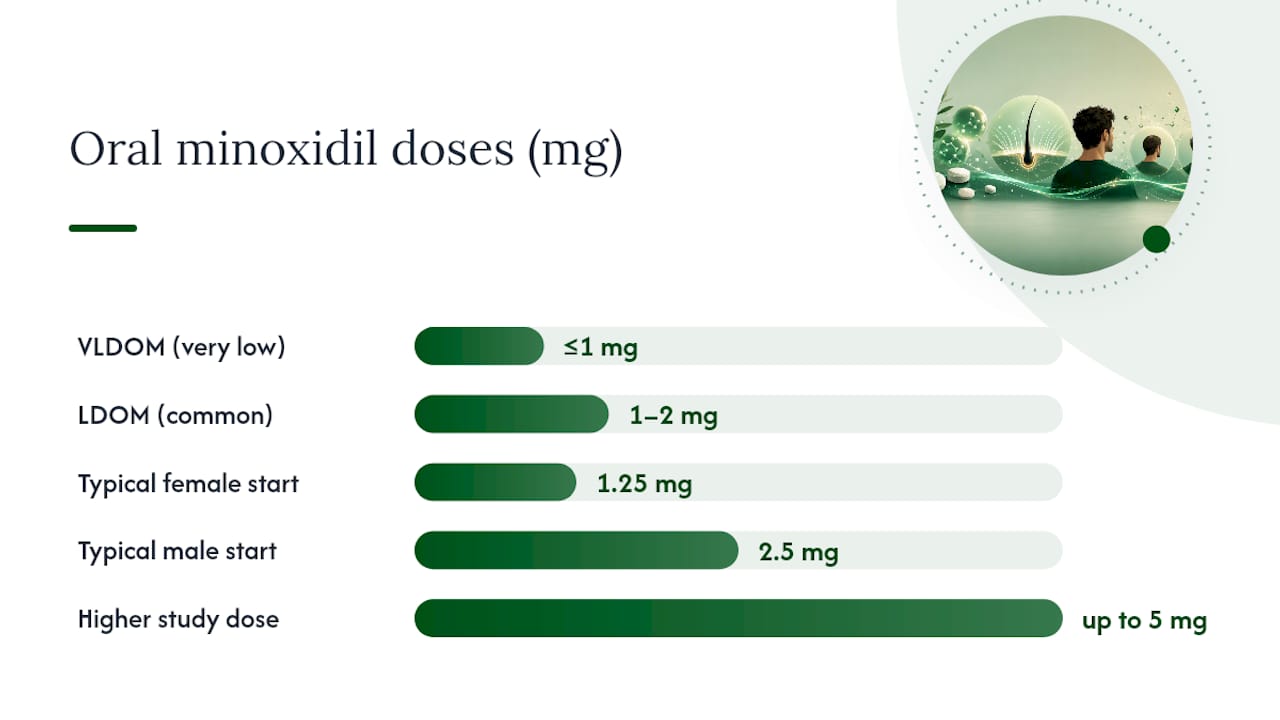
Dosing for hair loss sits in a strange spot: minoxidil tablets were originally approved for blood pressure at doses up to 100 mg daily, but the doses used off-label for alopecia are a tiny fraction of that.
Clinical literature groups oral minoxidil doses into a few practical categories:
Consensus clinical review literature commonly points to starting doses around 1.25 mg daily for women and 2.5 mg daily for men, with a broader reported range across studies spanning roughly 0.25 to 5 mg daily depending on sex, body size, and tolerability. StatPearls similarly documents off-label dosing in the 0.25 to 2.5 mg range as the more conservative, commonly used band in practice.
Why the lower starting dose for women? Partly body size, but mostly because women tend to be more sensitive to hypertrichosis on the face, which is a bigger cosmetic concern for female patients than for men.
In practice, clinicians rarely just pick a dose and walk away. Titration is standard: start low, check in after a few weeks, and adjust based on two things, how well it’s working and how the patient is tolerating it. If someone develops noticeable facial hair growth or swelling in the ankles, the next move is usually a dose reduction rather than stopping altogether. Some providers split the daily dose into two smaller doses, morning and evening, to smooth out blood pressure fluctuations rather than delivering one larger dose at once.
Formulation matters too. Oral minoxidil is manufactured in standard tablet strengths, most commonly 2.5 mg and 10 mg, which don’t divide neatly into the small fractional doses often used for hair loss. This is where compounding pharmacies come in, producing custom low-dose tablets or capsules (0.5 mg, 1.25 mg, and similar strengths) that match the actual off-label dosing used in studies rather than forcing patients to awkwardly split a blood-pressure-strength pill.
Understanding oral minoxidil safety means separating two very different categories: common, mostly cosmetic nuisances, and rare but genuinely serious cardiovascular events.
1. Hypertrichosis (unwanted hair growth). This is the single most reported side effect across nearly every study. It’s dose-dependent, meaning higher doses produce more of it, and it typically shows up on the face, forearms, or other body areas rather than staying confined to the scalp. In the JAMA Dermatology RCT using 5 mg daily, 49% of patients experienced hypertrichosis, notably higher than rates seen in lower-dose studies pooled into the broader meta-analysis.
2. Fluid retention and swelling (edema). Because minoxidil is a vasodilator, it can cause the body to retain fluid, sometimes showing up as swelling in the ankles or lower legs. This tends to be more common at higher doses and is one of the more frequent reasons clinicians reduce a dose rather than discontinue treatment entirely.
3. Headache and lightheadedness. These usually relate to the drug’s blood-pressure-lowering effect and tend to be more noticeable in the first few weeks before the body adjusts.
4. Rare but serious cardiovascular risks. This is the category that justifies real caution. Because minoxidil is fundamentally an antihypertensive drug, product labeling and pharmacology references document rare but serious effects including pericardial effusion (fluid buildup around the heart) and symptomatic hypotension, particularly at higher doses or in patients with existing cardiac vulnerability. These events are uncommon at the low doses used for hair loss, but they’re the entire reason screening exists before anyone starts this medication.
The screening rationale in one number: with an overall adverse-event rate around 27% across pooled studies, most side effects are manageable and cosmetic, but the drug’s vasodilator mechanism is exactly why baseline cardiac screening isn’t optional busywork; it’s the step that catches the small subset of patients for whom this drug is genuinely risky.
A responsible baseline screening checklist, drawn from clinical review recommendations, typically includes:
Monitoring after that first visit usually means a follow-up blood pressure check within the first few weeks, then periodic symptom check-ins. The clearest stop signs are new or worsening swelling, chest discomfort, rapid heartbeat, or lightheadedness severe enough to interfere with daily activity. Those symptoms warrant a call to your provider, not a wait-and-see approach.
The most direct evidence comes from the JAMA Dermatology randomized trial comparing oral minoxidil 5 mg daily against topical minoxidil 5% applied twice daily over 24 weeks. On the primary outcome, overall hair count, neither treatment clearly beat the other. That’s an important finding on its own: oral minoxidil isn’t a magic upgrade that automatically outperforms the topical version everyone already knows.
But the trial’s blinded photographic analysis told a more interesting story. That’s a real signal, just a narrower one than “oral wins across the board.”
Where oral minoxidil pulls ahead isn’t necessarily raw efficacy. It’s adherence:
The trade-off is the side-effect profile. Topical minoxidil’s main downside is localized scalp irritation. Oral minoxidil trades that for systemic effects, hypertrichosis, potential fluid retention, and the blood-pressure considerations covered above. Clinical reviews consistently point to oral minoxidil as a practical option for people who can’t tolerate topical formulations or who’ve struggled to stick with a topical routine long enough to see results. In practice, some clinicians combine the two, using topical minoxidil focally where tolerated alongside a low oral dose, though evidence specifically on that combination approach is thinner than for either treatment alone.
Not everyone responds the same way, and the clinical data points to a few consistent predictors worth knowing before you set expectations.
Oral minoxidil tends to make the most sense as a first-line or early option for people newer to treatment, and as a switch-to option for people who’ve tried topical minoxidil and either didn’t tolerate the scalp irritation or simply couldn’t stay consistent with the daily application. If you’ve had prior heart issues, uncontrolled blood pressure, or are pregnant or trying to become pregnant, it’s usually not the right starting point, and a provider will typically steer you toward alternative approaches instead.
You cannot reliably judge minoxidil oral dosage results by staring in the bathroom mirror every morning. Hair growth is too gradual, and daily comparison invites you to notice nothing at all.
Pro Tip: Skip the daily mirror check entirely for the first three months. Set a calendar reminder for your month-three photo instead. You’ll actually be able to see the difference instead of getting discouraged by noise.
If side effects show up, don’t just tough it out. Mild hypertrichosis is a cosmetic annoyance worth discussing at a regular follow-up. Swelling, chest discomfort, a racing heartbeat, or severe dizziness are different: those warrant an urgent call to your provider, not a wait-until-next-appointment approach.
A safe oral minoxidil prescription starts with the same screening steps outlined earlier, blood pressure, cardiac history, medication review, delivered through a structured intake process rather than skipped entirely.
FitRx built its hair loss program around that exact sequence. The process starts with an intake questionnaire covering your hair loss history, timeline, and family pattern, followed by targeted screening questions about cardiovascular history, current medications, and blood pressure status. A licensed provider reviews that information before any prescription is written, and consent conversations cover realistic expectations, the shedding phase, and potential side effects before treatment begins.
Pro Tip: Have your blood pressure checked at a pharmacy or with a home cuff before your telehealth visit. It speeds up screening and gives your provider a real baseline to work from instead of relying on your last doctor’s visit from two years ago.
Telehealth has real limits, and a good program should tell you that upfront. If you have a known cardiac condition, uncontrolled hypertension, or symptoms that need an in-person exam (an irregular heartbeat, unexplained swelling, chest pain), the right move is referral to in-person cardiology or dermatology care, not a remote prescription. A female hair loss program built around sex-specific dosing considerations reflects that same principle: matching the treatment plan to the person, not forcing everyone through an identical protocol.
The biggest mistake I see in how oral minoxidil gets discussed online is treating it as either a miracle or a scam, when the honest clinical picture sits firmly in between. It works for most people, not all people, and “works” usually means meaningful improvement or a halt to further loss rather than a total reversal back to your 20-year-old hairline.
What actually separates good outcomes from disappointing ones isn’t the drug itself. It’s patient selection and follow-through: starting at a dose matched to your body and risk profile, getting screened properly before that first pill, and sticking with it through the shedding phase instead of quitting at week four out of panic. The people who do best treat the first six months as a monitoring period, not a verdict, and they show up for the blood pressure check that catches problems early rather than skipping it because they feel fine.
FitRx gets you from “I think I need this” to a written, monitored treatment plan without booking a dermatology appointment weeks out and sitting in a waiting room to have the same screening conversation covered above.

The process runs entirely through your phone: an intake covering your hair loss history and health background, a review by a licensed provider who checks for the cardiovascular red flags that matter before prescribing anything, and, if you’re a candidate, a personalized plan with medication shipped to your door. Ongoing check-ins through the app let you flag side effects or lack of progress without waiting for a scheduled visit. If your screening turns up something that needs hands-on evaluation, an irregular heartbeat, uncontrolled blood pressure, or symptoms suggesting a cardiac issue, you’ll be told to see an in-person provider rather than pushed through anyway. Ready to find out if you’re a candidate? Start your evaluation on the FitRx hair loss page and get a provider’s read on your specific situation within days, not weeks.
Most people notice the first signs of change around 3 months, with peak improvement typically arriving between 6 and 12 months of consistent use.
Yes, for most patients. A 2025 meta-analysis found 35% saw significant regrowth and 47% saw moderate improvement, meaning around 82% of patients improved or stabilized.
Not overall. A randomized trial found no clear advantage on total hair count, though photographic analysis showed greater improvement at the vertex for oral users, along with a higher rate of hypertrichosis.
Celebrity treatment regimens aren’t independently verified or medically documented, so specific claims about individual public figures can’t be confirmed here; the clinical evidence in this article covers what’s actually been studied.
No. Because minoxidil is a systemic vasodilator, baseline blood pressure and cardiac history screening are recommended before starting, which is exactly the process a telehealth evaluation like FitRx’s hair loss program is designed to walk you through.


.svg)