If you missed a pill, take it as soon as you remember and keep going with your pack. Whether you also need backup contraception depends on two things: which type of pill you take and how many hours or days have passed. Combination pills give you more room to breathe; progestin-only pills do not. The full breakdown below covers one missed pill, two or more, and what changes if it happened in week three.
TL;DR:
- Missing a combination pill within 24 to under 48 hours usually requires no backup contraception, and taking the missed dose immediately is sufficient.
- Missing two or more consecutive combination pills or a progestin-only pill by more than 3 hours necessitates using backup protection for seven days and may require skipping placebo days.
- Progestin-only pills follow a stricter timing rule, with more than 3 hours late counting as missed, except for drospirenone formulations, which have a 48-hour window.
- Emergency contraception is recommended if unprotected sex occurs after multiple missed pills or during the first week of a new pack, with levonorgestrel being over-the-counter and most effective when taken promptly.
- Frequent forgetting suggests switching to a more reliable, non-daily contraceptive method, such as an IUD or patch, to avoid the risk of unintended pregnancy.
The clock that matters is different for combination pills and progestin-only pills, and mixing up the two rules is where a lot of the confusion (and the pregnancy risk) starts.
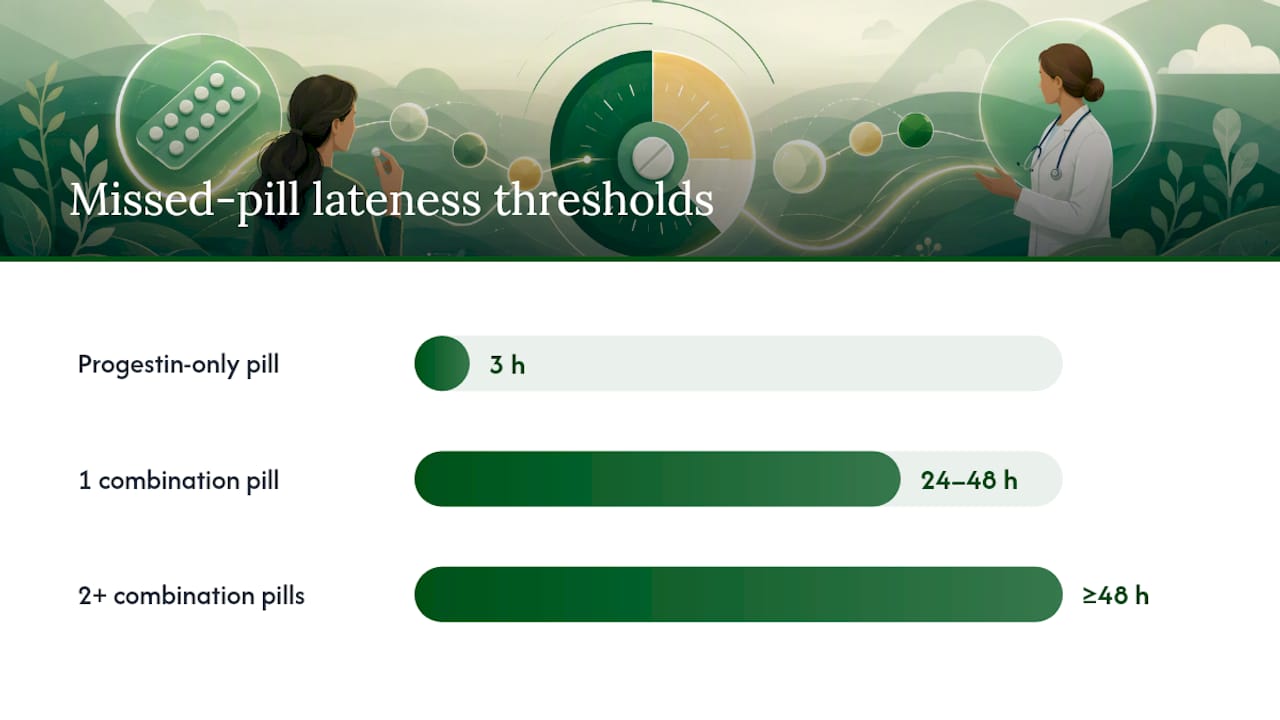
Combination pills, which contain both estrogen and progestin, work mainly by suppressing ovulation. That gives you a cushion. According to CDC guidance on combined hormonal contraceptives, a pill taken 24 to under 48 hours late still falls in the “late but manageable” zone, not the danger zone.
Progestin-only pills, sometimes called minipills or POPs, don’t have that cushion. They work largely by thickening cervical mucus, and that effect depends on keeping hormone levels steady around the clock. For traditional norethindrone or norgestrel POPs, more than 3 hours late counts as missed, full stop. Drospirenone-containing POPs are the exception, following a looser under-48-hour standard closer to combination pill rules.
A few things worth keeping straight:
Cervical mucus protection takes roughly 48 hours to rebuild after a missed POP dose, which is exactly why the backup contraception window for minipills runs two full days. Check your pill pack insert for your specific brand, and if you call a provider, have that brand name ready. Not all “progestin-only” pills are timed the same way, and guessing wrong is how gaps happen.
The right response scales with how many doses you’ve missed and, for combination pills, which week of the pack you’re in. Here’s the sequence clinicians actually recommend.
One missed combination pill (24 to under 48 hours late). Take the missed pill the moment you remember, even if that means swallowing two pills the same day. Keep taking the rest of the pack on schedule. CDC guidance says backup contraception usually isn’t necessary at this stage, since ovulation suppression hasn’t had time to lapse.
Two or more consecutive combination pills missed (48 hours or more). This is where the rules tighten:
Progestin-only pill missed (more than 3 hours late). Take it as soon as possible, then continue at your usual daily time going forward. Use backup contraception, or avoid sex, until you’ve taken the pill correctly for 2 consecutive days. Drospirenone POPs follow the more forgiving under-48-hour standard, so check which formulation you’re on before assuming the strict 3 hour rule applies.
Pro Tip: Never take more than two pills in one day, even if you’re catching up on several misses. If you’re unsure whether you’re covered, use condoms and consider emergency contraception rather than guessing.
Missing pills doesn’t automatically mean you need emergency contraception, but certain situations call for it without much debate.
Consider EC if you had unprotected sex in the previous 5 days and either of these applies:
Two main options exist. Levonorgestrel (available over the counter) works best the sooner you take it and may be less effective at higher body weights. Ulipristal acetate (UPA, prescription-only) remains effective longer within the 5-day window and tends to maintain effectiveness better regardless of weight, though it requires a prescription and should not be taken on the same day as a progestin-only pill.
Levonorgestrel is available at most pharmacies without a prescription. UPA requires either a clinic visit or a telehealth consult. If you’re not sure which fits your situation, call a provider rather than waiting.
Catching up on a missed dose can throw your body a small curveball, and that’s normal.
Breakthrough bleeding or spotting is the most common aftereffect, especially if you doubled up on pills or skipped the placebo week. It typically settles within a cycle or two as hormone levels stabilize. Nausea shows up sometimes too, usually tied to taking two pills in one day rather than the missed dose itself.
A few ways to manage it:
Pro Tip: If you’re due for placebo days but you recently caught up on missed active pills, ask your provider whether delaying the placebo week makes sense for your situation.
Some situations shouldn’t wait for a routine appointment. Call a provider promptly if you had unprotected sex after missing multiple pills and EC access isn’t immediate, if you notice signs that could suggest pregnancy (missed period, unusual fatigue, breast tenderness), or if side effects feel severe rather than mild and short-lived.
If missing pills is a pattern rather than a one-off, it’s worth a real conversation about alternatives. Options like an IUD, implant, patch, ring, or injection remove the daily adherence problem entirely, which makes them worth considering if pills keep slipping through the cracks. FitRx’s birth control services connect you with a licensed provider who can walk through those options.
Before a visit or telehealth call, jot down which pills you missed, how many hours or days late each was, and whether you had unprotected sex in that window. That detail changes the recommendation.
Most missed-pill guidance gets written like a flowchart, and flowcharts assume you’re standing there calmly counting hours. In practice, you’re finding the pill in your bag at 11 PM wondering if you’re already too late. That’s the real gap. The rules aren’t complicated. Sticking to them under stress is.
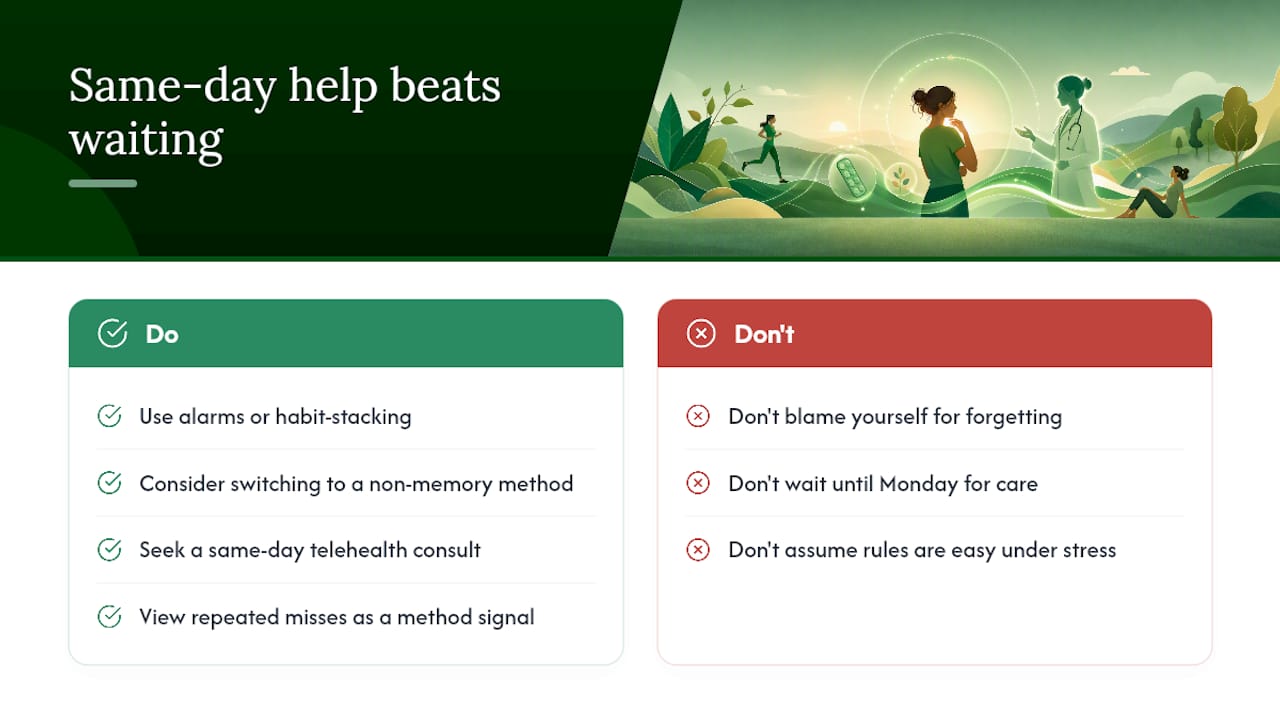
The other thing conventional advice underplays: forgetting occasionally is not a personal failing, it’s a predictable outcome of asking a person to remember something at the same time every single day for years. If you’ve missed pills more than once or twice this year, that’s a signal about the method, not about you. Alarms and habit-stacking help some people. For others, the honest fix is switching to something that doesn’t depend on memory at all.
Telehealth closes a real gap here too. If you’re staring at a missed-pill situation at 9 PM on a Sunday, a same-day virtual consult beats waiting for a Monday appointment, especially when emergency contraception’s effectiveness drops with every hour that passes.
— Bryan
FitRx skips the waiting room entirely for exactly the kind of situation this article covers: a missed dose, a fast refill, or a conversation about switching to a method you won’t have to remember every day. Signing up takes a few minutes, gets you a virtual consult with a licensed provider, and connects to prescription fulfillment shipped to your door or ready at a local pharmacy.

That structure matters most when timing is tight. If you’ve missed multiple pills and need emergency contraception guidance, or you’re just tired of setting alarms and want to talk through options like a patch, ring, or IUD, a provider can review your history and adjust your plan the same day. FitRx’s prescription refill service is built for exactly this: no scheduling three weeks out, no waiting room.
Start a consult through FitRx and get a same-day plan for your refill, your method, or your next step.
The step-by-step actions in this article follow the CDC’s Selected Practice Recommendations for combined and progestin-only pills, the CDC’s recommended-actions reference, and patient-facing summaries from Cleveland Clinic.
This article is general information, not a substitute for advice from a qualified doctor. Consult a qualified healthcare professional about your own circumstances before acting on anything here.
Take the missed pill as soon as you remember, even if that means taking two pills the same day, then continue your pack on schedule.
For traditional norethindrone or norgestrel POPs, more than 3 hours late counts as missed; drospirenone POPs follow a looser under-48-hour rule.
Usually not for one late combination pill within 48 hours, but you do need backup for 7 days after two or more missed combination pills, or for 2 days after a missed progestin-only pill.
Consider EC if you had unprotected sex in the previous 5 days and missed pills happened in week one of your pack or you missed two or more doses.
Yes, breakthrough bleeding and mild nausea are common after catching up and typically resolve within a cycle or two; contact a provider for heavy bleeding, severe pain, or fever.
Talk to a provider about switching to a method that doesn’t rely on daily memory, such as an IUD, implant, patch, or ring; FitRx’s birth control consults can help you compare options quickly.

.svg)