Yes, minoxidil can cause a temporary increase in shedding, often called the “dread shed,” and for most people it’s a self-limited phase that shows up before regrowth, not instead of it. It usually starts within the first few weeks of treatment and settles down within a couple of months. This doesn’t happen to everyone, and when it does, it’s rarely a sign that treatment is failing.
Research on topical minoxidil found the shedding phase concentrated in the first 12 weeks, with visible hair density improvements by week 24. That’s the pattern worth holding onto while your sink looks alarming.
What to do right now:
Minoxidil shedding is a temporary, self-limited phase driven by follicles synchronizing into anagen, and it typically resolves within three to four months without stopping treatment.
| Point | Details |
|---|---|
| Shedding is usually temporary | Most cases resolve within 12 weeks, with density improvements often visible by 24 weeks. |
| Formulation affects duration | 2% minoxidil users showed longer shedding windows than 5% users in retrospective study data. |
| Onset follows a predictable window | Shedding commonly starts at 2 to 8 weeks and peaks around weeks 3 to 5. |
| Persistence past 3 to 4 months needs evaluation | Continued or worsening shedding, patchy loss, or scalp inflammation are reasons to see a clinician. |
| FitRx offers a direct evaluation path | Virtual consults through FitRx review your shedding pattern, formulation, and next steps with a licensed provider. |
Not everyone sheds. Some people start minoxidil, see nothing dramatic in the sink, and go straight to slow, steady regrowth. Others notice a distinct wave of extra hair loss in the first month or two. Both are normal responses to the same drug.
Rates and duration vary by formulation. A retrospective study of androgenetic alopecia patients found that the transient shedding phase lasted longer in people using 2% minoxidil than those using 5%, though both groups saw hair parameters improve by six months. That’s counterintuitive if you assumed the stronger formulation would cause more disruption. It’s the opposite.
A handful of factors shape how noticeable your shedding will be:
Plenty of people in online hair-loss communities report zero noticeable shedding at all. If that’s you, it doesn’t mean the treatment isn’t working. Subjective awareness of shedding varies as much as the biology does.
Minoxidil often shortens the resting phase of the hair cycle and pushes follicles back into active growth, and that transition is what ejects the old resting hairs early. It sounds like the drug is working against you. It’s actually doing the opposite.
Here’s the short version of the hair cycle, translated out of dermatology-speak: hair grows for years during anagen, briefly transitions during catagen, rests for a few months during telogen, and then sheds during exogen as a new hair pushes it out from below. Normally these four phases are staggered across your scalp so you never notice much turnover at once. Minoxidil disrupts that staggering. It nudges a batch of resting follicles to wake up and start the anagen phase simultaneously, which means the old telogen hairs they were holding onto get released together instead of trickling out over months.
Clinical review literature describes this mechanism directly: minoxidil prompts follicles to exit telogen and re-enter anagen, producing a temporary exogen phase that resolves on its own as the new anagen hairs mature.
The shedding isn’t the treatment failing. It’s a batch of follicles getting synchronized into a growth phase they’d otherwise have entered on a slower, more staggered timeline.
Pro Tip: If your part width and hairline stay in the same place while your total volume dips temporarily, that’s consistent with treatment-induced shedding. If you notice a specific patch getting visibly thinner or bald while the rest of your scalp looks unchanged, that’s a different pattern, more consistent with an independent cause like telogen effluvium or alopecia areata, and worth a clinician’s look.
Shedding typically starts within two to eight weeks of your first application, peaks around week three to five, and tapers off over the following month or two. Review-level evidence puts onset in that 2 to 8 week window, with many people noticing early regrowth signs by around the three-month mark.
A rough month-by-month expectation looks like this:
Formulation matters for timing too. The same retrospective study found people on 2% minoxidil experienced a longer shedding window than those on 5%, even though both eventually showed improved density by 24 weeks. Oral low-dose minoxidil follows a similar but sometimes faster arc, with dread shed in some reported cohorts beginning at 2 to 4 weeks and lasting 3 to 6 weeks.
A modest, temporary bump in daily hair loss is expected. Sudden clumps coming out in the shower, or a new bald patch appearing where there wasn’t one before, is not.
For context, dermatologists generally consider somewhere around 50 to 100 hairs lost per day to be typical background shedding for most people, even without any treatment involved. During a minoxidil-related shed, that number can climb noticeably for several weeks, which is enough to fill a drain trap or leave more strands on your pillow than you’re used to.
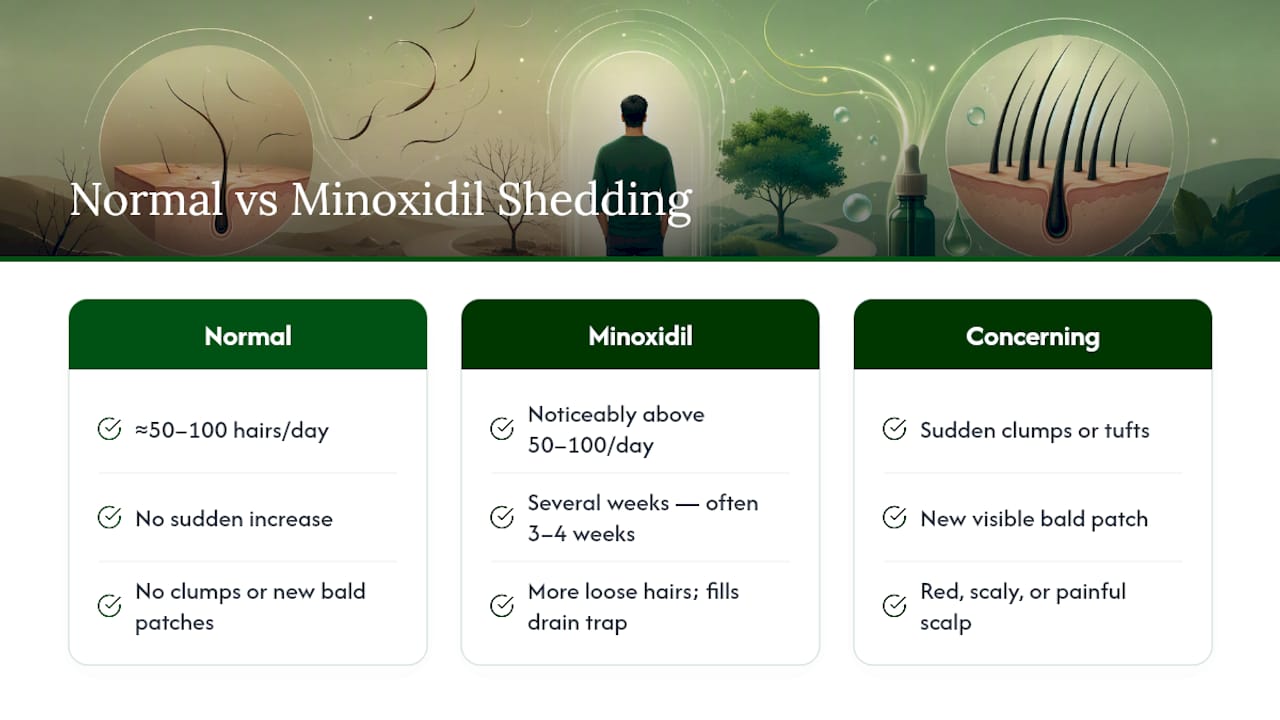
Two quick scenarios: if you’re seeing more loose hairs on your brush for three or four weeks, then it gradually eases, that’s the expected pattern. If instead you’re seeing hair come out in tufts, or you can see scalp through a specific patch that wasn’t visible before, or your scalp itself is red, scaly, or painful, that’s outside the normal minoxidil shedding pattern and worth getting checked.
If shedding hasn’t started slowing down by three to four months, or if it’s severe from the start, it’s time to get evaluated rather than wait it out further. Patient-facing guidance from major clinics generally advises against stopping treatment abruptly without first talking to a provider, since quitting cold can trigger its own shedding wave.
A practical sequence to work through:
As a rule of thumb: pause treatment only if you’re developing a scalp reaction or your provider tells you to. Otherwise, persistence through the expected window is usually the right call.
Layering treatments doesn’t reliably prevent the dread shed, but it doesn’t clearly worsen it either. A multicenter chart review of patients starting low-dose oral minoxidil found that 5.2% experienced new-onset dread shed, and continuing topical minoxidil at the same time did not significantly change that rate.
Low-dose oral minoxidil requires medical supervision: it can cause fluid retention, a faster heart rate, and lowered blood pressure, so clinicians typically monitor blood pressure and ask about heart conditions before prescribing. It is not recommended during pregnancy or breastfeeding. Discuss these risks with a physician before starting.
That’s a useful data point if you’re transitioning from topical to oral minoxidil and wondering whether keeping the topical going will cushion the switch. Based on this cohort, it probably won’t hurt, but don’t expect it to eliminate shedding risk either. Sample sizes in this research were limited, so treat it as a reasonable starting assumption rather than settled science.
Finasteride and other adjuvant therapies work on a different pathway entirely and won’t stop the initial minoxidil-related shed. What they can do, over the following months, is support longer-term density alongside minoxidil’s effects.
Finasteride is FDA-indicated for men only. Women who are or may become pregnant must not handle crushed or broken finasteride tablets, due to the risk of harm to a male fetus. It can also cause sexual side effects (reduced libido, erectile dysfunction) in a minority of men, which usually resolve after stopping treatment. Discuss these risks with a physician before starting.
Keep applying minoxidil on your normal schedule unless you’re seeing red-flag symptoms. Consistency matters more here than almost any other single factor, since interrupted use tends to restart the cycle you’re trying to get through.
A few do’s and don’ts for the shedding window:
Pro Tip: If the liquid solution is causing itching or flaking, switching to the foam formulation often resolves it, since foam skips the propylene glycol that’s the usual irritant in liquid minoxidil.
For the cosmetic side, root touch-up powders and volumizing dry shampoo can camouflage thinning temporarily while your follicles cycle through. Neither speeds up regrowth, but both make the wait easier to live with.

See a provider if shedding continues past three to four months, if you notice patchy rather than diffuse thinning, or if you develop scalp inflammation alongside the hair loss. Those are signs worth ruling out something beyond a standard treatment-induced shed.
A typical evaluation includes a history review, scalp photos, sometimes basic bloodwork, and a look at any other medications you’ve started recently. From there, a provider can adjust your regimen or investigate other causes.
Pro Tip: Bring your weekly progress photos to the appointment. A visual timeline gives a provider far more to work with than a verbal description of “more hair than usual.”
Getting a personalized read on your shedding shouldn’t require guessing whether it’s normal on your own. FitRx connects you with a licensed provider through a virtual visit, so instead of comparing your bathroom sink to internet forum posts, you get an actual evaluation of your history, your formulation, and whether your timeline matches what’s expected.

Through FitRx’s hair loss program, a consult covers your treatment history, current shedding pattern, and whether adjusting your formulation or adding a complementary therapy makes sense for you. If labs are warranted, your provider can guide next steps, and prescriptions ship directly to your door with ongoing app-based check-ins so you’re not left wondering if week six is supposed to look like this. Readers navigating shedding tied to hormonal or pattern-based causes can also review FitRx’s female hair loss resources for treatment options specific to that presentation.
Getting started takes a short intake form and a scheduled virtual visit. Book your hair loss consultation and get a clear answer on whether your shedding is on track.
The retrospective cohort study on transient shedding is the strongest available data on how shedding duration differs by minoxidil concentration. The dread shed overlap study covers oral minoxidil initiation specifically. For scalp-level detail on mechanical shedding and follicle cycling in general, this consumer explainer on shedding causes is a useful plain-language companion, and Mayo Clinic’s hair loss overview covers when patient-facing guidance says to seek care.
This article is general information, not a substitute for advice from a qualified doctor. Consult a qualified healthcare professional about your own circumstances before acting on anything here.
Most minoxidil-related shedding resolves within 8 to 12 weeks, with hair density improvements typically visible by 24 weeks. If it continues past three to four months, get evaluated.
No. Shedding is common but not universal. Some people move straight into regrowth without a noticeable dread shed phase at all.
Let it absorb without heavy rubbing, ideally for at least four hours before washing. Vigorous rubbing on a wet scalp during the shedding phase can add unnecessary mechanical stress to loosening hairs.
No. In a multicenter study of people starting oral low-dose minoxidil, only 5.2% experienced new-onset dread shed, meaning most people in that cohort did not.
Generally no, unless you’re seeing scalp inflammation or a clinician advises it. Stopping abruptly can trigger another round of shedding when you restart, so persistence through the expected window is usually the better path, and a FitRx consult can help confirm whether your specific pattern is normal.


.svg)