The best alternatives to Midi Health are Alloy Women’s Health (cash-pay, protocol-driven HRT), Winona (compounded BHRT subscription), PlushCare (mental health and primary care complement), and FitRx (integrated telehealth with menopause-adjacent care, weight management, and mental health support). Which one fits you depends on one question above everything else: do you have PPO insurance that covers Midi, or are you paying out of pocket?
| Provider | Care model | Pricing shape | HRT type | Speed to Rx |
|---|---|---|---|---|
| Midi Health | Live video, insurance-billed | Insured copay or self-pay per visit | FDA-approved HRT + non-hormonal | one to two weeks |
| Alloy Women’s Health | Async intake, physician-matched | Membership + medication | FDA-approved HRT | within a few days |
| Winona | Async subscription | Subscription tiers | Compounded BHRT + some FDA | within a few days |
| PlushCare | Live video, insurance or self-pay | Per-visit or subscription | Non-hormonal, SSRI, primary care | 1–3 days |
| FitRx | Virtual consultation + app support | Subscription/membership | Menopause-adjacent, weight, mental health | Fast async |
Quick shortlist:
The best Midi Health alternative depends on one variable above all others: whether PPO insurance covers a clinical practice in-network, because that single factor determines whether cash-pay subscriptions actually save money or cost more over a full year.
| Point | Details |
|---|---|
| Insurance first | Check PPO in-network status before paying cash-pay rates; insured copays of $0–$30 to $20–$75 can beat annual subscription totals. |
| Speed vs. scope | Async platforms (within a few days to Rx) are faster; appointment-based clinical practices offer broader midlife care including thyroid and metabolic support. |
| Credentials over title | Menopause-trained clinicians (NCMP, The Menopause Society certified) matter more than MD vs. NP distinctions when evaluating any platform. |
| Compounded BHRT tradeoffs | Compounded formulations offer customization but are not FDA-approved as finished products and are rarely covered by insurance. |
| FitRx for integrated care | FitRx suits patients managing overlapping symptoms (weight, mood, sleep, hair) through one subscription platform with app-based ongoing support. |
Midi Health operates as a clinical practice, not a subscription product. Visits happen over live video with clinicians trained specifically in midlife women’s health, and the platform accepts many PPO plans and some Medicare Advantage plans. That insurance acceptance is its biggest differentiator.
On the cost side, insured patients with in-network coverage often pay $0–moderate copays per visit depending on their plan, while self-pay visits typically run at a higher cash rate. For a patient who sees a clinician four times a year, the insured path can cost less annually than any cash-pay subscription once labs and medications are added in.
Midi’s clinical scope goes beyond HRT. Clinicians address thyroid function, metabolic health, mood, and sleep as part of a broader midlife picture, which is genuinely useful for patients whose symptoms don’t fit neatly into a single category. FDA-approved HRT options and non-hormonal alternatives are both available, and labs are ordered as part of the clinical workup.
Pros:
Cons:
Pro Tip: If you have a PPO plan, call your insurer before booking anywhere. Confirming in-network status takes ten minutes and can save hundreds of dollars annually compared to cash-pay subscriptions.
FitRx is a direct-to-consumer telehealth platform offering virtual consultations with licensed providers, personalized treatment plans, and prescription delivery to your door. The care model is app-based and ongoing: after your initial consultation, you manage refills, follow-ups, and support through the FitRx platform rather than scheduling separate appointments each time.
Where FitRx stands apart from a dedicated menopause clinic is breadth. The platform covers weight management (including GLP-1 medications), anxiety and depression, hair loss, skincare, sleep, and primary care alongside menopause-adjacent needs. For patients whose symptoms overlap — weight gain, mood shifts, sleep disruption, and hair thinning are all common during perimenopause — managing everything through one platform is genuinely more practical than juggling three separate providers.

The subscription model means predictable monthly costs rather than per-visit billing surprises. Prescriptions are fulfilled and shipped directly, labs can be integrated into the care plan, and the app provides continuous support between consultations. Clinicians are licensed providers, and the platform is built around personalized protocols rather than one-size-fits-all treatment.
FitRx fits best when:
Where a dedicated menopause clinic may serve you better:
Pro Tip: Check FitRx’s offerings before assuming you need a separate menopause-only platform. If your symptoms span more than one category, consolidating care often reduces both cost and coordination friction.
Alloy Women’s Health uses an asynchronous intake model: you complete a detailed health questionnaire, get matched with a physician, and receive a care plan and prescription without scheduling a live appointment first. That process typically takes within a few days from intake to prescription, compared to the 1–2 week scheduling window at appointment-first clinical practices.
The pricing structure is membership plus medication rather than per-visit billing. That predictability is the main draw for cash-pay patients. You know what you’re spending each month, and the physician-matching model means your care plan is reviewed by an actual MD rather than auto-generated from a protocol.
Alloy’s formulary focuses on FDA-approved HRT options. Patients who specifically need compounded formulations will find the selection narrower here than at a compounding-focused platform like Winona.
Pros:
Cons:
Key specs:
Winona’s defining feature is its focus on compounded BHRT. The platform offers subscription tiers for compounded combination creams and some FDA-approved products, targeting patients who want custom formulations rather than standard commercial preparations.
Compounded hormones can be useful when a patient needs a specific dose or delivery method not available in FDA-approved products. The tradeoff is real: compounded drugs are not FDA-approved as finished products, quality can vary between compounding pharmacies, and they are generally not billable to insurance. Patients considering compounded BHRT should ask the platform to disclose the compounding pharmacy’s credentials and quality assurance practices, and confirm whether the prescription can be filled at an outside pharmacy if needed.
The subscription model makes monthly costs predictable, and the asynchronous intake means faster access than appointment-based practices. For patients who’ve already tried standard HRT and want a different formulation, or who specifically prefer a compounded approach, Winona is the most focused option in this category.
Pros:
Cons:
Pro Tip: Before committing to a compounded BHRT subscription, ask specifically: which compounding pharmacy fills your prescriptions, what quality testing do they perform, and can you fill the prescription elsewhere if you move or the platform closes? These questions separate transparent platforms from opaque ones.
PlushCare is a general telehealth platform offering live video visits with primary care providers and behavioral health specialists, accepting both insurance and self-pay. It is not a dedicated menopause platform, but that’s exactly why it belongs in this comparison.
Mood disruption, anxiety, insomnia, and cognitive fog are among the most common and most undertreated menopause symptoms. SSRIs and SNRIs are clinically recognized non-hormonal options for hot flashes and mood, and cognitive behavioral therapy for insomnia (CBT-I) is often more effective long-term than sleep medications. A platform like PlushCare can prescribe and manage these treatments, coordinate with a separate HRT provider, and handle primary care needs in the same place.
Understanding how digital mental health platforms work is useful here: behavioral health telehealth operates differently from HRT-focused platforms, with a stronger emphasis on scheduled video visits, ongoing therapy coordination, and medication management for mood conditions.
When PlushCare (or a similar platform) makes sense:
Coordination tip: Tell both providers what the other has prescribed. Drug interactions between HRT and antidepressants are real, and neither platform can manage them if they don’t know about each other.
The right platform depends primarily on whether you prioritize whole-person care with insurance billing or fast HRT access through a subscription model. Start with these four questions before you look at any platform’s marketing.
Four primary decision drivers:
Intake checklist:
Questions to ask on intake:
Red flags to walk away from:
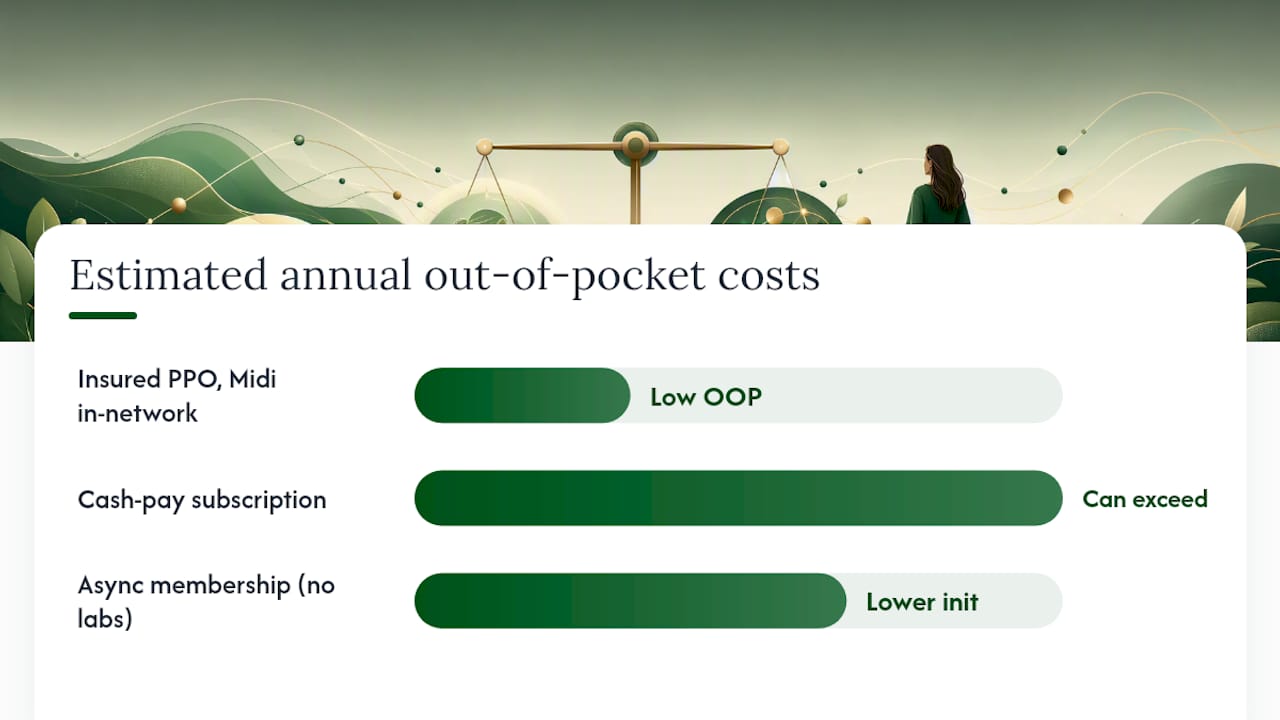
Annual cost scenarios:
| Scenario | Estimated annual cost |
|---|---|
| Insured PPO patient, Midi in-network (4 visits at low copays copay + covered meds) | Low out-of-pocket; varies by plan |
| Cash-pay subscription platform (membership + medication + labs) | Can exceed insured path; calculate total before committing |
| Async membership, no labs required upfront | Lower initial cost; factor in labs and follow-up fees annually |
Clinician credentials matter more than title. An NP with menopause certification from The Menopause Society (NCMP) is a stronger choice for HRT management than an MD with no menopause-specific training. Ask directly.
Most telehealth menopause platforms start with either an asynchronous questionnaire or a scheduled video visit. Async platforms let you complete intake on your own time; a clinician reviews it and sends a care plan, typically within a few days. Appointment-based practices schedule a live video visit, which usually takes one to two weeks for new patients.
Labs commonly ordered before starting HRT include a basic metabolic panel, lipid panel, TSH (thyroid-stimulating hormone), and sometimes targeted hormone levels (FSH, estradiol). Some async platforms allow a prescription without upfront labs for lower-risk patients, ordering labs after the first prescription cycle. Others require labs before any prescription is written. Ask this question explicitly during intake.

Once a prescription is issued, pharmacy fulfillment adds another variable. Standard pharmacies typically fill within 1–3 days. Compounded prescriptions sent to specialty pharmacies can take longer, and some compounding pharmacies only ship to certain states.
A peer-reviewed clinical review on menopause management confirms that HRT decisions should account for individual cardiovascular, thrombotic, and breast cancer risk factors, which is why a thorough intake and lab workup matters even on fast-turnaround platforms.
Urgent signs that require in-person or emergency care, not a telehealth message:
Practical tips for a smoother process:
Asynchronous platforms generally provide care plans and prescriptions faster (within a few days) than appointment-based practices, which often require one to two weeks for new patient scheduling, according to platform comparison data. That speed difference is real and worth factoring in if symptoms are significantly affecting your quality of life right now.
Most comparison articles frame this as a simple ranking: platform A beats platform B. The reality is messier, and this framing does readers a disservice.
The single most overlooked factor is the true annual cost calculation. A subscription platform that charges a flat monthly fee looks cheaper than a per-visit clinical practice until you add labs, medications, and follow-up fees. For a patient with a good PPO plan where Midi or a similar clinical practice is in-network, the insured path frequently wins on total cost. Cash-pay services are easier to budget month-to-month, but easier to budget is not the same as cheaper.
The second thing most comparisons miss: clinical scope is not a bonus feature. Perimenopause and menopause frequently arrive alongside thyroid changes, metabolic shifts, mood disruption, and sleep disorders. A platform that only manages HRT is genuinely insufficient for a meaningful percentage of patients. That’s not a knock on protocol-driven services; it’s a reason to be honest about what you’re buying.
FitRx is the publisher of this article, and it’s presented here as a recommended option for patients managing overlapping symptoms across weight, mental health, and menopause-adjacent needs through one platform. That’s a real use case, not a manufactured one. But if your primary need is complex HRT titration with insurance billing, a dedicated clinical practice is the more appropriate choice, and saying otherwise would be misleading.
The credential question is the one I’d push hardest. Menopause training is not standard in medical education. An NCMP certification or documented affiliation with The Menopause Society is a meaningful signal that a clinician has gone beyond the basics. Ask for it explicitly, regardless of which platform you choose.
If your symptoms don’t fit neatly into a single category, a dedicated menopause-only platform may leave gaps. Weight changes, mood shifts, sleep disruption, and hair thinning often arrive together during perimenopause, and managing each one through a separate provider creates coordination problems that compound over time.

FitRx addresses this directly. The platform offers virtual consultations with licensed providers, personalized treatment plans, and prescription delivery across weight management, anxiety and depression, hair loss, sleep, skincare, and primary care. The app-based model means ongoing support between consultations rather than waiting for the next scheduled appointment. Labs are integrated into the care plan, and medications ship directly to you.
The pricing is subscription-based, which means predictable monthly costs rather than per-visit billing surprises. For patients who’ve been piecing together care across multiple platforms, consolidating under one provider often reduces both cost and friction.
This is general information, not clinical advice. Verify state licensure and coverage details with FitRx directly, and consult a primary care clinician for complex comorbidities before starting any new treatment.
Start your FitRx evaluation to check availability in your state and review which services apply to your situation.
Comparative platform reviews:
Clinical guidance:
Compounded BHRT and subscription models:
The closest alternatives to Midi Health are Alloy Women’s Health (cash-pay, physician-matched FDA-approved HRT), Winona (compounded BHRT subscription), PlushCare (primary care and mental health telehealth), and FitRx (integrated virtual care covering menopause-adjacent symptoms, weight, and mental health). Each serves a different patient profile depending on insurance status, HRT type preference, and speed requirements.
For patients without PPO coverage, Midi’s self-pay visits typically run $150–$250 per visit, which can add up quickly compared to cash-pay subscription alternatives. Uninsured patients who want predictable monthly costs and faster access typically find async membership platforms a more practical fit.
FDA-approved HRT products have passed standardized safety and efficacy testing; compounded BHRT is custom-mixed by a compounding pharmacy and is not FDA-approved as a finished product. Compounded formulations can offer dosing flexibility, but quality varies by pharmacy, and they are generally not covered by insurance.
Asynchronous platforms typically deliver a care plan and prescription within within a few days of completing intake. Appointment-based clinical practices usually require one to two weeks for a new patient video visit before a prescription is issued, with additional time for pharmacy fulfillment.
FitRx offers virtual consultations and personalized treatment plans covering menopause-adjacent concerns including weight management, mood, sleep, and hair loss through one subscription platform. Patients managing overlapping perimenopause symptoms across multiple categories may find integrated care through FitRx more practical than coordinating separate providers.


.svg)