Metformin can produce modest, durable weight loss for some patients, typically a few percent of body weight over a year, and works best as a low-cost adjunct for people with insulin resistance, prediabetes, PCOS, or obesity rather than as a standalone solution. It is not FDA-approved for weight loss. Anyone considering it needs baseline kidney function and periodic vitamin B12 monitoring under medical supervision.
TL;DR:
- Among participants who lost at least 5% in year one, the metformin group maintained an average 6.2% loss from baseline through years 6 to 15.
- Appetite changes often begin after four to eight weeks, while measurable weight loss usually appears during months three to six.
- People with prediabetes or insulin resistance tend to respond best; higher starting BMI and doses above 1,500 milligrams daily correlate with larger average reductions.
- Check kidney function before treatment and monitor B12 periodically; metformin is generally avoided below eGFR 30, and some samples report B12 deficiency in 7%.
- The Diabetes Prevention Program’s lifestyle arm produced more initial weight loss than metformin, which served better as a maintenance aid alongside consistent diet and exercise.
The strongest evidence comes from the Diabetes Prevention Program, a long-running trial that followed people with prediabetes for over a decade. Participants assigned to metformin lost weight gradually, and critically, kept more of it off than expected. Among those who lost at least 5% of their body weight in the first year, the metformin group maintained an average of 6.2% weight loss relative to baseline between years 6 and 15 of follow-up. That is a meaningfully different story from most weight-loss interventions, where regain after a year or two is the norm.
A pooled analysis of multiple randomized trials found that metformin reduces BMI by a weighted mean of roughly 1.3 units compared with placebo, with a 95% confidence interval spanning −2.07 to −0.54, across treatment periods of six months or longer. The effect was not uniform. People with a starting BMI above 35 saw a smaller but still real reduction, around 1.12 units, while higher doses above 1,500 milligrams per day outperformed lower doses in the same analysis.
A few patterns show up consistently across the research:
A pooled meta-analysis found that metformin reduces BMI by about 1.3 units on average, with larger effects concentrated in higher-dose, higher-BMI subgroups. That single number hides a wide range of individual responses. Some people lose very little, others lose considerably more, and a smaller, independent review of trials and meta-analyses found results were generally modest and sometimes inconsistent when weight loss was only a secondary endpoint rather than the trial’s main focus.
For an individual reader, the practical translation is this: metformin is unlikely to produce dramatic transformation on its own, but for the right candidate, it offers a real, evidence-backed nudge that tends to stick better than many short-term diets.
Metformin was developed as a diabetes medication, and its weight effects appear to be a secondary consequence of how it changes metabolism rather than a direct appetite suppressant in the way some newer drugs are. Researchers have identified several overlapping pathways that probably contribute.
None of these mechanisms work like a switch. They work like a thermostat, nudging multiple systems a few degrees at a time. That is consistent with what the trial data show: slow, incremental weight change rather than the faster losses associated with GLP-1 receptor agonists, which act more directly and powerfully on appetite centers. The Lac-Phe finding is still new and mechanistic rather than a therapeutic algorithm, but it does help explain why metformin’s appetite effects feel similar in character, if smaller in magnitude, to what people experience after sustained aerobic exercise.
Metformin’s weight effects are not evenly distributed. Some groups show consistently better responses in the available research, which helps explain why it works well for some people and barely moves the scale for others.
Age, how much weight someone lost in the first year, and whether they stayed on the medication long-term all predict who keeps the benefit. In extended follow-up of the Diabetes Prevention Program, participants who lost at least 5% of their body weight in year one and remained on metformin saw the largest cumulative losses by years six through fifteen, with older age also associated with better long-term maintenance. That early-response pattern is one of the more useful signals clinicians use to decide whether someone is a good long-term candidate.
Metformin does not work overnight, and setting the right timeline expectations prevents people from quitting too early or expecting too much too soon.
A practical clinical rule of thumb: if someone has lost less than 5% of body weight after 6 to 12 months on an adequate dose, it is worth re-evaluating adherence, checking whether the dose can be safely increased, and discussing whether an additional strategy, like structured lifestyle coaching or a different medication class, makes sense. Consistent use and parallel lifestyle changes tend to amplify whatever metformin contributes on its own; people who combine it with dietary changes generally see better results than those relying on the medication in isolation.
Metformin has a long safety track record, but it is not free of side effects, and a few monitoring steps matter enough that skipping them is not advisable.
For context, GI tolerability is one area where metformin tends to compare favorably with some injectable weight-loss medications; a clinician-oriented review of GLP-1 drugs found that nearly 40% of patients report gastrointestinal issues on those medications, a notably higher rate than metformin’s typical experience once titration is handled carefully.
Pro Tip: Take metformin with food, and if nausea or diarrhea shows up early, ask about switching to the extended-release version before assuming the medication is not tolerable.
Metformin dosing for weight-related use generally follows the same ranges studied in diabetes and prediabetes trials, since there is no separate weight-loss-specific dosing standard.
Clinicians typically choose between immediate-release and extended-release based on how someone tolerates the first few weeks, then track adherence and side effects at follow-up visits before deciding whether to hold the dose, increase it, or add another intervention.
Metformin requires a prescription, but the medication itself is inexpensive compared with most other weight-related treatments.
Metformin was never studied as a replacement for diet and exercise, and the trial data make clear that lifestyle intervention does the heavier lifting. In the Diabetes Prevention Program, the lifestyle-intervention arm outperformed the metformin arm on initial weight loss, with metformin’s advantage showing up later as a maintenance tool rather than the primary driver of loss.
The most effective approach pairs metformin with a structured eating pattern, since the medication’s modest appetite effects are easier to notice and act on when meals are already reasonably controlled. Resistance training and regular aerobic activity add another layer of benefit, partly because exercise itself raises Lac-Phe, the same appetite-regulating molecule implicated in metformin’s effects, so the two interventions may reinforce a shared biological pathway rather than working through entirely separate mechanisms.
Sleep and stress management matter more than people expect. Poor sleep raises insulin resistance and appetite hormones in ways that can blunt whatever metabolic benefit metformin provides. A realistic plan treats metformin as one input among several: a tool that makes consistent habits a little easier to sustain, not a substitute for them.
There is no fixed duration for metformin when used for weight management, and decisions about continuing or stopping depend on individual response rather than a calendar.
The most useful checkpoint comes around 6 to 12 months. If someone has lost at least 5% of body weight and tolerates the medication well, continuing often makes sense, since longer-term Diabetes Prevention Program follow-up found that early responders who stayed on metformin maintained the largest cumulative weight loss over years six through fifteen. For someone who sees little to no change in that window despite good adherence and an adequate dose, it is reasonable to reassess: increase the dose if renal function allows, address other contributing factors, or consider a different approach altogether.

Stopping is generally considered when side effects outweigh benefit, when kidney function declines below safe thresholds, or when someone’s underlying reason for taking it, such as prediabetes, resolves through sustained lifestyle change. Because metformin’s effects fade once it is discontinued, anyone stopping it should expect that weight maintenance will depend more heavily on diet and activity going forward.
A few persistent myths are worth correcting directly, since they shape expectations in ways that set people up for disappointment or unnecessary worry.
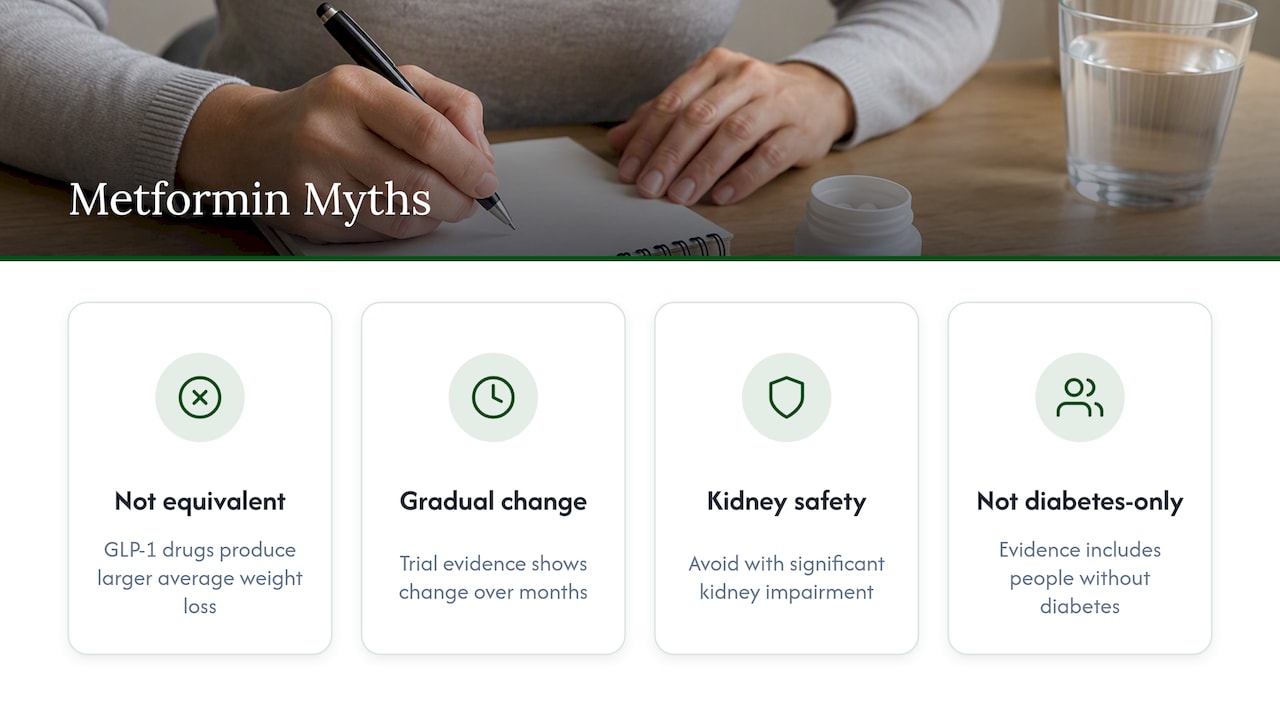
“Metformin is basically Ozempic.” It is not. The two drugs work through different pathways, metformin’s effects are driven largely by changes in insulin sensitivity and modest appetite signaling, while GLP-1 receptor agonists act much more directly and powerfully on appetite centers, which is why their average weight-loss magnitude tends to be larger.
“If I’m not losing weight fast, it’s not working.” Metformin was never going to produce fast results. The trial evidence consistently shows gradual change over months, and clinical guidance frames it as a low-cost adjunct for weight management rather than a rapid-acting treatment.
“It’s dangerous for your kidneys.” Metformin is avoided in people with significant kidney impairment, but for people with normal or mildly reduced renal function, it has a long track record of safety when dosed and monitored appropriately.
“It only works for diabetics.” The evidence base, including the Diabetes Prevention Program and multiple meta-analyses, specifically includes people without diabetes who have prediabetes, insulin resistance, or obesity, which is the population most relevant to weight-focused use.
Metformin occupies an unusual spot in weight management: unglamorous, inexpensive, and genuinely useful for the right person. It will never produce the dramatic numbers associated with newer injectable medications, and treating it that way sets people up to quit too early. Its real value shows up over years, not weeks, in people who have insulin resistance working against them and who stay consistent long enough for the slow mechanisms to compound.
We think the biggest mistake is using metformin in isolation and expecting it to carry the whole effort. Paired with structured lifestyle support and the right candidacy screening, it earns its place as one of the more durable, low-risk tools available.
— Bryan
Starting metformin without the right screening is where most of the risk lives, not in the medication itself. Our weight loss care path starts with an online evaluation and a review of relevant labs, including kidney function and metabolic markers, so a licensed provider can confirm candidacy before anything gets prescribed.

From there, a titration plan is built around how the patient tolerates the medication, formulation or dose adjusted as needed, and prescriptions can be shipped directly to the home. Ongoing app-based support can keep nutrition, activity, and sleep guidance connected to the same plan, rather than treating the prescription as a standalone fix.
What this looks like in practice:
If you think metformin might fit your situation, the fastest way to find out is to start an evaluation on our weight loss page and let a licensed provider walk through your history and labs with you.
For most people, metformin alone is unlikely to produce a loss that large. Observational data point to an average of roughly 4 to 7 pounds over a year, with larger individual results possible but not typical.
They are not direct substitutes. Metformin produces modest, gradual weight loss through insulin sensitivity and mild appetite effects, while GLP-1 medications like Ozempic act more directly on appetite centers and generally produce larger average weight loss; the better choice depends on your metabolic profile, candidacy, and what your provider recommends.
Yes. Clinical guidance supports considering metformin as a low-cost adjunct for weight management in people without diabetes who have obesity or metabolic risk factors like insulin resistance or prediabetes.
Metformin’s weight loss is generally reflected in overall BMI reduction rather than fat loss targeted to one area. Pooled trial data show BMI reductions averaging about 1.3 units, with no specific evidence that the effect concentrates in abdominal fat more than elsewhere.


.svg)
