Mail order pharmacies generally work best for stable, long-term medications you take every month, while a retail pharmacy remains the smarter choice for anything urgent, newly prescribed, or requiring refrigeration during transit. The right pick usually comes down to three factors: cost, convenience, and safety. Before trusting any pharmacy with a prescription, confirm it is properly licensed and verified.
TL;DR:
- Mail order pharmacies generally provide lower costs for 90-day supplies and automatic refills, but shipping delays and refrigeration needs can cause issues.
- Retail pharmacies offer same-day access, in-person counseling, and additional services like vaccinations, but at a higher per-fill cost and longer wait times.
- Verifying a mail order pharmacy’s legitimacy requires checking licensing, physical address, prescription requirements, and pharmacist availability, as many online sites operate outside safety rules.
- Insurance often favors mail order for long-term medications with lower copays for 90-day fills, but plan specifics and discounts should be checked before switching.
- A hybrid approach combining mail order for stable, chronic drugs and retail for urgent or new prescriptions optimizes safety, cost, and adherence.
The two models solve different problems, and the gap shows up clearest when you line up the details side by side.
Retail pharmacies typically dispense a 30-day supply per copay, while mail order plans are often built around 90-day fills, which can lower the cost per day of therapy for medications you take continuously. Refill logistics differ too: mail order services frequently offer automatic refills tied to your prescription schedule, while retail refills usually require you to call, use an app, or show up in person each cycle. Pharmacist access is the other major divide. Retail pharmacists are available face to face for questions about a new drug or an interaction, while mail order pharmacies typically offer phone or chat access to a licensed pharmacist rather than a walk-in counter.
Cost: 90-day mail fills often reduce per-dose cost for maintenance drugs compared with repeated 30-day retail copays.
Supply and refills: mail order favors automatic 90-day cycles; retail favors flexible, shorter fills.
Pharmacist access: retail offers in-person counseling; mail order offers remote pharmacist support.
Best fit: mail order suits ongoing chronic care; retail suits acute, new, or urgent prescriptions.
If you take a blood pressure medication or a daily antidepressant, the 90-day mail model tends to reduce hassle and cost. If you just left urgent care with a five-day antibiotic course, retail is the only practical option.
Every choice involves trade-offs that only become obvious once you live with them.
Mail order pharmacies tend to offer lower per-fill costs on 90-day supplies, automatic refill scheduling that removes the memory burden, and more privacy since medications arrive at your door rather than passing over a counter. The downsides are logistical: shipping delays can leave you waiting on a refill, medications needing refrigeration require careful packaging and timing, and the first order often takes longer to process than a retail pickup.
Retail pharmacies give you same-day access when you need a prescription filled immediately, hands-on counseling from a pharmacist who can flag interactions on the spot, and access to vaccines and other point-of-care services. The tradeoffs are a higher cost per fill for chronic medications and the time cost of driving there and waiting in line.
Mail order pros: lower cost on 90-day fills, automatic refills, more privacy.
Mail order cons: shipping delays, refrigeration handling, longer first-order processing.
Retail pros: same-day fills, in-person counseling, vaccines and point-of-care services.
Retail cons: higher per-fill cost, travel and wait time.
Pro Tip: When switching a maintenance medication to mail order, keep a short overlap, filling one cycle locally while the mail order account gets set up, so you never run dry waiting on the first shipment.
Not every website selling medication is a real pharmacy, and the FDA’s BeSafeRx guidance lays out exactly what to check before you order.
The FDA and NABP both warn that a large share of online pharmacy websites operate outside these rules, often skipping the prescription requirement entirely or hiding their physical location. Red flags include prices that seem too low for brand-name drugs, no prescription requirement, and no way to reach a pharmacist. If you suspect you received a counterfeit or altered medication, stop taking it, report it to the FDA, and contact your prescriber right away.
Your out-of-pocket cost has less to do with the pharmacy itself and more to do with how your insurance plan structures copays.
Many insurers build tiered copay structures that reward 90-day mail order fills with a lower cost per day of supply than three separate 30-day retail copays, which is part of why payer communications routinely steer members with chronic conditions toward mail order for adherence and cost reasons. Some plans go further and designate a preferred mail order pharmacy, applying a penalty copay if you fill a maintenance drug at retail instead.
For a closer look at how large retail chains stack up against digital delivery services, see this comparison of retail pharmacy and online prescription delivery.
The strongest argument for mail order isn’t convenience, it’s what happens to people’s actual medication-taking behavior over time.
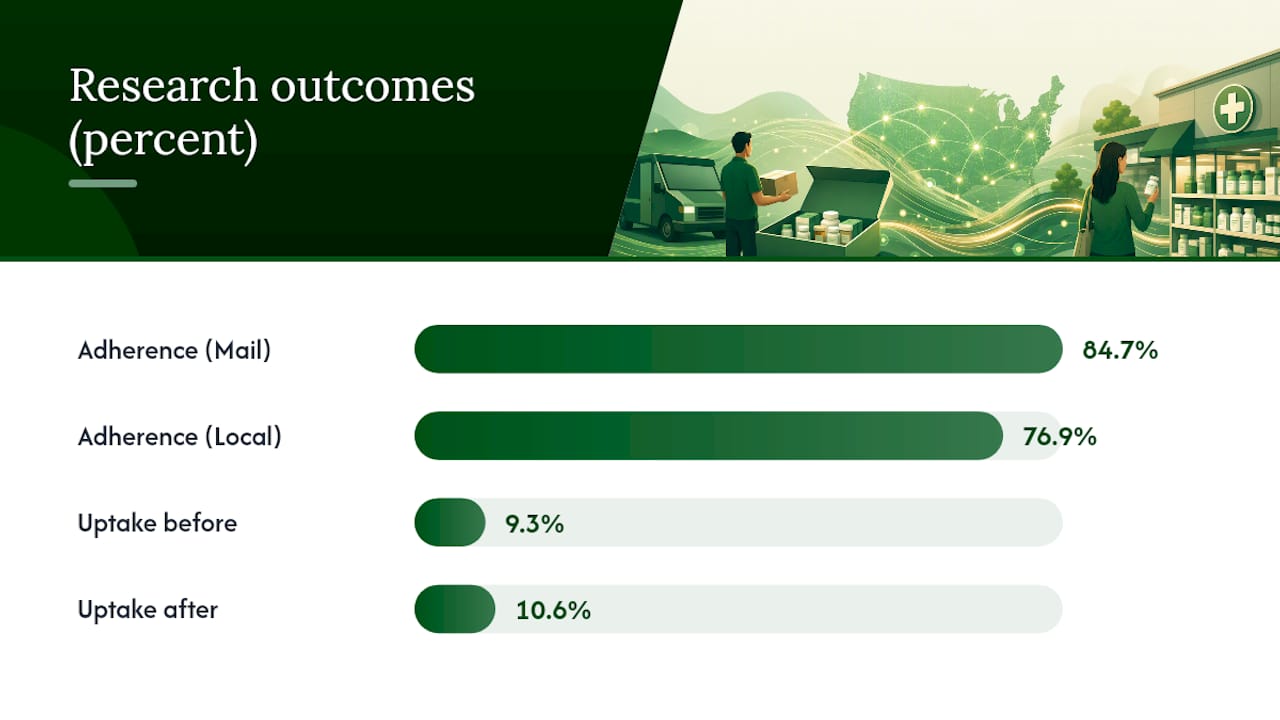
A Kaiser Permanente cohort study found that patients using mail order pharmacy for diabetes medications had 84.7% adherence, compared with 76.9% among local pharmacy users, a 7.8 percentage point gap. That difference matters for a condition where missed doses directly affect blood sugar control. A separate randomized encouragement trial tested whether actively encouraging patients to switch produced the same effect: outreach modestly increased mail order enrollment, from 9.3% to 10.6% uptake, and produced small adherence gains for metformin in some subgroups. Together, the two studies suggest mail order is genuinely associated with better adherence, though getting people to switch takes more than just offering the option.
What seems to drive the improvement isn’t the mail truck itself but the mechanics behind it: automatic refill scheduling removes the need to remember a monthly errand, and 90-day supplies mean three fewer chances per year to miss a pickup. The practical risk sits at the seams. First-fill processing can take longer than a retail pickup, so build in a short overlap and confirm your refill window in advance. If a shipment is delayed and you are close to running out, a local pharmacy can usually bridge a few days while the mail order fill catches up.
Work through this before switching anything, especially if you take multiple medications.
Ask your prescriber whether a medication is appropriate for a 90-day supply, and ask your insurer directly what your copay would be under each option. Details about how digital refill requests actually work, from submission to shipment, are covered in this guide to online prescription refills.
Pro Tip: Request a short overlap fill at your local pharmacy the same week you submit your first mail order request, so a shipping delay never turns into a missed dose.
Most people don’t need to pick a side permanently. A hybrid strategy, retail for anything acute or newly started and mail order for anything chronic and stable, tends to capture the cost and adherence benefits of mail order without giving up the safety net of a local pharmacist. Some health systems already build this in, pairing mail order distribution with local pharmacy networks and telephone pharmacist access so patients get both convenience and a real person to call.
This is also where clinician-integrated delivery models add value. A platform that combines an online consultation with a licensed provider, a personalized treatment plan, and direct-to-home shipping keeps a clinician in the loop rather than leaving you to manage the switch alone. That coordination matters most around dose changes or medications that need refrigeration during shipping, situations where a quick check-in with a provider before switching pharmacies is worth the extra step. Details on how temperature-sensitive medications are packaged and shipped are covered in this guide to how weight loss medications ship home.
I’d rather see someone use both options deliberately than pick one out of habit. The adherence data on mail order is genuine, not marketing, but it only pays off if you actually verify the pharmacy first and keep a local backup for the moments mail order can’t cover. Talk to your prescriber before switching a chronic medication, and don’t assume mail order is cheaper until you’ve actually checked your plan’s copay tiers.
The safest version of this decision is the boring one: verify licensing, ask questions, keep a local pharmacy in your contacts, and let the evidence, not convenience alone, guide the switch.
— Bryan
If the idea of mail order appeals to you but you’d rather not manage prescriptions on your own, FitRx builds the clinician into the process. Licensed providers conduct the initial consultation, build a personalized treatment plan, and medications ship directly to your home with ongoing support available through the app.

Whether managing an ongoing prescription or starting new treatment, it’s advisable to verify provider credentials and medication availability before enrolling. You can start by reviewing FitRx’s weight loss and telehealth services to see if the model fits how you want your prescriptions handled.
This article is general information, not a substitute for advice from a qualified doctor. Consult a qualified healthcare professional about your own circumstances before acting on anything here.
The main downsides are shipping delays, longer processing time on your first order, and added complexity for medications that need refrigeration during transit. These issues rarely affect stable, long-term prescriptions but can be a real problem if you run out of a medication and need it immediately.
It often is for maintenance medications, since insurers frequently price 90-day mail fills lower per day of supply than repeated 30-day retail copays. Whether it’s cheaper for you specifically depends on your plan’s formulary and preferred pharmacy rules, so checking your benefits is the only way to know for sure.
Research shows mail order use is associated with meaningfully higher adherence: one Kaiser Permanente cohort found 84.7% adherence among mail order users for diabetes medications versus 76.9% for local pharmacy users. Reliability drops mainly around shipping delays and first-fill processing time, which is why keeping a short overlap during the switch is worth doing.
There isn’t a single best option since the right pharmacy depends on your insurance plan’s preferred network and the specific medication you need. Clinician-integrated services like FitRx offer one model that pairs a licensed provider with home delivery, but comparing your insurer’s preferred pharmacy list is the first step regardless of which service you consider.


.svg)
