The essential hair loss labs to check are ferritin and a full iron panel, a complete blood count (CBC), TSH with free T4, and 25-hydroxyvitamin D. If you have patterned thinning or signs like acne, irregular periods, or excess facial hair, add free testosterone, SHBG, and DHEAS. Request these tests along with a clinical scalp exam. Do not start treatment until you have both.
TL;DR:
- Testing ferritin levels above 40 to 70 ng/mL is often necessary for optimal hair growth, as standard labs may falsely categorize these levels as normal.
- In cases of pattern baldness, hormone tests should include free testosterone, SHBG, and DHEAS, especially if acne or irregular periods are present, to identify androgen excess.
- Abnormal TSH levels can disrupt hair growth, and adding TPO antibodies helps confirm autoimmune thyroiditis as a cause when thyroid function is off.
- Scalp examinations like dermoscopy and scalp biopsies are essential for identifying miniaturization or scarring that blood tests cannot detect.
- Correcting deficiencies or hormonal imbalances typically results in hair regrowth over several months, so patience and consistent treatment are crucial.
Start with the tests that catch the most common, most fixable causes. A clinician cannot diagnose the pattern of your hair loss from blood work alone, but blood tests are how you catch internal triggers like an underactive thyroid, iron deficiency, or elevated androgens that a scalp exam won’t reveal on its own, according to Healthline’s review of blood tests for hair loss.
Here’s the core panel most dermatologists start with for diffuse or unexplained shedding:
If your history suggests something autoimmune or inflammatory, your provider may add ESR or CRP. These aren’t part of a routine panel, but they matter when scarring alopecia or an inflammatory scalp condition is on the table.
Androgen testing isn’t for everyone. It’s reserved for patterned thinning, meaning a receding hairline or crown thinning in men, or widening part lines in women, especially when other signs point to hormone involvement.
When it’s warranted, the panel typically includes:
For women, timing matters. These hormones fluctuate across the menstrual cycle, so providers usually order this panel early in the cycle for a cleaner read.
Pro Tip: If you’re seeing acne flare-ups, new facial hair, or periods that have become unpredictable alongside the thinning, mention that upfront. It’s what tells your provider to reach for the androgen panel instead of a generic nutrition check.
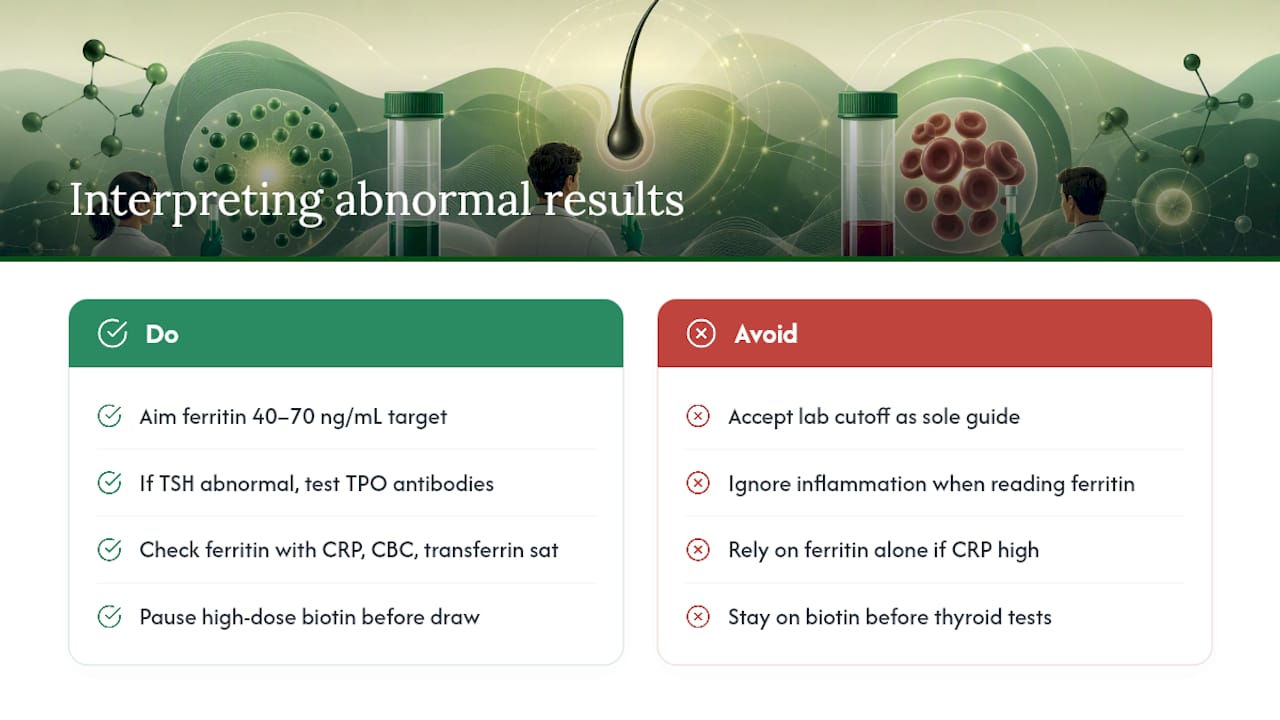
Numbers on a lab report only matter in context. A ferritin level that a standard lab flags as “normal” might still be too low for healthy hair growth, since many dermatologists use a higher functional target, often cited around 40 to 70 ng/mL, well above the lab’s minimum cutoff for iron deficiency.
TSH outside the normal range can disrupt the hair cycle in either direction, according to Healthline. If TSH is abnormal, TPO antibodies help confirm or rule out Hashimoto’s.
The confounder to know: ferritin is an acute-phase reactant, meaning inflammation, infection, or even a recent illness can push it artificially high and mask a real deficiency. That’s why ferritin should be read alongside transferrin saturation, CBC, and CRP when inflammation is a possibility, per MDedge’s clinical guide to ferritin in hair loss patients. High-dose biotin supplements can also distort certain thyroid assay results, so pausing biotin for a few days before your blood draw is worth doing if you remember.
Labs tell you what’s happening internally. They can’t tell you what your scalp and follicles actually look like, which is why a physical exam still carries equal weight.
A history and scalp exam are non-negotiable companions to lab work, not an optional add-on, per NYU Langone’s guidance on diagnosing hair loss.
The right starting point depends heavily on what your hair loss actually looks like.
Red flags that warrant urgent referral rather than routine labs: sudden, severe hair loss over days rather than months, visible scarring or scalp inflammation, or hair loss paired with unexplained weight change and heart palpitations.
Correcting a deficiency doesn’t produce overnight regrowth. Follicles move through their growth cycle slowly, so visible improvement after fixing low iron typically takes several months to show up, not weeks. Oral iron supplementation is the usual first step; IV iron or a GI workup gets considered if oral iron isn’t tolerated or absorption is suspect.
Thyroid correction follows a similar timeline. Once TSH normalizes, hair shedding often slows within a few months, though full regrowth takes longer. Hormonal causes like PCOS usually mean a referral to endocrinology alongside ongoing dermatologic care, since managing shedding tied to hormones often means treating the underlying condition, not just the hair.
Pro Tip: Take a photo of your part line or hairline under the same lighting every month. It’s far more reliable than memory for spotting real progress, and it gives your provider something concrete when deciding whether to repeat labs.
Getting these labs ordered usually means a doctor’s visit first. FitRx’s hair loss program connects you with a licensed provider online who can help coordinate lab ordering, interpret results, and build a treatment plan with app-based follow-up. Telehealth speeds up that first step, but it doesn’t replace an in-person biopsy or fungal culture when one is genuinely needed.
Most articles on this topic hand readers a generic list of tests and call it done. That misses the part that actually matters: sequencing. Ordering an androgen panel for someone with plain diffuse shedding wastes money and delays the answer, and ordering only ferritin for someone with clear signs of hyperandrogenism does the same in reverse.
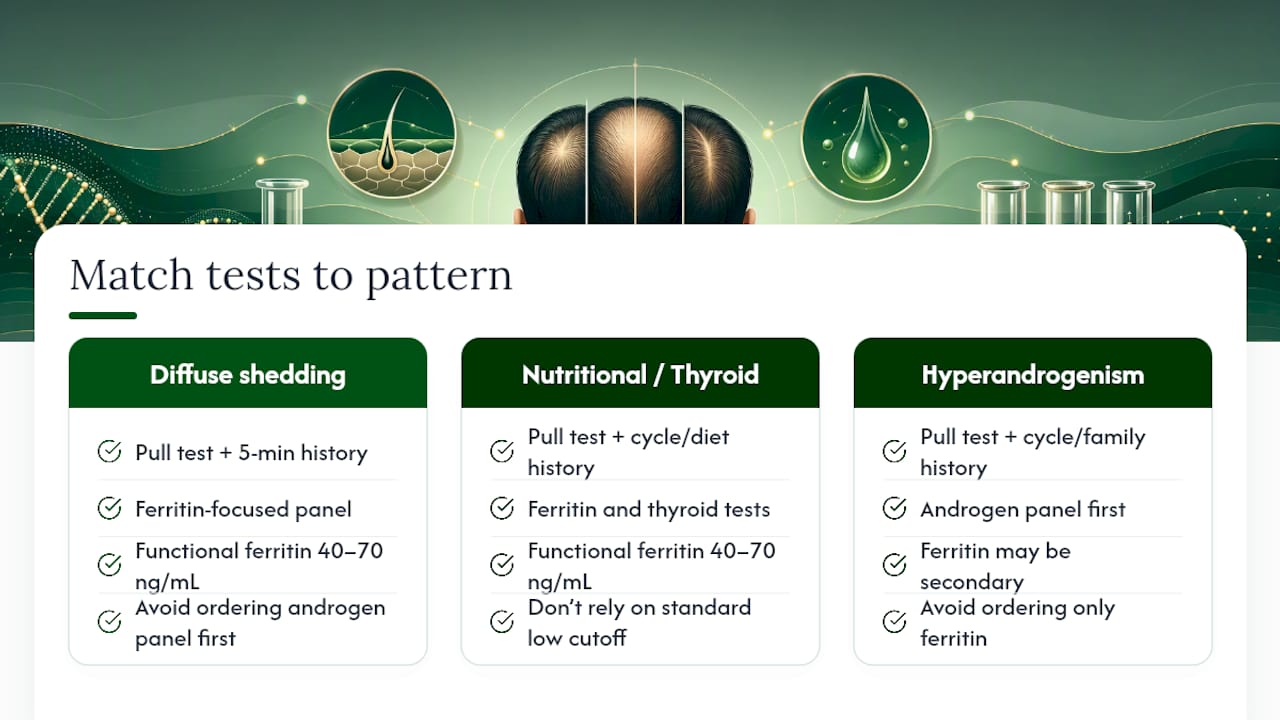
The uncomfortable truth is that a lot of hair loss workups fail not because the labs were wrong, but because nobody paused to match the tests to the pattern first. A pull test and a five-minute conversation about your cycle, your diet, and your family history should always come before the blood draw, not after. That’s also why the “functional” ferritin target dermatologists use, often 40 to 70 ng/mL, gets ignored so often. Standard labs flag deficiency at a much lower cutoff, so plenty of people walk away with a “normal” result that’s still too low for their hair to recover.
If there’s one thing worth pushing back on, it’s the idea that more testing is always better. A tight, symptom-matched panel beats a shotgun approach almost every time, both for your wallet and for how fast you get a real answer.
— Bryan
This article is general information, not a substitute for advice from a qualified doctor. Consult a qualified healthcare professional about your own circumstances before acting on anything here.
The three most commonly checked labs for thinning hair are ferritin (iron stores), TSH with free T4 (thyroid function), and 25-hydroxyvitamin D. Many providers also run a CBC alongside these to give the ferritin result proper context.
There’s no single blood test that measures DHT directly in routine practice. Instead, providers check free testosterone, SHBG, and DHEAS, since low SHBG combined with normal or high free testosterone suggests more active androgen effect on hair follicles.
Diagnosis combines a clinical history, a scalp exam with the pull test and dermoscopy, and blood work, including ferritin, CBC, TSH with free T4, and 25(OH)D. A punch biopsy or fungal culture gets added when the pattern is unclear or looks patchy and inflammatory.
Ask for ferritin and iron studies, a CBC, TSH with free T4, and 25-hydroxyvitamin D as a starting panel. If you have signs of hormonal imbalance like acne or irregular periods, ask about adding free testosterone, SHBG, and DHEAS.
Visible regrowth after correcting a deficiency like low ferritin or an underactive thyroid typically takes several months, since hair follicles cycle slowly even after the underlying cause is treated.


.svg)