Inject GLP-1 medications subcutaneously in one of three approved spots: the abdomen, the front or outer thigh, or the back or outer upper arm. Clinical research shows similar absorption across all three sites, so the main rules are to rotate between spots, stay about 2 inches from your belly button when using the abdomen, and always inject into fatty tissue under the skin rather than muscle.
TL;DR:
- All three approved injection sites—abdomen, thigh, and upper arm—provide similar medication absorption levels when used correctly.
- Injecting into fatty tissue rather than muscle reduces absorption variability, with proper technique including skin pinching when necessary.
- Rotating injection spots by at least 1 to 1.5 inches every week helps prevent lumps and uneven absorption caused by tissue buildup.
- Common mistakes include injecting too close to the navel, reusing the same spot, and skipping skin preparation, which can lead to discomfort or uneven drug delivery.
- Proper preparation, site rotation, and following device instructions minimize pain and prevent injection-site complications.
Picking a site comes down to comfort and access more than anatomy. All three approved locations work equally well when the injection is done correctly, so the “best” spot is simply the one you can reach easily and use consistently.
The abdomen is the area most self-injectors reach for first. It spans the soft tissue between your ribs and hip bones, and it gives you a clear view of the needle and skin fold, which makes technique easier to control. Keep the injection site at least 2 inches, roughly 5 centimeters, away from your navel, since the tissue right around the belly button is thinner and often scarred from past procedures or healing.
The front or outer thigh is a solid alternative, especially when you’re wearing loose pants or traveling and don’t want to lift a shirt in public. Use the upper, outer portion of the thigh and avoid the inner thigh, where skin is thinner and nerves sit closer to the surface.
The back or outer upper arm, specifically the triceps area, is approved too, but it’s the hardest to reach on your own. Most people need a partner, family member, or caregiver to pinch the skin and guide the needle safely into that spot.
A quick way to think through your options:
Similar systemic exposure is achieved whether you inject into the abdomen, thigh, or upper arm, according to FDA prescribing information for semaglutide. That means switching sites week to week for comfort doesn’t change how much medication reaches your bloodstream.
Once you’ve settled on a site, the physical process is the same whether you’re using a prefilled pen or drawing from a vial with a syringe. Our guide on how to inject semaglutide correctly walks through the abdomen-specific version of this routine in more detail.
Don’t rub the site after injecting. If you see a small drop of blood, press a clean cotton ball or gauze against it for a few seconds instead.
Pro Tip: Pens and syringes aren’t interchangeable in handling time, so read the instructions for use that came with your specific device before your first dose, even if you’ve injected other medications before.
Injecting the exact same spot week after week can cause lipohypertrophy, a buildup of lumpy tissue under the skin that makes future doses absorb unevenly. Placement and rotation guidance for once-weekly injectables recommends moving at least 1 to 1.5 inches, or about 2.5 to 4 centimeters, from your prior injection point every time.
A simple rotation habit keeps this manageable:
This kind of simple tracking matters more than it seems. A missed rotation here and there won’t cause lasting harm, but a pattern of reusing the same patch of skin will.
A brief sting during the injection, mild redness, or a small bruise afterward are common and usually fade within a day or two. Injection-site reactions overall are uncommon in clinical trials of these medications.
When something feels off, a few quick fixes handle most situations:
Injection-site reactions were reported in a small percentage of trial participants in placebo-controlled trials of semaglutide, which lines up with how uncommon serious site problems tend to be in practice.
Some signs need medical attention right away: spreading redness, increasing pain instead of improvement, fever, or pus at the injection site. Contact your prescriber promptly if any of these appear. Avoid injecting a new dose directly into a spot where you recently gave another shot or had a reaction, and check your medication’s instructions for use if you’re on more than one injectable at a time.
Save this for your next dose day.
| Checklist item | Source guidance |
|---|---|
| Approved sites | Abdomen, thigh, or upper arm, per FDA prescribing information |
| Exposure across sites | Similar systemic exposure regardless of which approved site is used |
| Route | Subcutaneous injection only, not intramuscular |
| Rotation | Move to a new spot each week, avoiding the exact prior injection point |
| Technique | Pinch skin if needed, insert at a 90-degree angle for most adults, per CDC subcutaneous guidance |
| Disposal | Place used needles in an FDA-cleared sharps container immediately |
Your device’s instructions for use remains the final word on handling details specific to your pen or syringe, since timing and button mechanics vary by manufacturer.
A little preparation goes a long way toward making weekly injections painless. Letting your skin come to room temperature matters if you store your medication in the refrigerator: pulling it out 15 to 30 minutes before injecting reduces the sting that cold liquid causes.
Numbing the area briefly with an ice cube for a few seconds before cleaning the skin can dull sensation without interfering with absorption. Make sure any alcohol you use to clean the site has fully dried before the needle goes in, since alcohol that’s still wet intensifies the burning sensation.
Relaxing the muscle underneath the injection site also helps. Tensing up, especially in the thigh or arm, makes the needle feel sharper than it is. Breathing out slowly as you insert the needle is a simple trick that works for a lot of first-time injectors.
Needle gauge and length are already set by your device, so you can’t adjust those, but inserting the needle in one smooth, quick motion rather than slowly is generally less painful than a hesitant approach. If you consistently feel more than mild discomfort, mention it to your prescriber. Occasionally a different approved site or device suits your skin and nerve sensitivity better.

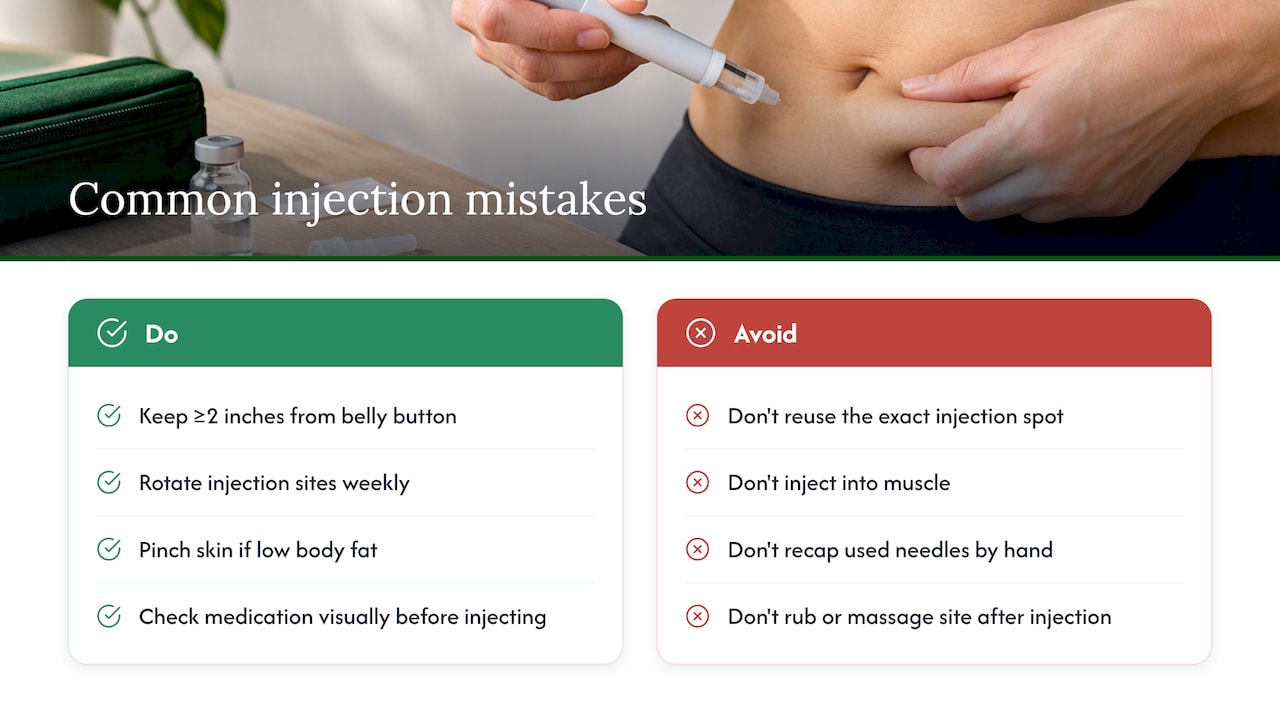
A handful of errors account for most injection problems, and nearly all of them are easy to fix once you know to watch for them.
Injecting too close to the belly button is one of the most frequent mistakes. Staying under the 2-inch minimum puts the needle into thinner, more sensitive tissue. Reusing the same exact spot week after week is another common habit that leads to lumps and uneven absorption over time.
Injecting into muscle instead of the fatty layer under the skin is a technique error that can speed up or change how the medication absorbs. This usually happens when someone with very little body fat skips the skin pinch step. Skipping a visual check of the medication before injecting is also easy to overlook, but cloudy liquid or visible particles mean the dose shouldn’t be used.
Recapping a used needle by hand, rather than disposing of it immediately, creates an unnecessary needlestick risk. Finally, rubbing or massaging the site right after injecting can push the medication out faster than intended and irritate the skin unnecessarily. Each of these is a small adjustment, but together they make the difference between a routine that feels easy after a few weeks and one that stays frustrating.
Pick a consistent day and time each week so the routine becomes automatic. For more detailed guidance on administration and missed doses, see this weight-loss drugs resource. Wear clothing that gives easy access to your chosen site, and if needles make you anxious, practicing with a saline-filled syringe beforehand can help. The thigh is convenient for travel days, and arm injections go smoother with a second pair of hands. Keep your sharps container within reach every time. Reach out to your prescriber for dose questions or if a site problem doesn’t resolve.
— Bryan
Once you know the technique, the bigger hurdle for a lot of people is getting a prescription and reliable refills without juggling in-person appointments. We connect you with licensed providers through virtual consultations, build a treatment plan around your health profile, and support medication delivery with ongoing support through our app.

Always follow your prescribing clinician’s instructions and never adjust your dose without medical guidance. If you want to see whether treatment is a fit, you can find out if weight loss injections could be right for you and start with a consultation.
This article is general information, not a substitute for advice from a qualified doctor. Consult a qualified healthcare professional about your own circumstances before acting on anything here.
There isn’t one site that works better than the others. Obesity medicine specialists note that clinical research shows equivalent systemic exposure across the abdomen, thigh, and upper arm, so the most effective site is simply the one you can inject consistently and comfortably each week.
No. FDA prescribing information states that similar exposure is achieved whether the injection goes into the abdomen or the thigh. Choose whichever site is easier for you to reach and see clearly.
Tissue immediately around the navel tends to be thinner and may have scarring from past surgeries or procedures, which can affect how the medication absorbs. Guidance recommends staying at least 2 inches away from the belly button when using the abdomen as your injection site.
Yes, common errors include injecting into muscle instead of the fatty layer under the skin, reusing the same spot every week, and injecting too close to the navel. Following the rotation and technique steps in your device’s instructions for use helps you avoid these mistakes.


.svg)
