For most healthy men, finasteride does not cause lasting infertility. A smaller group of men who already have low sperm counts can see a reversible decline in sperm production while taking it. If you’re planning to conceive, the sensible next step is a semen analysis and a conversation with your clinician before you decide whether to stop.
Finasteride is FDA-indicated for men only. Women who are or may become pregnant must not handle crushed or broken finasteride tablets, due to the risk of harm to a male fetus. It can also cause sexual side effects (reduced libido, erectile dysfunction) in a minority of men, which usually resolve after stopping treatment. Discuss these risks with a physician before starting.
TL;DR:
- Finasteride does not significantly affect sperm in healthy men without prior fertility issues, based on a 48-week controlled trial.
- Men with preexisting low sperm counts or infertility who stop finasteride typically see substantial improvements in sperm levels within a few months.
- Men with known fertility concerns should get a semen analysis before starting or stopping finasteride to accurately assess risk and recovery potential.
- Paternal finasteride exposure through semen is unlikely to harm a fetus, but handling crushed tablets is risky for pregnant women.
- For those actively trying to conceive, stopping finasteride and tracking semen quality with a clinician increases the chances of successful pregnancy.
The clinical picture on finasteride and fertility splits cleanly into two groups, and the split matters more than any single statistic. In healthy men with no prior fertility issues, controlled trials have not found a clinically significant effect on sperm. In men already dealing with low sperm counts or infertility, the picture looks different, and finasteride can be a contributing factor worth ruling out.
Here’s how the major evidence lines up:
Men with fertility complaints who stopped taking finasteride experienced a marked increase in sperm counts after discontinuation, according to the clinic-based study tracking 27 men on the medication. That’s the number worth remembering if you’re in the higher-risk group. For everyone else, the trial data on standard 1 mg dosing simply doesn’t show that kind of disruption. Low risk for most, real and actionable risk for a minority. That’s the honest summary before you dig into the specifics.
Not all finasteride research applies equally to your situation, and the details of each study determine how much weight it should carry for you personally.
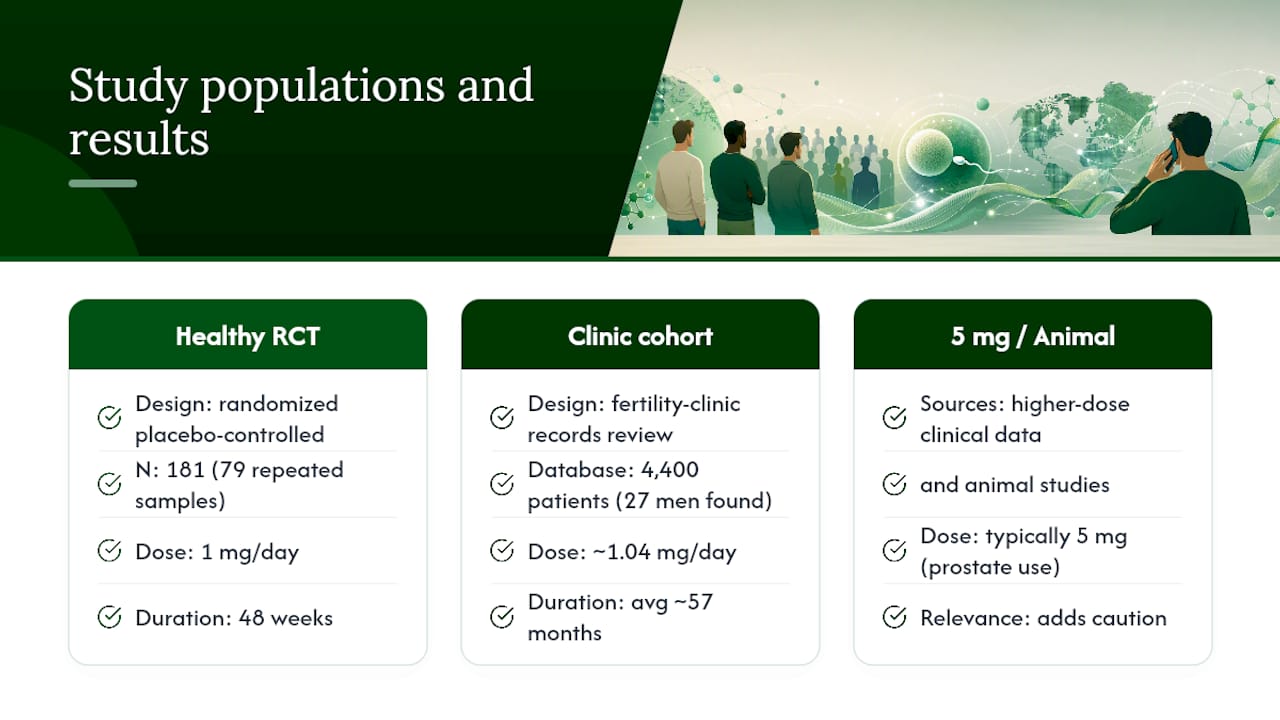
The most reassuring data comes from a 48-week randomized, placebo-controlled trial involving 181 healthy young men, with a subset of 79 providing repeated semen samples throughout treatment. At the standard 1 mg daily dose used for hair loss, researchers tracked sperm concentration, total sperm per ejaculate, motility, and morphology, and found no clinically meaningful changes compared to placebo, either during treatment or after stopping. This is the study that supports the “low risk for most men” conclusion, and it’s the largest controlled look at 1 mg finasteride in men without prior fertility problems.
The less reassuring data comes from a different population entirely. The fertility-clinic discontinuation study pulled records from a database of 4,400 patients and identified 27 men who had been taking finasteride, with an average treatment duration of about 57 months and an average dose close to 1.04 mg per day. These weren’t healthy volunteers. They were men already being worked up for infertility. After stopping finasteride, their sperm counts rose substantially, and a majority of the men with severe oligospermia (low sperm counts) improved to levels generally considered within a normal range. Recovery in this group often showed up within a few months of discontinuation.
Higher-dose data (5 mg, typically studied for prostate conditions rather than hair loss) and animal studies add some caution but don’t map directly onto typical hair-loss dosing. Animal models use exposure levels and routes that don’t reflect how a man taking 1 mg daily actually experiences the drug.
Here’s how the key semen endpoints stack up across the two population types:
The takeaway isn’t that one study is right and the other is wrong. They’re measuring different populations, and both conclusions can be true at once.
Certain factors raise your odds of being in the group that actually needs to worry about finasteride’s effect on sperm.
If any of that describes you, the standard workup starts with a semen analysis. That single test does more to clarify your actual risk than any amount of reading about population averages. Depending on the result, your clinician may add endocrine testing (FSH and testosterone levels), since finasteride and testosterone levels interact in ways worth understanding: finasteride blocks conversion of testosterone to DHT rather than lowering testosterone itself, but abnormal readings still warrant a closer look.
Pro Tip: Get a semen analysis before you stop finasteride, not just after. Without a baseline, you won’t know whether a low count six months from now is a new problem or one that predated the medication.
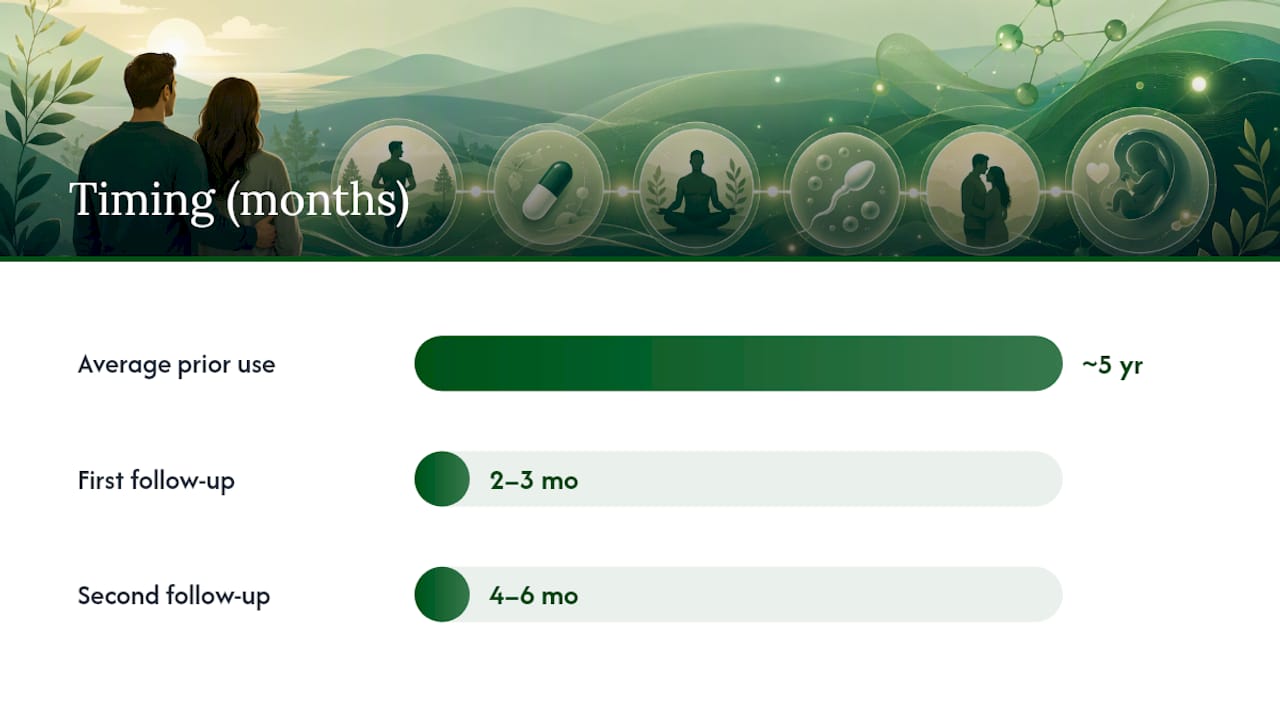
If results come back abnormal, the typical path is to discontinue finasteride, then repeat semen analysis around 2 to 3 months later, with a second follow-up near 4 to 6 months to see if the trend is improving. Men whose counts don’t recover to a usable range in that window are often referred to a reproductive endocrinologist to discuss assisted reproductive options.
The right move depends heavily on which group you fall into, so treat this as two separate paths rather than one universal rule.
Pro Tip: If you and your partner are actively trying, loop your clinician in on the timeline before you stop the medication, not after. Recovery windows in the clinic data ran a few months, and knowing that ahead of time keeps expectations realistic instead of frustrating.
Bring your partner into this conversation early. Conception planning works better as a shared decision than a surprise you announce after the fact.
The concern here is different from the sperm-count question, and the evidence is reassuring. Finasteride concentrations found in semen are very low, and MotherToBaby’s guidance states that paternal exposure through sex is unlikely to cause fetal harm. The animal studies that raise red flags about fetal genital development involve pregnant females given the drug directly at doses far higher than anything transferred through semen, so they don’t translate cleanly to a man’s exposure.
That said, a few low-effort precautions are still worth following:
No confirmed cases of fetal harm from paternal finasteride exposure have been documented in humans, which is why the guidance leans toward simple precautions rather than an outright prohibition.
Most online discussions of finasteride and fertility collapse into one of two extremes: either “it’s completely safe, don’t worry about it” or “it destroys your sperm count.” Neither holds up against the actual data. The truth is boring in the best way: it’s a dose-and-population question, not a universal risk.
What gets underestimated is how much the burden of proof should shift based on your starting point. A 28-year-old with no fertility history and a normal semen analysis has almost nothing to worry about based on the 48-week trial data. A 35-year-old who’s been quietly struggling to conceive for a year and happens to be on finasteride should treat that medication as a variable worth testing, not dismissing. The clinic-based study’s 11.6-fold recovery number is remarkable specifically because it shows how much room some men have to improve once the variable is removed.
The other underrated point: testosterone anxiety around finasteride is often misplaced. The drug blocks an enzyme, not testosterone production itself, and conflating the two leads men to either overreact or ignore a real signal buried in the noise. If you’re going to worry about something, worry about getting an actual semen analysis instead of guessing from forum posts.
— Bryan
If you’re on finasteride and thinking about starting a family, guessing at your risk level helps nobody. You can get access to a licensed clinician who can order a semen analysis, review your results, and help you decide whether to continue, pause, or adjust your treatment.

A typical visit starts with an online consultation where you walk through your history, including how long you’ve been on finasteride and whether you or your partner are trying to conceive. From there, your clinician can order the relevant labs, walk you through what the numbers mean, and set a follow-up plan that fits your specific timeline rather than a generic script. If continuing finasteride still makes sense for you, Ongoing prescription and monitoring can also be managed as needed. Learn more about how FitRx evaluates finasteride side effects and what monitoring looks like, or head straight to the hair loss program page to start your consultation today.
The clinical guidance in this article draws on a handful of primary sources worth reading directly if you want the full detail behind any recommendation:
This article is general information, not a substitute for advice from a qualified doctor. Consult a qualified healthcare professional about your own circumstances before acting on anything here.
For most healthy men, no. Trial data on 1 mg dosing found no significant effect on sperm parameters, though men with preexisting low sperm counts can see a reversible decline worth addressing before trying to conceive.
Yes. Semen concentrations of finasteride are very low, and MotherToBaby states that paternal exposure through sex is unlikely to cause fetal harm, though avoiding contact with crushed tablets is still recommended.
If you have a known low sperm count, clinicians typically recommend stopping and re-checking semen analysis at 2 to 3 months, with a second check around 4 to 6 months to confirm recovery. Men with no fertility history often don’t need to stop at all.
Not typically in healthy men at standard doses. Finasteride and other DHT blockers can affect sperm production in men who already have low counts or fertility issues, but the effect is usually reversible after discontinuation.
If you’re planning to have children in the near future or have any history of fertility concerns, a baseline semen analysis before starting gives you and your clinician a clear reference point. FitRx can order this testing as part of an online consultation focused on finasteride and fertility planning.


.svg)