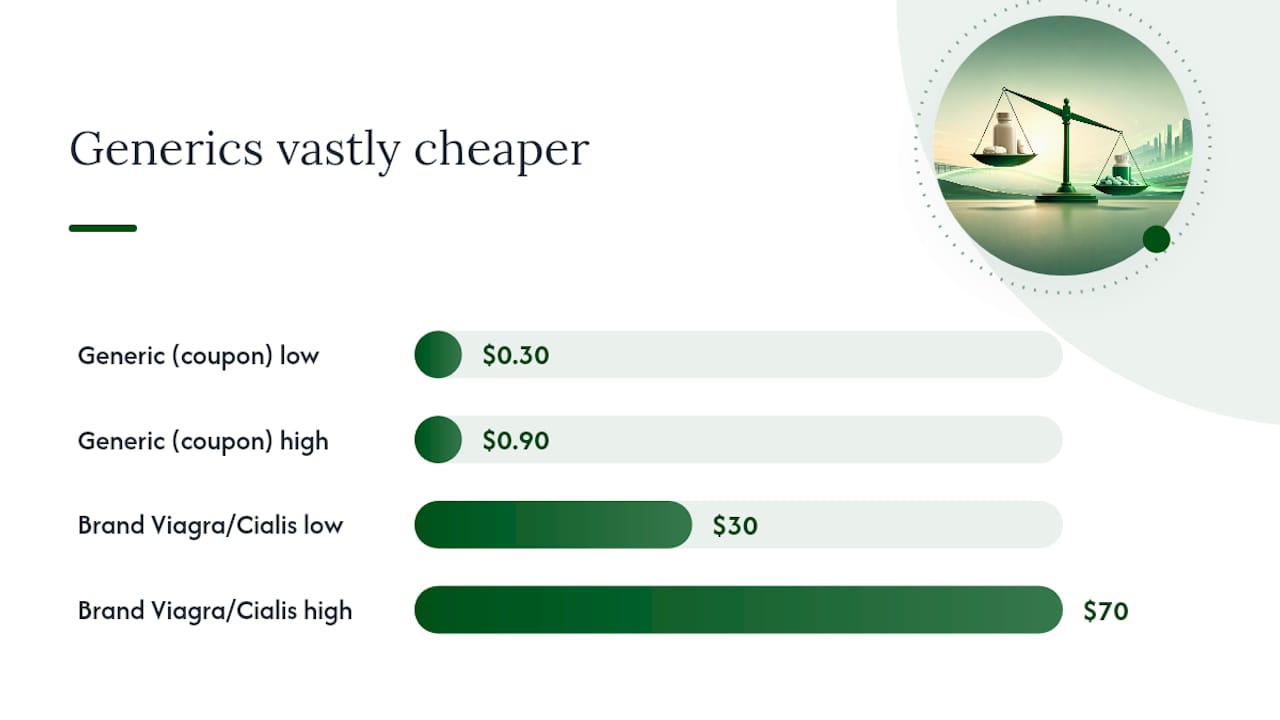
Most men can get effective erectile dysfunction medication for well under $1 per pill. Generic sildenafil and tadalafil, the active ingredients in Viagra and Cialis, are available at discount pharmacies and through coupon services for as little as $0.30–$0.90 per pill when you pay cash. Brand-name versions of those same drugs can run $30–$70 per pill without insurance, which is why the generic switch matters so much.
Here’s a quick price snapshot for the five main ED drugs:
A realistic monthly cost for generic sildenafil or tadalafil, using 8–12 pills per month with a coupon, runs $5–$20. Published 2026 price roundups confirm sub-dollar-per-pill cash prices are achievable at discount pharmacies and mail-order services.
Pro Tip: The cheapest path for most men is a telehealth or in-person consult to get a prescription, then filling it with a discount coupon (GoodRx, RxSaver, or similar) at a local or mail-order pharmacy — not running it through insurance.
Generic sildenafil and tadalafil are clinically equivalent to brand Viagra and Cialis per FDA standards, and cash/coupon prices under $1 per pill make them the most cost-effective ED medications available in 2026.
| Point | Details |
|---|---|
| Generic prices are very low | Generic sildenafil and tadalafil run $0.30–$0.90 per pill with coupons at discount pharmacies. |
| Brand names cost far more | Brand Viagra and Cialis can run $30–$70 per pill cash, with no clinical advantage over generics. |
| Insurance rarely covers ED drugs | Most plans classify ED medications as lifestyle drugs; coverage improves only when tadalafil is prescribed for BPH. |
| Coupon path often beats insurance | GoodRx or RxSaver cash prices frequently undercut insurance copays for generic sildenafil and tadalafil. |
| FitRx offers a direct path | FitRx provides same-day online consults, prescription issuance, and home delivery or pharmacy transfer for ED treatment. |
Understanding the cost of erectile dysfunction medication means looking at each drug separately, because pricing varies dramatically based on whether a generic exists and how long it’s been on the market.
Generic sildenafil is the most price-competitive ED drug on the market. Brand-name Viagra pricing varies widely, but generic sildenafil costs a fraction of that at most pharmacies. The standard on-demand dose is 50–100 mg taken 30–60 minutes before activity, with effects lasting 4–6 hours. Best for men who want a proven, flexible option at the lowest possible price.
Generic tadalafil’s biggest selling point is its 36-hour window, which removes the need to time a pill precisely. At 5 mg daily, it also treats benign prostatic hyperplasia (BPH), which can affect insurance coverage. Per peer-reviewed clinical reviews, tadalafil’s longer half-life makes it the preferred choice for men who want spontaneity or who take it daily. Cash prices for generic tadalafil are now competitive with generic sildenafil at many pharmacies.
Avanafil has the fastest onset of any oral ED drug, working in as little as 15 minutes for some men. The catch: no generic exists yet, so every pill costs $25–$45 out of pocket. Best for men who prioritize speed and can absorb the higher cost.
Generic vardenafil is available and meaningfully cheaper than brand Levitra, though still pricier than sildenafil or tadalafil generics. Staxyn is an orally disintegrating formulation that doesn’t require water. Onset is similar to sildenafil (30–60 minutes), with a 4–5 hour duration. A reasonable middle-ground option if sildenafil doesn’t work well for you.
Alprostadil works differently from oral PDE5 inhibitors. Per the official DailyMed prescribing information, Caverject is an injectable formulation administered directly into the penis, while Muse is a urethral suppository. Both are FDA-labeled alternatives for men who don’t respond to oral medications. Cost per dose is significantly higher, and insurance coverage is more likely given the medical indication. Not a first-line choice for most men, but an important option for refractory cases.
The same 100 mg sildenafil tablet can cost $0.40 at one pharmacy and $12 at another. That gap isn’t random. Several concrete factors drive it.
Insurance classification is the biggest wildcard. Many insurance plans treat Cialis and other ED drugs as “lifestyle” medications and exclude them from coverage entirely. Medicare Part D plans are largely prohibited from covering ED drugs for the ED indication. Coverage improves when tadalafil is prescribed for BPH, since that’s a recognized medical condition under most formularies. If your doctor can document a secondary diagnosis like BPH, that single change can shift your copay from full cash price to a standard tier.
Pharmacy type creates the second-largest spread. Big-box retail chains often charge full cash price. Discount chains (Costco, Walmart, Sam’s Club pharmacies) frequently list generic sildenafil and tadalafil at dramatically lower prices. Mail-order pharmacies and cost-plus models publish transparent markup structures that can push per-pill prices below $0.50. Price transparency data shows wide dispersion between retail and mail-order channels.

Dose and quantity matter more than most men realize. A 90-day supply almost always costs less per pill than three separate 30-day fills. Higher doses (100 mg sildenafil vs. 25 mg) cost more per tablet but can be split if your clinician approves, effectively halving the per-dose cost.
Coupon services like GoodRx, RxSaver, and SingleCare negotiate cash prices with pharmacies. These prices are often lower than what you’d pay running the fill through insurance, even with a copay.
Telehealth add-ons bundle the consult fee into a subscription price. That’s convenient, but the per-pill cost embedded in a telehealth plan can be higher than buying the same generic at a discount pharmacy with a coupon. Convenience has a price.
Pro Tip: Before running an ED prescription through your insurance, check the GoodRx or RxSaver cash price for the same drug and quantity at nearby pharmacies. For generic sildenafil and tadalafil, the coupon price frequently beats the insurance copay, and you skip the prior authorization hassle.
These steps are ordered from cheapest to most convenient. Pick the one that fits your situation.
Already have a prescription? Use a coupon at a discount pharmacy. Pull up GoodRx or RxSaver, enter your drug and zip code, and compare prices at nearby pharmacies. For generic sildenafil or tadalafil, you can often find prices under $1 per pill within a few miles. Mail-order pharmacies can go lower still, especially for 90-day supplies.
No prescription yet? A telehealth consult is the fastest path. A single online visit with a licensed clinician typically runs $20–$75. Once you have the prescription, transfer it to a local discount pharmacy or mail-order service for ongoing fills. That combination often beats a telehealth subscription on per-pill cost.
Want everything in one place? A telehealth subscription handles consult, Rx, and delivery. Monthly plans from telehealth providers typically run $20–$60 per month for generic sildenafil or tadalafil, including medication. That’s more per pill than the coupon-only path, but you get the convenience of one bill, home delivery, and ongoing clinician access. For men who value privacy or don’t want to deal with a local pharmacy, this is often worth the premium.
Use your HSA or FSA. ED medications prescribed by a licensed clinician are eligible for HSA and FSA reimbursement. Paying with pre-tax dollars effectively reduces your cost by your marginal tax rate, which for many men is 22–24%.
Ask about 90-day fills. Most pharmacies and mail-order services charge less per pill on a 90-day supply than on three monthly fills. If you’re on daily tadalafil, this alone can save $10–$30 per quarter.
Pill splitting for on-demand use. Some clinicians prescribe a higher-dose tablet (100 mg sildenafil) with instructions to split it, effectively doubling the number of doses per prescription. Confirm with your prescriber before splitting any tablet.
Pro Tip: If you use an HSA or FSA account, pay for your ED prescription directly from that account rather than reimbursing yourself later. It simplifies recordkeeping and the tax benefit applies immediately.
The FDA estimates a significant portion of online pharmacies operating without a valid U.S. license sell counterfeit or substandard medications. Knowing where to buy matters as much as knowing what to pay.
Trusted purchase channels:
Safety checklist before buying online:
Timeline from consult to medication: A telehealth visit typically takes 15–30 minutes. If the clinician approves treatment, a prescription is usually issued the same day. Mail-order delivery runs 2–5 business days. Local pharmacy pickup can happen within hours of the prescription being sent. For a step-by-step look at how telehealth ED consultation works, FitRx has a detailed walkthrough of the process.
These examples use publicly available cash and coupon prices for generic medications. Brand-name costs are included for comparison only.
Assumptions behind these numbers:
The gap between the coupon path and the brand-name path is striking. For a man using 8 pills per month, switching from brand Viagra to generic sildenafil with a coupon saves roughly $230–$550 per month, or $2,760–$6,600 per year.
Price data in this article reflects publicly available cash prices, coupon service listings, and telehealth plan pricing pages current as of early 2026. Sources include FDA and DailyMed drug labels, published pharmacy cash-price listings, coupon aggregators, and published pricing roundups. All prices are U.S.-only and reflect cash-pay or coupon pricing unless otherwise noted. Telehealth plan prices are used only for the convenience-comparison scenarios and are drawn from publicly listed plan pages.
The conventional wisdom on ED medication cost goes something like this: “Check your insurance, try a coupon, maybe look at telehealth.” That’s not wrong, but it undersells the single most important variable, which is whether you’re taking a generic at all.
The FDA is explicit: approved generic drugs meet the same standards for safety, purity, and effectiveness as their brand-name counterparts. They cost less because manufacturers don’t repeat the original clinical trials or fund the same marketing. That’s not a compromise — it’s just how drug economics work after patent expiration.
The practical implication is that a man paying $400 per month for brand Cialis is getting the same active molecule as someone paying $15 for generic tadalafil. The difference isn’t clinical. It’s marketing and habit.
Where I’d push back on the standard advice is on telehealth subscriptions. They’re genuinely useful for men who want privacy, don’t have a primary care doctor, or want everything handled in one place. But the per-pill cost embedded in a subscription is often two to five times what you’d pay buying the same generic with a coupon at a discount pharmacy. If you already have a prescription and you’re comfortable with a local pharmacy, the coupon path almost always wins on price. Telehealth earns its premium through convenience and access, not through medication cost.
The one scenario where I’d recommend a telehealth subscription without hesitation: men who haven’t discussed ED with a clinician yet and feel uncomfortable doing so in person. The psychosocial weight of ED is real, and a private online consult removes a significant barrier to getting care. That’s worth paying a modest premium for.
Getting a prescription is the step most men delay longest, and it’s the one that unlocks every cost-saving strategy in this article. Without an Rx, coupons and discount pharmacies don’t help.

FitRx connects you with U.S.-licensed clinicians through a private online visit, typically completed in under 30 minutes. If treatment is appropriate, a prescription is issued the same day and medication ships directly to your door, no pharmacy trip required. The platform also provides ongoing app-based support, so follow-up questions don’t require scheduling another appointment.
For men who want the lowest long-term cost, FitRx can send your prescription to a local or mail-order pharmacy of your choice instead of fulfilling it directly, giving you full flexibility to use coupons or discount pricing. Start your ED consultation with FitRx and have a clinician review your situation today.
Always confirm current prices with your pharmacist or insurer before filling a prescription, as prices change frequently and vary by location.
This article provides general pricing information and is not a substitute for medical advice. Consult a licensed clinician to determine which ED medication is appropriate for your situation and confirm coverage terms with your insurer.
Generic sildenafil and generic tadalafil are consistently the cheapest options, with cash/coupon prices as low as $0.30–$0.90 per pill at discount pharmacies. Both are FDA-approved generics with the same active ingredients as brand Viagra and Cialis.
Brand Cialis can cost $200–$520 per month at retail cash prices. Generic tadalafil for the same 30-day daily supply typically runs $9–$30 with a coupon, making the generic the clear choice for most men.
Brand-name ED drugs carry high retail prices because manufacturers set them to recoup research and marketing costs. Pharmacy markup and the absence of coupon negotiation also contribute.
For most men using generic sildenafil or tadalafil on demand (8–12 pills per month), the average out-of-pocket cost runs $5–$30 per month with coupons. Daily tadalafil users typically pay $9–$30 per month for the generic. Brand-name paths run $200–$560 per month without insurance.
Most commercial insurance plans and Medicare classify ED drugs as lifestyle medications and exclude them from coverage for the ED indication. Coverage is more likely when tadalafil is prescribed for BPH. Checking your plan’s formulary and asking your clinician about documented secondary diagnoses is worth doing before assuming you’ll pay full cash price.


.svg)