Most healthy men can have a drink or two while taking ED medications without real danger. Substantial drinking is a different story: it raises the odds of dizziness and lightheadedness, and it often blunts the drug’s effect anyway. If you take nitrates, multiple blood-pressure medications, or have heart disease, skip alcohol entirely and talk to your prescriber first. For everyone else, moderation is the line that matters.
TL;DR:
- Drinking one or two standard drinks with ED medications like tadalafil is generally safe for healthy men, but higher alcohol intake can cause blood pressure drops.
- Heavy drinking reduces the effectiveness of ED medications by dulling sexual arousal signals, making treatment less reliable even if medication doses are correct.
- Men taking nitrates, multiple blood-pressure medications, or with heart disease should avoid alcohol entirely and consult their healthcare provider before drinking.
- Consistent heavy and frequent alcohol consumption leads to vascular and hormonal damage that can worsen erectile function and hinder medication effectiveness over time.
- Honest disclosure about drinking patterns and medication use helps clinicians develop safer, personalized ED treatment plans, especially for those with regular alcohol intake.
Alcohol and PDE5 inhibitors like sildenafil and tadalafil both relax blood vessels. Taken separately, that’s usually manageable. Combined in higher amounts, the vasodilation stacks, and blood pressure can drop further than either substance would cause alone.
That drop shows up clinically as orthostatic hypotension: blood pressure that falls sharply when you stand up after sitting or lying down. Symptoms include dizziness, lightheadedness, a pounding or racing heart, and occasionally fainting. It’s the standing-up part that trips people, since blood needs a moment to redistribute against gravity, and a dilated vascular system makes that adjustment sluggish.

The clearest clinical signal comes from tadalafil’s prescribing information, which documents measurable blood-pressure drops when the drug was combined with roughly 0.6 to 0.7 grams of alcohol per kilogram of body weight in study conditions, an amount labeled as equivalent to a substantial number of standard drinks. Sildenafil, tested at 50 milligrams in healthy volunteers, did not show the same added blood-pressure effect at the doses studied.
Alcohol is a central nervous system depressant. It doesn’t just relax you, it dulls the nerve signaling that produces sexual arousal in the first place, and that matters more for ED medications than most men realize.
PDE5 inhibitors don’t manufacture arousal out of nothing. They amplify a signal your body is already sending. If alcohol has muted that signal, the medication has less to work with. This is why a heavy night out sometimes ends in disappointment even after taking a full dose. A review on alcohol and sexual function backs this up: alcohol suppresses arousal, and heavier drinking makes ED drugs measurably less reliable in practice, not because the pill failed, but because the signal it needed wasn’t there.
A U.S. standard drink equals 0.6 fluid ounces (14 grams) of pure alcohol, whether that’s a 12-ounce beer at 5% ABV, a 5-ounce glass of wine, or a 1.5-ounce shot of liquor. The CDC defines moderate drinking for men as up to two standard drinks per day, and that threshold is a reasonable ceiling to keep in mind before taking ED medication too.
Manufacturer studies give more specific warning points:
Pro Tip: Rapid drinking on an empty stomach spikes blood alcohol faster than the same amount sipped over a meal, which raises interaction risk even at a “moderate” drink count. Pace yourself and eat first.
Some men need to treat this guidance as a hard stop rather than a moderation exercise.
If you fall into any of these groups, the safest move is a conversation with your clinician before your next drink, not after.
Watch for fainting, chest pain, severe or worsening dizziness, or an erection lasting more than four hours accompanied by lightheadedness. Any of these warrants immediate attention.
Chest pain or loss of consciousness means calling 911, full stop. Persistent dizziness after standing, or an unusually long-lasting erection, means contacting your prescriber the same day rather than waiting it out. Mild, brief lightheadedness that resolves quickly when you sit down is common and usually not an emergency, but it’s still worth mentioning at your next visit. Rising slowly from sitting or lying positions after drinking reduces fall risk while your blood pressure catches up.
Before your next appointment or refill, walk through this list.
Pro Tip: If you’re not sure how your body responds, test a single dose with just one drink in a low-stakes setting, ideally not the same week you start a new blood-pressure medication. An ED consultation checklist can help you organize these details before your visit.
Occasional moderate drinking alongside ED medication isn’t associated with lasting damage in healthy men. The concern builds with pattern, not a single night.
Chronic heavy drinking independently damages the vascular and nervous systems that erections depend on. Alcohol affects testosterone production, nerve sensitivity, and the blood vessel lining, called the endothelium, that has to dilate properly for an erection to happen at all. Layer ED medication on top of years of heavy drinking, and you’re often treating a symptom while the underlying cause, alcohol-related vascular and hormonal damage, keeps getting worse.
There’s also a psychological loop worth naming. Men who repeatedly drink heavily before sex and then have a disappointing result sometimes conclude the medication doesn’t work for them, when the real issue was arousal suppression from alcohol, not drug failure. That misread can lead to skipping doses, doubling up incorrectly, or giving up on treatment that would otherwise be effective.
The reassuring part: this isn’t necessarily permanent. Reducing drinking frequency often improves baseline erectile function over time, independent of medication, because vascular and hormonal systems can recover meaningfully once the chronic alcohol load drops. It’s not an overnight fix, and severe long-term damage doesn’t always fully reverse, but consistent moderation tends to produce a real, measurable improvement rather than none at all. The CDC’s guidance on alcohol and health points people toward professional support if drinking has become frequent or heavy, which is worth taking seriously if you notice this pattern in yourself.
A single heavy night is a different risk profile than steady heavy drinking spread across a week, even if the total volume looks similar on paper.
An occasional five-drink night while on ED medication carries the acute risks already covered: blood-pressure drops, blunted effectiveness, and next-day fatigue. It’s not ideal, but for a healthy man without cardiovascular risk factors, it’s typically a one-time inconvenience rather than a lasting problem.
Drinking that same volume three or four nights a week is a different equation entirely. Frequent heavy drinking keeps blood vessels and blood pressure in a near-constant state of disruption, which compounds with ED medication’s own vascular effects rather than resetting between episodes. It also raises baseline cardiovascular risk over months, which is the exact population where PDE5 inhibitors carry more caution to begin with.
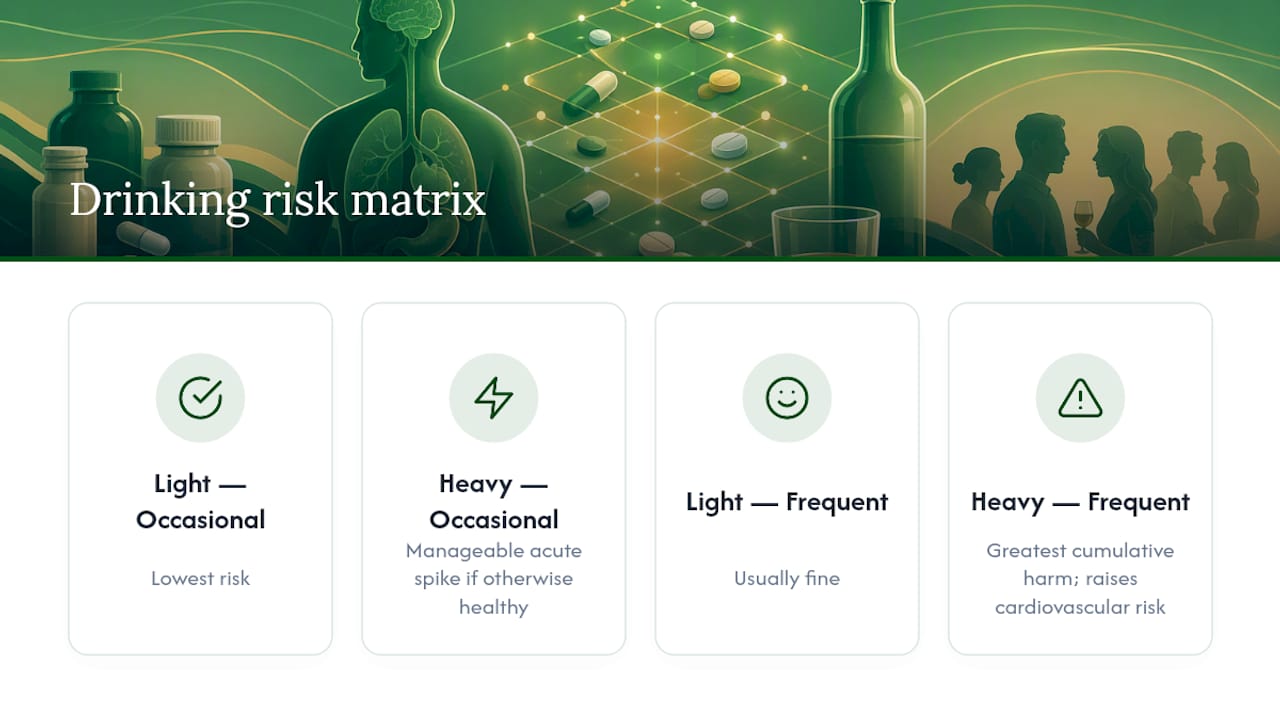
There’s a dose-and-frequency matrix worth internalizing: light and occasional is lowest risk, heavy and occasional is a manageable spike if you’re otherwise healthy, light and frequent is usually fine, and heavy and frequent is where real harm accumulates. If your pattern lands in that last category, the conversation with your clinician isn’t really about the ED medication anymore. It’s about the drinking itself, and the medication question becomes secondary.
If your social life or routine includes regular drinking, that doesn’t mean ED treatment is off the table. It means the conversation with your prescriber needs to include that detail upfront so the plan actually fits your life.
Some practical adjustments clinicians consider: choosing a medication and dosing schedule that gives you flexibility around when you drink, being more conservative with quantity guidance, and monitoring blood pressure more closely if you have any cardiovascular risk factors alongside regular drinking. For men who drink often but not heavily, on-demand dosing timed around lower-alcohol occasions is sometimes more manageable than a daily regimen. Understanding how to take tadalafil on the right schedule for your habits, rather than a generic one-size-fits-all approach, makes a real difference here.
Honesty about drinking frequency is the single biggest lever you have. A clinician who knows you drink several nights a week can build a safer plan around that reality. One who doesn’t know is working with incomplete information, and that’s when avoidable complications show up. If drinking has crept up to a level that concerns you independent of ED treatment, that’s worth raising too. Treating both issues together tends to produce better results than treating either in isolation.
Some telehealth clinicians factor alcohol use into medication safety screening from the first visit, not as an afterthought. Recommendations get tailored around what you actually disclose. Ongoing app-based support and home delivery can mean dose adjustments or follow-up questions don’t require a new office visit every time. Being upfront about your drinking habits is what lets that tailoring actually work.
— Bryan
A telehealth service can connect you with licensed providers who review your health profile, including alcohol habits, before recommending a treatment plan, so you’re not left piecing together warnings from a drug label on your own.

Before your visit, jot down how often you drink, any blood-pressure medications or nitrates you take, and whether you’ve ever felt faint after standing up. That information shapes everything your provider recommends, from dosage to timing advice. The telehealth service handles the consultation, the prescription, and delivery to your door, with app-based follow-up if anything needs adjusting. If ED medication side effects have been part of what’s held you back from treatment, a personalized review often addresses that faster than trial and error. Start your consultation through the FitRx enrollment page and get a plan built around your actual habits, not a generic label warning.
This guidance draws on tadalafil’s FDA prescribing information, Drugs, CDC standard drink guidance, and MedlinePlus drug information.
This article is general information, not a substitute for advice from a qualified doctor. Consult a qualified healthcare professional about your own circumstances before acting on anything here.
Yes, in moderation. Tadalafil (Cialis) studies show clinically noticeable blood-pressure drops mainly at higher alcohol levels, around five standard drinks in study conditions, so one or two drinks is generally tolerated by healthy men.
Sildenafil (Viagra) didn’t show added blood-pressure lowering at tested doses in healthy volunteers, but heavy drinking still blunts arousal and can make the medication feel less effective. Large amounts of alcohol also carry the same general dizziness risk that applies to any PDE5 inhibitor.
There’s no drink that improves how ED medication works. If you’re going to drink, the safer approach is one to two standard drinks, consumed with food rather than on an empty stomach, to avoid a rapid spike in blood alcohol.
Cutting back on heavy, frequent drinking often improves erectile function over time, since vascular and hormonal systems can recover meaningfully once alcohol intake drops. Severe long-term damage doesn’t always fully reverse, but consistent moderation tends to produce measurable improvement rather than none.
Yes. FitRx providers ask about alcohol habits and other medications as part of the safety screening before recommending treatment, and pricing details for consultations are available on the FitRx enrollment page.


.svg)
