Daily tadalafil is a once-daily, low-dose regimen of the PDE-5 inhibitor tadalafil (sold as brand-name Cialis) designed for men who want erections available on demand rather than timed to a pill. The FDA-approved prescribing label sets the starting dose at 2.5 mg once daily for erectile dysfunction (ED), with an option to increase to 5 mg based on how well it works and how well you tolerate it; men with benign prostatic hyperplasia (BPH) or both ED and BPH start at 5 mg daily. The single most important safety rule: never take tadalafil if you use nitrate drugs for chest pain or heart conditions. Common side effects include headache, flushing, back pain, and nasal congestion.
Quick self-screen: daily tadalafil may be worth discussing with your clinician if:
The clinical evidence for daily tadalafil is solid, though not without limits. A 2017 systematic review and meta-analysis pooled six randomized controlled trials covering 1,534 patients and found that the daily regimen produced statistically superior results on the SEP-2 and SEP-3 Sexual Encounter Profile questions compared with on-demand dosing. SEP-2 measures whether penetration was achieved; SEP-3 measures whether the encounter was satisfactory. Both improved more consistently with daily use. Safety rates between the two regimens were similar.
For BPH, the evidence is equally clear. The 5 mg daily dose is FDA-approved specifically for lower urinary tract symptoms, and clinical trials have shown improvements in urinary flow and symptom scores alongside ED benefits. For men managing both conditions, one pill handles both.
Then there is the 2024 data. A large observational cohort study published in the American Journal of Medicine followed 509,788 men with ED and found that tadalafil use was associated with significantly lower risks of all-cause mortality, myocardial infarction, stroke, venous thromboembolism, and dementia compared with men who used no PDE-5 inhibitor. The 5 mg daily dose showed notable associations in certain subgroup analyses. This is a striking finding, but it is observational. Residual confounding, selection bias, and the healthy-user effect all limit what you can conclude. The study does not prove that tadalafil prevents heart attacks or extends life. What it does is generate a compelling hypothesis and give clinicians a reason to feel less cautious about long-term use in appropriate patients.
Harvard Health and Mayo Clinic both summarize the evidence in patient-friendly terms and point readers to the full FDA prescribing information for dosing specifics. Those are worth bookmarking alongside this article.
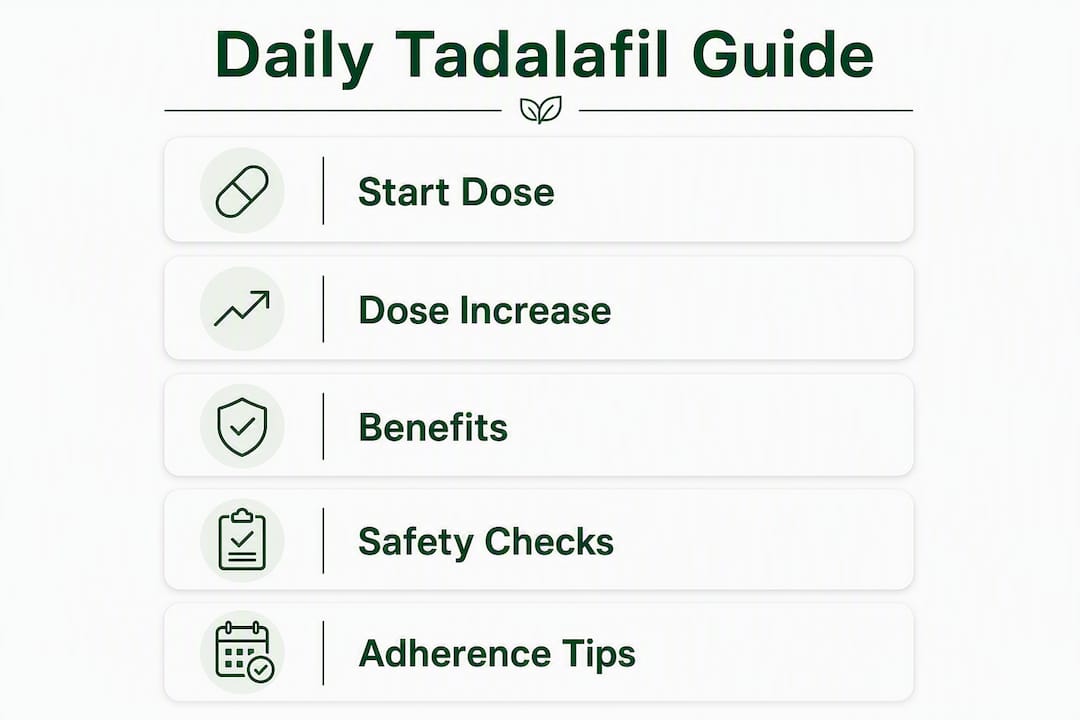
FDA labeling for tadalafil is specific and worth knowing before your first appointment:
| Indication | Starting dose | Maximum daily dose |
|---|---|---|
| ED only (once daily) | 2.5 mg | 5 mg |
| BPH only (once daily) | 5 mg | 5 mg |
| ED + BPH (once daily) | 5 mg | 5 mg |
| ED on-demand (not daily) | 10 mg as needed | 20 mg (once per day max) |
The daily regimen is taken at approximately the same time each day, without regard to when sexual activity occurs. That is the whole point: the drug maintains steady plasma levels around the clock, so timing sex around a dose becomes unnecessary.
If 2.5 mg does not produce adequate results after a reasonable trial (typically a few weeks), your clinician can increase to 5 mg. If you are already using on-demand tadalafil at 10 or 20 mg and want to switch to daily dosing, your prescriber will reassess your baseline and start the daily regimen fresh at 2.5 mg or 5 mg, not carry over the higher on-demand dose.

For renal or hepatic impairment, the FDA label flags caution. Severe renal impairment (creatinine clearance below 30 mL/min) and severe hepatic impairment (Child-Pugh Class C) require specific clinical judgment; the label advises against use or recommends careful dose limitation in those scenarios. Elderly patients do not require automatic dose adjustment based on age alone, but they may be more sensitive to blood-pressure effects, so clinicians typically start at the lower end and monitor carefully.
Daily tadalafil works by maintaining steady-state drug concentrations, not by delivering a peak effect right before sex. Missing a dose does not produce an immediate failure the next morning, but consistent gaps erode the steady-state benefit over time. If you miss a dose, take it as soon as you remember unless your next scheduled dose is close. In that case, skip the missed dose and resume your normal schedule. Never double up.
Pro Tip: Set a phone alarm tied to a fixed daily habit, such as brushing your teeth at night or taking a morning vitamin. Habit stacking is the most reliable adherence strategy for once-daily medications.
The most frequently reported side effects with daily tadalafil are:
Most of these appear within the first week or two and tend to diminish as your body adjusts to steady-state levels. If they persist or are bothersome, a dose reduction from 5 mg back to 2.5 mg often resolves them without abandoning the regimen.
On-demand dosing means the drug is in your system for roughly 36 hours after each dose. Daily dosing means it is always present at a lower, steady concentration. For most men, this actually reduces the peak-exposure side effects like flushing. The tradeoff is that any interaction risk, including the blood-pressure drop that comes with heavy alcohol intake, is persistent rather than episodic. Harvard Health specifically flags this: daily tadalafil users need to be counseled about alcohol because the interaction risk does not have an “off” window.

Stop tadalafil and call your provider if side effects are persistent, worsening, or interfering with daily function. Call 911 or go to an emergency room if you experience priapism, sudden vision or hearing loss, chest pain, or fainting.
Men who have had a recent myocardial infarction (within 90 days), a recent stroke (within 6 months), unstable angina, or uncontrolled arrhythmia should not start tadalafil without cardiology clearance. Sexual activity itself carries a cardiovascular demand, and adding a vasodilatory drug without assessing cardiac reserve is not appropriate. A clinician doing a thorough pre-prescription evaluation will ask about these conditions directly.
Review your complete medication list with your prescriber or pharmacist before starting. This is not optional.
| Decision axis | Daily tadalafil (2.5–5 mg) | On-demand tadalafil (10–20 mg) |
|---|---|---|
| Spontaneity | Full: no timing required | Limited: take 30 min before activity |
| Dosing complexity | Once daily, same time | Only when needed |
| Typical dose range | 2.5–5 mg | 10–20 mg |
| Side-effect exposure | Continuous at low level | Episodic at higher peak |
| BPH symptom relief | Yes (5 mg approved for BPH) | No approved indication |
| Cost per month | Higher (daily pill) | Lower if sex is infrequent |
| Insurance coverage | Varies; generic available | Varies; generic available |
Some clinicians recommend a four-to-eight-week trial of daily dosing for men who are uncertain. The steady-state effect takes a few days to establish, and many men find the experience of spontaneous readiness changes their preference. If daily dosing does not suit you after a fair trial, switching back to on-demand is straightforward. The 2017 meta-analysis found comparable safety between the two regimens, so the decision is largely about lifestyle fit rather than clinical risk.
Steady-state plasma concentrations with daily tadalafil are typically reached within five days of consistent dosing. Most clinicians recommend assessing benefit at the four-to-six-week mark. If 2.5 mg is not producing adequate results by then, the dose is increased to 5 mg. A follow-up check at 8–12 weeks is standard to confirm tolerability, review blood pressure if relevant, and decide whether to continue, adjust, or refer.
Telehealth is a well-established pathway for both initiating and monitoring daily tadalafil. A clinician can take a thorough history, review your medications, and prescribe safely through a virtual visit, with follow-up handled the same way. Pairing medication with lifestyle changes for ED recovery also tends to improve outcomes.
Pro Tip: Bring a photo of your medication bottles or a typed list to your telehealth visit. Medication reconciliation is the single most important safety step before prescribing tadalafil, and having it ready cuts the visit time significantly.
The 2024 cohort study published in the American Journal of Medicine is the largest real-world dataset on tadalafil outcomes to date. Researchers analyzed data from 509,788 men with erectile dysfunction and found that tadalafil use was associated with statistically significant reductions in all-cause mortality, myocardial infarction, stroke, venous thromboembolism, and dementia compared with men who used no PDE-5 inhibitor. Subgroup analyses specifically noted associations with the 5 mg daily dose.
Observational studies cannot establish that tadalafil caused these better outcomes. Several alternative explanations are plausible. Men who are prescribed and consistently take tadalafil may be healthier at baseline, more engaged with their healthcare, more likely to exercise, and less likely to smoke. This is the healthy-user effect, and it is a well-documented source of bias in observational pharmacoepidemiology. Residual confounding from unmeasured variables is also likely.
Randomized controlled trials are still needed to determine whether tadalafil has genuine cardioprotective or neuroprotective effects. Until those trials exist, the 2024 data should be interpreted as hypothesis-generating.
The study gives clinicians a reason to feel reassured rather than cautious about long-term daily tadalafil use in men who are appropriate candidates. It does not change prescribing indications, and it is not a reason to start tadalafil in men who do not have ED or BPH. For men who are already good candidates, the data is supportive context, not a mandate.
Daily tadalafil at 2.5–5 mg once daily is the FDA-approved regimen for men who want spontaneous sexual readiness, with the 5 mg dose also approved for BPH symptom relief.
| Point | Details |
|---|---|
| FDA starting dose | 2.5 mg once daily for ED; increase to 5 mg if needed; 5 mg for BPH or ED+BPH. |
| Best candidate profile | Men having sex two or more times per week, those wanting spontaneity, or those with concurrent BPH. |
| Critical safety rule | Never combine tadalafil with nitrates; the blood-pressure drop can be life-threatening. |
| Monitoring timeline | Assess benefit at 4–6 weeks; consider dose change or referral at 8–12 weeks. |
| FitRx telehealth option | FitRx offers online ED consultations, clinician safety checks, and home prescription delivery for men evaluating daily tadalafil. |
Most articles on this topic spend a lot of space on the pharmacology and not nearly enough on the actual decision a man faces. The choice between daily and on-demand tadalafil is not primarily a clinical question. It is a lifestyle question with a clinical safety layer on top.
The safety layer is non-negotiable: nitrates, recent cardiac events, and severe organ impairment are hard stops. A clinician has to clear those before anything else. But once that box is checked, the decision comes down to how you actually live. If you are having sex twice a week or more, or if the mental overhead of timing a pill is affecting intimacy, daily dosing is almost always the better fit. The spontaneity argument is not marketing language. It is a real quality-of-life difference that shows up in patient-reported outcomes.
What gets underestimated is the adherence piece. Daily tadalafil works through steady-state maintenance, not through a peak effect. Men who take it inconsistently, skipping doses when they do not anticipate sex, are essentially getting neither the daily nor the on-demand benefit. The drug needs to be in your system consistently to do its job. That requires treating it like a blood-pressure pill, not like an as-needed rescue medication.
Cost is the legitimate barrier most guides gloss over. Generic tadalafil has made daily dosing far more accessible than it was when Cialis was only available as a brand-name drug. But insurance coverage for ED medications remains inconsistent, and a daily pill adds up faster than an occasional one. That conversation belongs in the first appointment, not as an afterthought.
The 2024 observational data is worth knowing about, but it should not drive the decision. Men should not start daily tadalafil because of a potential cardiovascular benefit that has not been proven in a randomized trial. They should start it because they have ED, they are appropriate candidates, and the daily regimen fits their life better than the alternative.
Getting evaluated for daily tadalafil does not require an in-person visit or a long wait. FitRx connects you with licensed clinicians through a fully online consultation that covers your medical history, current medications, and cardiovascular screening before any prescription is written. If daily tadalafil is appropriate for you, the prescription ships directly to your home, and follow-up visits happen through the app on your schedule.

The safety checks built into the FitRx workflow, including medication reconciliation and cardiovascular screening prompts, are the same steps a traditional clinic would run. The difference is convenience and continuity: refills, dose adjustments, and monitoring questions are handled without scheduling an office visit. Men who want to understand their options before committing can review the steps to get started and come to their first visit prepared.
Ready to find out whether daily tadalafil is right for you? Start your FitRx ED consultation today and have your medication list ready for the visit.
This article provides general health information and is not a substitute for professional medical advice. Confirm current prescribing guidelines and your individual suitability with a licensed clinician or pharmacist.
The claims in this article draw from primary prescribing information, peer-reviewed trials, and authoritative patient-facing summaries. The sources below are worth reading directly.
| Source | What it covers | Best for |
|---|---|---|
| DailyMed FDA label | Exact US dosing, contraindications, warnings | Dosing and safety questions |
| 2017 PubMed meta-analysis | RCT efficacy comparison (daily vs. on-demand) | Evidence on effectiveness |
| 2024 AJM cohort study | Large observational cardiovascular associations | Understanding long-term data |
| Harvard Health summary | Patient-friendly decision guidance | Practical daily vs. on-demand choice |


.svg)