TL;DR:
- Subscription custom-compound services are ideal for mild acne beginners, offering affordable, guided monthly refills. Experienced users and severe cases benefit more from dermatologist-led or pay-per-prescription models with higher concentration options. The choice depends on acne severity, needed oversight, and whether systemic treatments are required.
If you want a personalized prescription skincare service like Curology, three alternative categories cover most needs: subscription custom-compound services, dermatologist-on-demand platforms, and pay-per-prescription compounding. FitRx is a recommended integrated option for U.S. patients who want prescription skincare alongside broader healthcare support, all in one place.
Here is a quick map of who fits where:
Two quick trust signals worth knowing upfront: who prescribes (board-certified dermatologist vs. nurse practitioner or physician assistant) shapes what you can be prescribed and how complex a case can be managed. Visible improvement from retinoid-based regimens typically takes several weeks to a few months, so patience matters regardless of which service you choose.
| Category | Best for | Medical model | Personalization | Billing model | Prescription flexibility | Conditions treated | Refill cadence |
|---|---|---|---|---|---|---|---|
| Subscription custom-compound | Beginners, mild-to-moderate acne | NP/PA-led, asynchronous | Custom-blended formula | Monthly subscription | Low-to-mid strength blends | Acne, early anti-aging | Monthly auto-ship |
| Dermatologist-on-demand | Experienced users, complex cases | Board-certified derm, live or async | Standard or custom Rx | Pay-per-visit | Higher concentrations available | Acne, hyperpigmentation, rosacea, anti-aging | Per-prescription |
| Pay-per-prescription compounding | Experienced users wanting control | NP/PA or derm, async | Custom-compounded | Per-prescription | Mid-to-high strength, single-ingredient options | Acne, anti-aging, hyperpigmentation | On-demand |
| OTC-first (adapalene, niacinamide) | Budget-focused, mild acne | None (self-directed) | None | One-time purchase | OTC only (adapalene 0.1%) | Mild acne, early anti-aging | As needed |
| In-person dermatologist | Severe, cystic, or complex cases | Board-certified derm, in-person | Full diagnostic workup | Insurance/co-pay or self-pay | Full formulary, oral meds, procedures | All conditions | Per-appointment |
| FitRx (integrated telehealth) | U.S. patients wanting Rx skincare + broader care | Licensed providers, virtual | Custom treatment plans | Subscription/per-visit | Prescription skincare + hair loss, hormonal, and other Rx | Skincare, hair loss, hormonal, weight, anxiety | App-based, ongoing |
Price shape by category:
Insurance and refund notes:
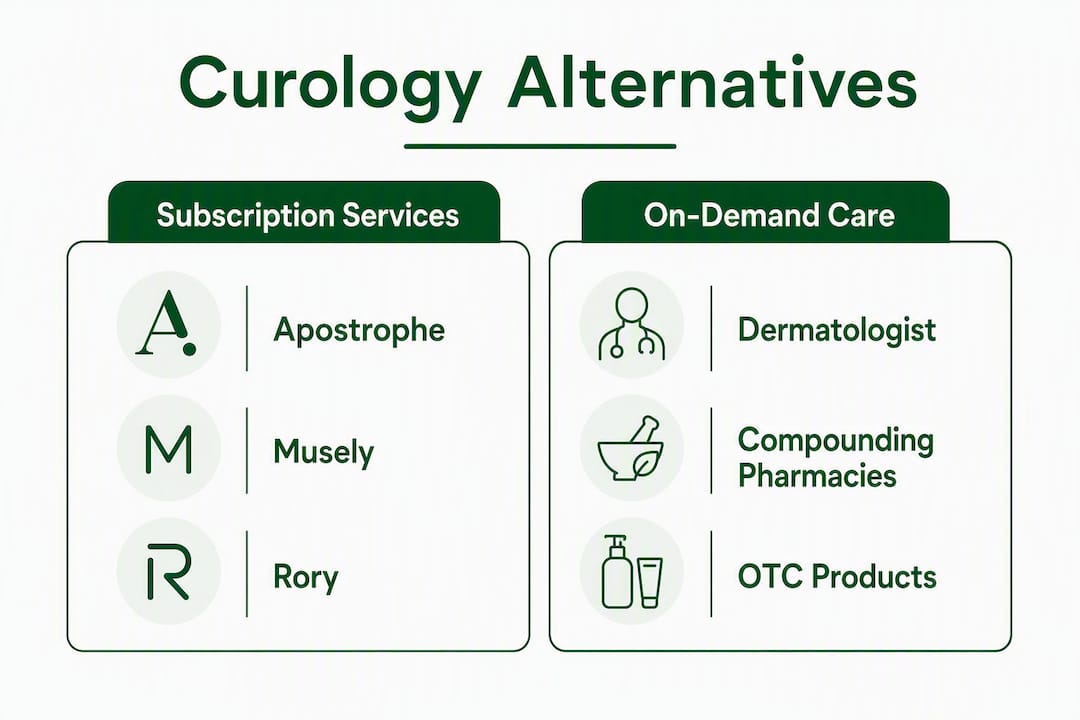
These platforms work similarly to Curology: you complete an intake form, upload photos, and a provider (usually an NP or PA) reviews your case asynchronously and formulates a custom-blended cream. The blend typically combines a retinoid with other actives like niacinamide, azelaic acid, or a topical antibiotic in a single tube.
Pros: Low barrier to entry, guided ramp-up, monthly auto-refills, affordable subscription pricing. Cons: Provider is usually an NP or PA, not a board-certified dermatologist. Ingredient concentrations in blended formulas are often lower than what you’d get from a discrete prescription. Escalation to oral medications or procedures requires a referral out.
Apostrophe and Musely both offer dermatologist-reviewed care, which puts them a step above pure NP/PA-only models. Rory, Hers, and Nurx lean more toward women’s health broadly, with skincare as one of several offerings. Miiskin focuses on skin tracking and photo documentation, which makes it more of a monitoring tool than a prescribing platform.
Availability note: Most of these services operate in the majority of U.S. states, but state-specific prescribing laws can limit access. Always confirm your state is covered before starting.
You pay per visit, speak (or message) directly with a board-certified dermatologist, and receive a standard prescription you fill at a pharmacy of your choice. No subscription lock-in.

Pros: Highest level of clinical oversight for telederm. Access to higher-strength tretinoin, broader formulary, and better escalation paths. Cons: Higher per-visit cost. No built-in compounding. Refills require follow-up visits or a standing prescription.
Some services pair a single telehealth consult with a compounding pharmacy that ships directly. You pay per formula rather than per month.
Pros: More concentration control than a subscription blend. Good for experienced users who know what they want. Cons: Less ongoing clinical oversight. Switching pharmacies can change the base cream, which affects texture, absorption, and tolerability, especially for dry or sensitive skin.
Over-the-counter adapalene 0.1% (sold as Differin) is a genuine retinoid, not a retinol. It is effective for many patients with mild-to-moderate acne and serves as a reasonable starting point before committing to a prescription service. Pair it with a non-comedogenic moisturizer and SPF 30+.
Pros: No consult fee, widely available, inexpensive. Cons: One concentration, no customization, no clinical oversight.
The gold standard for anything beyond mild or moderate acne. Procedures (cortisone injections, chemical peels, laser), oral medications, and full diagnostic capability are only available in person.
Pros: Full formulary, diagnostic accuracy, procedural access. Cons: Appointment wait times, insurance complexity, travel required.
Pro Tip: Before starting any new retinoid, ask your provider specifically whether the formula is a custom-compounded blend or a discrete prescription. The answer tells you how much concentration control you actually have and whether switching pharmacies later will change your experience.
The most practical difference comes down to three things: who prescribes, how the formula is structured, and whether you are locked into a subscription.
Standard subscription telederm services (Curology being the most recognized) use NP/PA-led teams operating on protocols. That model works well for routine cases but has real limits. NPs and PAs cannot always prescribe oral medications like spironolactone or doxycycline depending on state law, and they typically cannot perform procedures. Board-certified dermatologists, available through on-demand platforms or in-person visits, carry a broader scope of practice.
Prescription flexibility is where users most often feel the gap. A subscription blend at a fixed low concentration is fine for a beginner. An experienced user who has already tolerated tretinoin 0.05% and wants to step up to 0.1% as a single-ingredient prescription will often find that a dermatologist-led or pay-per-prescription model gives them more direct control over what goes on their skin.
The compounding question matters too. Custom-compounded blends combine multiple actives in one formula, which is convenient but reduces your ability to isolate which ingredient is causing a reaction or driving results. Discrete prescriptions let you add or remove actives one at a time. For patients with sensitive skin or a history of reactions, that granularity is worth paying for.
Subscription billing versus pay-per-visit is a real trade-off. Subscriptions are cheaper month-to-month if you use them consistently, but they can be hard to pause or cancel. Pay-per-visit models cost more per interaction but give you full control over when you engage.
Services like Rory, Hers, and Nurx extend beyond skincare into women’s health broadly, which is useful if you want one platform for birth control, hormonal support, and acne treatment. Miiskin is primarily a skin-monitoring app rather than a prescribing service, so it sits in a different category entirely.
Work through this in order:
Questions to ask any provider before signing up:
Red flags to watch for:
Pro Tip: When switching to a new retinoid service, treat it like starting fresh. Even if you have been on tretinoin for a year, a new compounded formula or a different base cream can change how your skin absorbs the active. Start at the lower end of the new formula’s concentration range for the first two to four weeks to avoid unnecessary irritation.
The single most important clinical differentiator in telederm is the level of medical oversight, not the price or the app design. A board-certified dermatologist brings diagnostic depth that protocol-driven NP/PA teams cannot fully replicate, particularly for anything beyond routine presentations.
Teledermatology is effective for managing common concerns like mild acne, early anti-aging, and stable rosacea. It is not a substitute for in-person care when the presentation is complex, when a lesion needs to be examined physically, or when procedures are required.
Asynchronous telederm platforms can manage many routine cases effectively, but in-person exams enable procedures and access to a broader range of oral medication options. Clinicians caution that diagnostic limitations are real for suspicious lesions, severe inflammatory disease, and any case where a physical exam would change the treatment plan.
Tretinoin ramp-up is a practical concern that most patients underestimate. Starting too high, or jumping straight to a concentration you tolerated on a previous formula, often triggers a purge and irritation cycle that makes patients abandon treatment prematurely. Changing providers may mean resetting that ramp-up entirely, especially if the new formula uses a different base cream.
Switching compound bases is not a trivial change. The base affects how quickly the active penetrates the skin and how the formula feels. A patient who tolerated a silicone-based compound well may find a water-based version drying, or vice versa.
Safety note: Tretinoin is contraindicated in pregnancy and for those actively trying to conceive. If you are pregnant, planning to become pregnant, or breastfeeding, tell your provider before starting any retinoid. Oral spironolactone carries similar restrictions. For any of these situations, an in-person dermatologist or OB-GYN should be your first call, not a telederm subscription.
Most telederm alternatives work from a similar formulary. Here is what is typically available and what each ingredient does:
Switching between compound bases or pharmacies can affect cream texture, absorption, and hydration, which matters most for patients with dry or sensitive skin. If your skin reacts differently after a refill, the base may have changed even if the active ingredient concentration stayed the same.
The right telederm alternative depends on your experience level, acne severity, and how much clinical oversight you need. Subscription custom-compound services work best for beginners; dermatologist-led or pay-per-prescription models suit experienced users who want concentration control.
| Point | Details |
|---|---|
| Medical oversight is the key differentiator | Board-certified dermatologists offer broader prescribing authority and diagnostic depth than NP/PA-led subscription teams. |
| Beginner vs. experienced user split | Starter retinoid users benefit from guided subscription blends; experienced users often need single-ingredient prescriptions at higher concentrations. |
| Hormonal acne needs oral options | Hormonal breakouts often require oral spironolactone or antibiotics, which not all telederm platforms can prescribe. |
| Compounding affects tolerability | Switching pharmacies or base creams can change absorption and texture, requiring a fresh ramp-up period. |
| FitRx covers skincare and more | FitRx offers prescription skincare alongside hair loss, hormonal, and other health treatments through one integrated virtual platform. |
Most people shopping for Curology alternatives focus on price and the ingredient list. Those matter, but they are not the variables that determine whether a telederm service actually works for you.
The real question is whether the provider reviewing your photos has the training and legal authority to catch what a protocol might miss. A subscription NP/PA team following a standard acne protocol will serve most mild-to-moderate cases well. But if your acne has a hormonal driver, if you have tried multiple topical regimens without success, or if you have a lesion that looks unusual, you need a board-certified dermatologist, not a faster intake form.
Personalization in telederm is also narrower than the marketing suggests. A custom-compounded blend is personalized in the sense that the concentrations are adjusted for you. It is not personalized in the sense that a dermatologist examined your skin under magnification and ruled out differential diagnoses. That distinction matters most when treatment is not working.
The services that tend to produce the best long-term outcomes are the ones that build in a clear escalation path: start with a telederm consult, adjust based on response, and refer to in-person care when the case demands it. That is the model worth looking for, regardless of which platform you choose.
Prescription skincare is one piece of a larger picture for many patients. Hormonal acne connects to hormonal health. Hair loss can overlap with thyroid issues or nutritional gaps. Skin that is not responding to topicals may need a systemic approach. FitRx is built for exactly that kind of connected care: licensed providers, prescription fulfillment shipped to your door, and ongoing app-based support that covers skincare, hair loss, weight, anxiety, and more.

For U.S. patients who want prescription skincare without managing five separate subscriptions, FitRx brings the consultation, the prescription, and the follow-up into one platform. Providers are licensed, the care model is virtual, and the scope goes well beyond a single custom cream. If your skin concerns are tied to hormonal shifts, stress, or other health factors, having one provider who can see the full picture is a practical advantage.
Start with a virtual consultation at FitRx to find out which prescription skincare options are right for you.
This article is for general informational purposes only and does not constitute medical advice. Consult a licensed healthcare provider or board-certified dermatologist for guidance specific to your condition.
The strongest substitutes depend on your needs. Apostrophe and Musely offer dermatologist-reviewed custom prescriptions; Rory, Hers, and Nurx combine skincare with women’s health. FitRx is a solid option for U.S. patients who want prescription skincare integrated with broader virtual healthcare.
Musely offers dermatologist-reviewed formulas and tends to allow more concentration flexibility than Curology’s NP/PA-led model, which can make it a better fit for experienced retinoid users. The right choice depends on your skin goals and how much clinical oversight you want.
Curology’s sister company is Agency, which focuses on anti-aging skincare using a similar subscription telederm model. Both operate under the same parent company.
Yes. Dermatologist-on-demand platforms and some pay-per-prescription compounding services let you get a tretinoin prescription through a single visit without a recurring subscription. You fill the prescription at a pharmacy of your choice.
See an in-person dermatologist for cystic or nodular acne, any suspicious or changing skin lesion, cases that have not responded to multiple telederm treatments, or when you need a procedure. Teledermatology is effective for routine presentations but cannot replace a physical exam for complex cases.


.svg)