Compounded semaglutide is not FDA-approved, and the safety record backs up the caution that warrants: the FDA has logged nearly 1,000 adverse event reports tied to these products, and a 2025 pharmacovigilance study found compounded GLP-1 drugs carry more than double the odds of hospitalization compared with approved versions. The main dangers cluster around four things: dosing and administration errors, contamination during preparation, unapproved salt forms of the drug, and shipping conditions that can degrade the medication before it reaches you.
TL;DR:
- Compounded semaglutide has a higher risk of causing serious adverse events, with hospitalization odds more than double those of FDA-approved versions.
- The risk of contamination and ingredient unknowns is significantly greater in compounded drugs due to less strict manufacturing controls and potential ingredient substitutions.
- Limited oversight and unverified salt forms in compounded semaglutide increase the chances of harmful reactions, especially if cold-chain storage is not maintained during shipping.
- Using licensed, supervised prescription services ensures verified ingredients, proper dosing, and better safety monitoring, reducing the risks linked to compounded semaglutide.
The FDA reports 990 adverse events tied to compounded semaglutide as of May 2026, with more than 730 additional reports linked to compounded tirzepatide. Those numbers only capture what got reported. Compounding pharmacies operating under state licenses aren’t required to report adverse events the way manufacturers of FDA-approved drugs are, so the real number of harmful reactions is almost certainly higher.
The most rigorous look at this came from a 2025 retrospective analysis of the FDA Adverse Event Reporting System (FAERS), covering 81,078 total GLP-1 receptor agonist reports, 707 of which involved compounded products. The findings were stark.
Compounded GLP-1 drugs showed 2.35 times higher odds of hospitalization compared to FDA-approved products, along with dramatically elevated reporting odds for contamination (ROR 19.00) and preparation errors (ROR 48.92).
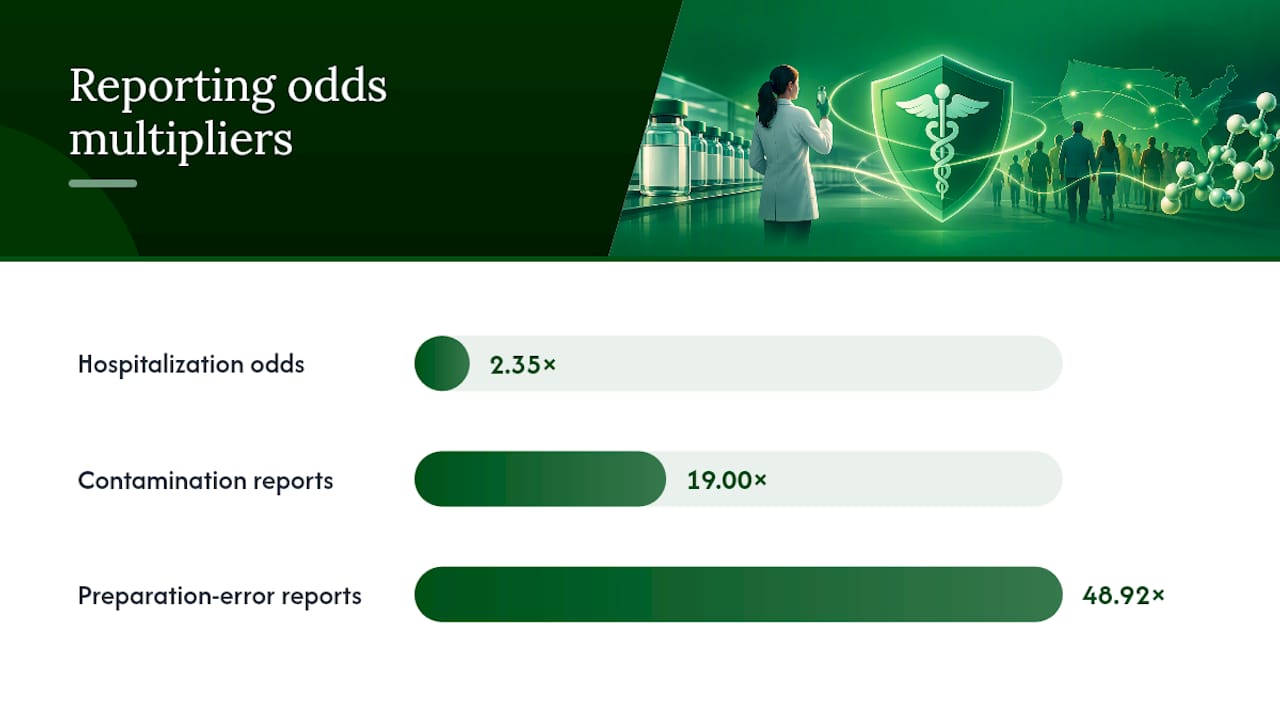
A reporting odds ratio (ROR) compares how often a specific adverse event shows up in reports for one drug category versus another. An ROR of 48.92 for preparation errors means those errors were reported at nearly 49 times the rate for compounded products compared to their FDA-approved counterparts. That’s not a marginal difference. The same pharmacovigilance study also found elevated reporting for suicidality and cholecystitis (gallbladder inflammation) among compounded product users, though researchers stopped short of claiming the compounding itself directly caused those specific outcomes.
Case-series data adds another layer. Reports submitted to poison control centers document real-world administration errors, including patients who measured out ten times their intended dose because they were drawing medication from a vial with a standard insulin syringe rather than using a calibrated pen device. The case series on compounded semaglutide administration errors links these overdoses to severe nausea, dehydration, emergency room visits, and hospital admissions in some cases.
A few caveats matter here. Adverse event databases like FAERS rely on voluntary or passive reporting, which means they can’t establish that a drug caused a specific reaction, only that a reaction was reported alongside its use. Underreporting is a persistent problem, especially since state-level oversight of compounding pharmacies varies widely and doesn’t funnel data back to a central federal system the way FDA-approved drug manufacturers must. Keep those limits in mind: they explain why the true harm rate could run higher than what the FDA has on record, not lower.
Three points sum up where the evidence currently stands:
Semaglutide itself, whether compounded or FDA-approved, carries a known side effect profile. Most patients experience nausea, vomiting, diarrhea, constipation, or fatigue, particularly during dose increases. These effects are documented for approved products and are generally manageable with dose adjustments and dietary changes, as outlined in FitRx’s overview of semaglutide side effects.
What changes with compounded versions is the frequency and severity of a second category of harm, one tied directly to how the drug is made and dispensed rather than to the molecule itself.
The clinical pathway from error to harm is fairly direct. A patient draws what they believe is a standard dose from a vial, using a syringe with the wrong unit markings, and ends up injecting five or ten times the intended amount. Within hours, severe gastrointestinal symptoms set in. If vomiting is prolonged, dehydration follows, and in a subset of cases, that cascades into acute kidney strain or hospitalization. The FDA’s warning about salt forms notes that these chemically altered versions have no established human safety data, meaning nobody, including the compounder, can say with confidence how the body processes them long-term.
Peptide drugs like semaglutide are also biochemically fragile. Small-batch compounding raises the risk of impurities, aggregation, or immunogenic reactions where the immune system responds to the drug as if it were foreign, according to FDA meeting materials on compounding oversight. None of this shows up on a label. It shows up in a patient’s bloodwork or emergency room chart.
Clinicians who monitor patients on compounded GLP-1 products typically watch for early warning signs: unexplained abdominal pain, changes in kidney function on basic metabolic panels, and gallbladder symptoms, given the elevated cholecystitis signal in the pharmacovigilance data. For a broader comparison of side-effect patterns across the GLP-1 drug class, see FitRx’s breakdown of GLP-1 side effects.
FDA-approved semaglutide ships in prefilled pens engineered to deliver a fixed, tested dose every time. That design isn’t decorative. It’s the safety mechanism that prevents most dosing accidents. Compounded versions frequently arrive as multi-dose vials, which shifts the entire burden of accurate measurement onto the patient using a separate syringe.
That shift explains most of the errors on record. Here’s how a routine dosing mistake typically happens:
This is exactly the failure mode documented in poison control case reports, and it’s largely absent from FDA-approved products because the pen removes the conversion step entirely. FDA compounding alerts have flagged this loss of “safety engineering” as a direct driver of higher error rates among vial-based patients.
Compounded products also don’t have to meet Current Good Manufacturing Practice (CGMP) standards the way FDA-approved manufacturers do. Small compounding operations run batch-to-batch, and quality can vary even within the same pharmacy over time. Add to that the chemical wildcard of salt forms like semaglutide sodium, substances the FDA says lack any human safety data, and you’re combining an unregulated production process with an unstudied active ingredient.
Pro Tip: Ask your pharmacy directly whether the product you’re receiving is base semaglutide or a salt form. If they can’t answer clearly or won’t provide documentation, treat that as a red flag, not a technicality.
Shipping adds one more failure point. Semaglutide is a peptide, and peptides are sensitive to temperature swings. A vial left in a hot delivery truck or a warehouse without reliable cold-chain tracking can degrade before it ever reaches your refrigerator, potentially making the drug less effective or introducing unknown breakdown products. For general guidance on syringe handling and why device mismatches matter, see this resource on needle and syringe safety.
Compounded semaglutide occupies a narrow legal space, and that space is shrinking. Compounding pharmacies can legally prepare semaglutide under specific conditions, most commonly during a documented drug shortage or for a patient with a demonstrated medical need that an approved product can’t meet, such as an allergy to an inactive ingredient. Outside those conditions, compounded copies of an available brand-name drug fall into a legal gray zone that the FDA has been actively closing.
The agency has proposed excluding semaglutide, tirzepatide, and liraglutide from the 503B bulks list, stating it found no clinical need for outsourcing facilities to keep compounding these drugs now that approved versions are widely available. That proposal signals where enforcement is headed: fewer legal pathways for large-scale compounded production going forward.
A few regulatory facts matter for anyone weighing this decision:
The practical upshot: once shortages of approved semaglutide products fully resolve, the FDA’s tolerance for enforcement discretion around compounded versions is expected to tighten further. If you’re currently using a compounded product tied to a shortage justification, that justification may not hold much longer. FitRx’s guide to compounded semaglutide rules walks through when compounding is and isn’t permitted under current FDA policy.
Start by verifying what you’re actually getting. Before your next refill, confirm the pharmacy holds a valid state pharmacy license, ask whether they’re a registered 503B outsourcing facility, and request the lot number, expiration date, and a certificate of analysis for your specific batch. These documents aren’t bureaucratic formalities. They’re the closest thing you have to proof that someone tested what’s in the vial.
Ask your prescriber and pharmacist three direct questions: What’s the exact concentration in milligrams per milliliter? What syringe type is compatible with this vial? And can you show me, step by step, how to draw and store this correctly? If nobody can answer clearly, that’s a signal to pause.
Pro Tip: If you’ve had any dosing confusion, don’t just switch products quietly. Document what you were taking (concentration, frequency, symptoms) so your clinician can safely transition you to an FDA-approved formulation at a conservative starting dose, with lab monitoring if a high-dose exposure is suspected. Proper injection technique also cuts down on user error considerably. FitRx’s guide on how to inject semaglutide correctly covers the mechanics most patients get wrong.
The data in this article doesn’t say semaglutide is dangerous. It says unsupervised, unverified sourcing is where the danger concentrates. Every serious harm documented here (the tenfold overdoses, the contamination reports, the salt-form unknowns) traces back to a gap in oversight, not a flaw in the molecule itself.
That’s the case for supervised telehealth done right: a licensed provider reviewing your history, a pharmacy that stands behind what’s in the vial, and someone walking you through injection technique instead of leaving you to guess. Skipping that layer is where most of the reported harm originates.
— Bryan
FitRx pairs you with a licensed provider who reviews your health history, confirms your prescription is medically appropriate, and sends medication from verified pharmacy sources, not an unlicensed vial with a guessed concentration. That’s the concrete difference: standardized dosing, clear injection instruction, and a real person checking in through the app instead of a label you have to interpret on your own.

Every prescription comes with plain-language counseling on side effects, dosing schedules, and what symptoms should prompt a call rather than a wait. Shipping is tracked and verified, which closes the cold-chain gap that puts compounded peptides at risk of degrading in transit. If you’re weighing whether a compounded product is worth the uncertainty, start by seeing whether a supervised option fits your situation. Visit FitRx’s weight-loss program to check eligibility and get matched with a licensed provider.
Key references: FDA safety communication on unapproved GLP-1 drugs, the FAERS pharmacovigilance study, a clinical review for providers, and poison control case series data.
This article is general information, not a substitute for advice from a qualified doctor. Consult a qualified healthcare professional about your own circumstances before acting on anything here.
No. Compounded semaglutide is not FDA-approved and carries meaningfully higher documented risk than approved products like Ozempic. A 2025 pharmacovigilance study found compounded GLP-1 drugs had 2.35 times higher odds of hospitalization along with sharply elevated reporting for contamination and preparation errors.
Not banned outright, but the legal pathway is narrowing. The FDA has proposed excluding semaglutide from the 503B bulks list, which would eliminate one major route for large-scale compounding now that approved versions are broadly available.
Standard side effects include nausea, vomiting, diarrhea, and fatigue, which occur with both compounded and FDA-approved versions. Compounded products specifically carry added risks of severe dehydration, pancreatitis, and contamination-related complications tied to dosing errors and preparation problems, as detailed in FitRx’s semaglutide side effects guide.
Approved semaglutide has a well-established safety profile when dosed and monitored correctly by a clinician. Compounded versions raise the risk substantially due to inconsistent manufacturing, unverified salt forms, and administration errors, which is why the FDA has logged nearly 1,000 adverse event reports tied specifically to compounded products.
FitRx connects patients with licensed providers who prescribe through verified pharmacy sources and provide standardized dosing guidance and injection counseling. Current pricing and program details for weight-loss medication are available on the FitRx weight-loss page.


.svg)
