Compounded semaglutide is not an FDA-approved equivalent to Ozempic, Wegovy, or Rybelsus. It is a custom-mixed version of the drug made by a pharmacy rather than a licensed manufacturer, and it never goes through the FDA’s premarket review for safety, efficacy, or manufacturing consistency.
Here’s what actually matters before you consider it:
Talk to your clinician about switching to an approved product, and if you’re currently using a compounded version, verify your pharmacy’s license before your next refill.
Compounded semaglutide skips FDA approval, CGMP manufacturing checks, and clinical trial testing, which is why regulators and clinicians recommend approved alternatives whenever they’re accessible.
| Point | Details |
|---|---|
| Not FDA-approved | Compounded semaglutide never goes through premarket review for safety or manufacturing consistency. |
| Shortages mostly resolved | Semaglutide left the FDA shortage list in February 2025, removing the main legal justification for compounding. |
| Rules are tightening | The FDA’s April 2026 proposal would exclude semaglutide from the 503B bulks list, closing large-scale compounding. |
| Verify before you order | Check pharmacy licensing and ask about API sourcing and clinical monitoring before starting any compounded product. |
| Consider the approved route | FitRx connects patients with licensed clinicians and verified pharmacies offering FDA-approved GLP-1 options. |
Compounded semaglutide is a custom-prepared version of the drug that a pharmacy mixes to order rather than pulling from a factory-sealed pen. Two types of facilities do this work: 503A pharmacies, which compound for individual patients with a prescription, and 503B outsourcing facilities, which produce larger batches under stricter oversight but still without FDA approval of the final product.
The active ingredient comes from a bulk supplier, not from Novo Nordisk or Eli Lilly, and pharmacies sometimes use alternative salt forms like semaglutide sodium or semaglutide acetate that were never tested in the clinical trials behind approved drugs. Formulations vary by pharmacy, too. Some add B12 or other vitamins. Some ship in multidose vials that require patients to draw their own doses with a syringe instead of using a prefilled pen.
That distinction matters for anyone assuming “compounded” means “generic.”
Compounding semaglutide became legal on a large scale for one reason: shortage. When a drug is on the FDA’s shortage list, federal rules allow compounding as a stopgap so patients aren’t left without treatment. That’s the loophole that built an entire compounded GLP-1 industry.
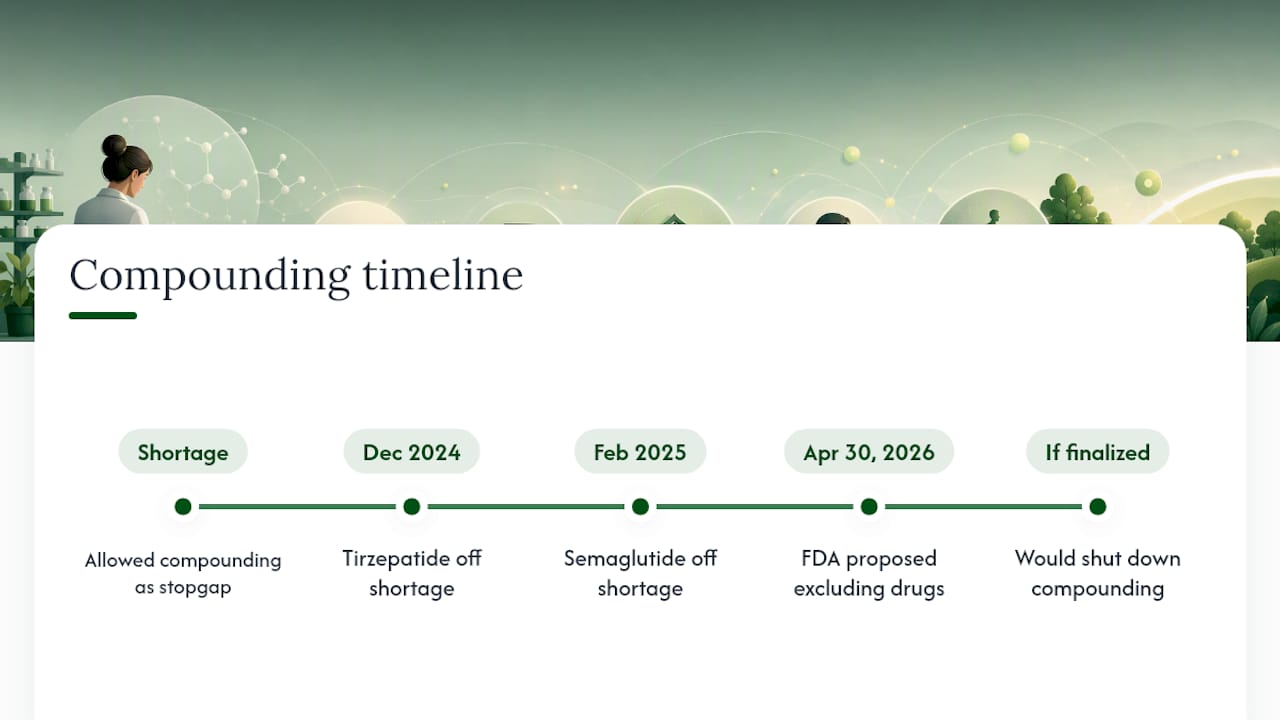
That justification is mostly gone now. Tirzepatide came off the shortage list in December 2024, and semaglutide followed in February 2025. Once a drug is no longer in shortage, the legal basis for routine compounding disappears.
The FDA has since moved to close the loophole entirely. On April 30, 2026, it proposed excluding semaglutide, tirzepatide, and liraglutide from the list of bulk substances 503B facilities can use. If finalized, that rule would shut down large-scale compounding of these ingredients almost entirely, leaving only narrow 503A exceptions for patients with documented medical needs, like an allergy to an approved product’s inactive ingredients.
If you’re currently on a compounded version, expect your supply to become harder to find and your pharmacy to eventually push you toward an approved product.
The gap between compounded and approved semaglutide isn’t cosmetic. It touches everything from how the drug is tested to how it’s shipped to your door.
| Factor | FDA-Approved (Ozempic, Wegovy, Rybelsus) | Compounded Semaglutide |
|---|---|---|
| Approval status | FDA-reviewed and approved | Not FDA-approved; no premarket review |
| Manufacturing standard | CGMP-certified facilities | Varies by pharmacy; no CGMP requirement |
| Dose consistency | Standardized, batch-tested | Can vary between pharmacies and batches |
| Delivery form | Prefilled pens (injectable) or tablets | Often multidose vials, sometimes sublingual drops |
| Storage and sterility | Validated cold chain, sealed units | Depends on pharmacy shipping practices |
| Adverse event data | Tracked through large clinical trials | Limited to scattered FDA reports |
The manufacturing gap is the one people underestimate most. Compounded products skip the mandatory clinical trials and CGMP reviews that brand-name drugs go through, which means there’s no independent check that a vial actually contains the dose printed on the label.
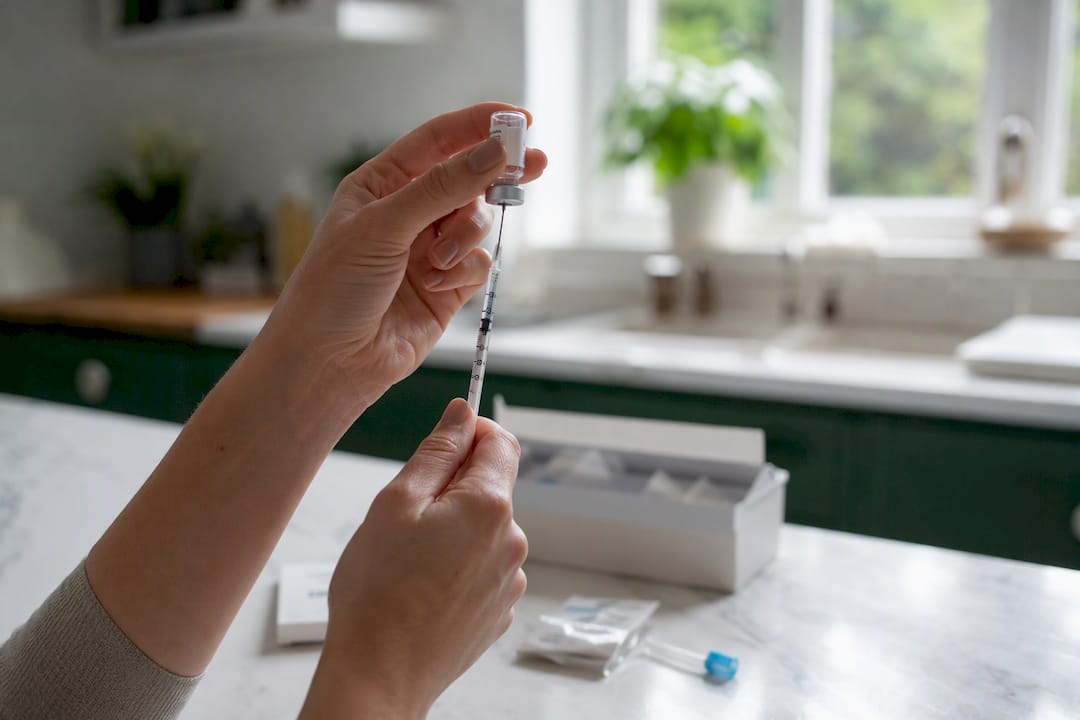
Delivery format compounds the risk. A prefilled pen delivers a fixed, tested dose every time. A multidose vial hands that responsibility to the patient, who has to draw the correct amount with a syringe, and a measuring error of even a small fraction can mean a meaningfully different dose. Add in sublingual drops or dissolving tablets, formats never validated for semaglutide absorption, and you’re looking at a product with real unknowns baked into how it works.
The safety picture here isn’t hypothetical. The FDA has issued direct warnings about unapproved GLP-1 products sold for weight loss, flagging cases where the active ingredient was the wrong salt form, present in the wrong amount, or missing altogether.
The roughly 600 adverse event reports the FDA had received by July 2025 don’t prove the compounded drug itself caused every problem. But they signal a monitoring gap that doesn’t exist with approved products, which get tracked through large, standardized trial and post-market surveillance systems.
Three failure patterns show up again and again:
Pro Tip: If you experience an unexpected side effect from any semaglutide product, compounded or approved, report it to FDA MedWatch. Those reports are one of the few ways regulators track real-world problems with unapproved drugs.
Before starting or continuing any GLP-1 therapy, confirm your pharmacy is properly licensed and that a clinician, not just an online form, is actually monitoring your treatment.
Not every telehealth provider selling semaglutide is equally trustworthy. Here’s how to check before you order anything.
Walk away if you see any of these:
Approved semaglutide products come in prefilled pens with fixed, tested doses, or as an oral tablet (Rybelsus) with a specific set of rules about taking it on an empty stomach with a small amount of water. Compounded versions usually skip that structure entirely, shipping as vials, syringes, or occasionally sublingual drops that patients dose themselves.
That do-it-yourself format creates real gaps:
These aren’t small technicalities. They’re the difference between knowing what you’re taking and guessing.
If shortage is no longer the barrier it once was, the safer path is usually the approved one. Ozempic and Rybelsus (both semaglutide) and Wegovy (semaglutide at a higher weight-loss dose) all come from Novo Nordisk with full FDA review behind them. Mounjaro, tirzepatide from Eli Lilly, works on a related but distinct mechanism and is approved for similar purposes.
The pipeline is also moving toward more convenient approved options. New oral GLP-1 pills and nonpeptide agents are reaching the market, and as Yale Medicine notes, that expansion reduces the clinical case for compounding altogether.
Cost is the real reason people consider compounded versions in the first place, and it’s worth addressing directly:
Three dates tell the whole story. Tirzepatide left the FDA shortage list in December 2024. Semaglutide followed in February 2025. Then, on April 30, 2026, the FDA proposed removing semaglutide, tirzepatide, and liraglutide from the bulk substances list entirely.
If that rule finalizes, 503B outsourcing facilities lose their legal basis for compounding these drugs in volume. 503A pharmacies would keep a narrower lane, compounding only for individual patients with a documented medical need, not as a general alternative to the approved products.
For patients, that means:
We think caution should come before convenience here. Compounded semaglutide might look like an easy workaround, but the safety data, the FDA’s own warnings, and the direction of the regulations all point the same way: approved products with real clinical oversight are the safer bet. FitRx builds its weight-loss programs around licensed clinicians and evidence-backed medication, not shortcuts.
If the safety gaps above make you want a second opinion, that’s the whole point of working with a licensed provider instead of an anonymous online seller. FitRx connects you with a licensed clinician who reviews your history, discusses whether an FDA-approved GLP-1 fits your situation, and prescribes through verified pharmacy partners, not unregulated compounding operations.

You get ongoing support built into the process: medication counseling, app-based check-ins, and ongoing monitoring so dosing questions get answered by a real clinician instead of guesswork with a vial and a syringe. That structure is exactly what’s missing from a lot of the compounded semaglutide offers flagged throughout this article.
Find out if a prescription weight-loss injection or approved oral option is right for you and get matched with a licensed provider who can walk you through safer, standardized alternatives.
This article is general information, not a substitute for advice from a qualified doctor. Consult a qualified healthcare professional about your own circumstances before acting on anything here.
No. Compounded semaglutide lacks FDA approval, CGMP manufacturing oversight, and the batch testing that ensures Ozempic’s dose consistency, so it isn’t considered an equivalent product.
Semaglutide in Ozempic, Wegovy, or Rybelsus is manufactured and tested under FDA-approved processes, while compounded semaglutide is custom-mixed by a pharmacy using bulk ingredients that skip that review entirely.
Timelines vary significantly by starting weight, dose, and individual response; you can find a general breakdown of what to expect in FitRx’s guide on how long semaglutide takes to work.
Some patients report weight loss on compounded versions, but there’s no clinical trial evidence confirming consistent effectiveness, and formulation differences like altered salt forms make outcomes harder to predict.
Compounding is legal under specific FDA rules, mainly during drug shortages or for documented individual medical need, but that legal basis has narrowed sharply now that semaglutide shortages have resolved.


.svg)