For most people with inflammatory acne, benzoyl peroxide combined with topical clindamycin beats either drug used alone, and clindamycin should almost never be prescribed by itself. Combination therapy produces faster, deeper lesion reduction while cutting the risk of antibiotic resistance that comes with clindamycin monotherapy. The numbers behind that recommendation, plus how each drug actually works, are below.
TL;DR:
- Benzoyl peroxide works quickly on bacteria and unclogs pores through oxidation, outperforming clindamycin in bacterial suppression and speed, with full results visible in about 10 weeks.
- Clindamycin’s anti-inflammatory effects bolster treatment for inflammatory acne but poses a risk of resistance when used alone, which combination therapy aims to mitigate.
- Side effects are generally mild; benzoyl peroxide may cause irritation and bleaching, while clindamycin has fewer skin reactions, with combination gels often balancing both tolerability issues.
- Over-the-counter benzoyl peroxide offers up to 10% concentrations, but prescriptions for combination gels are necessary for effective long-term treatment, especially for moderate or severe cases.
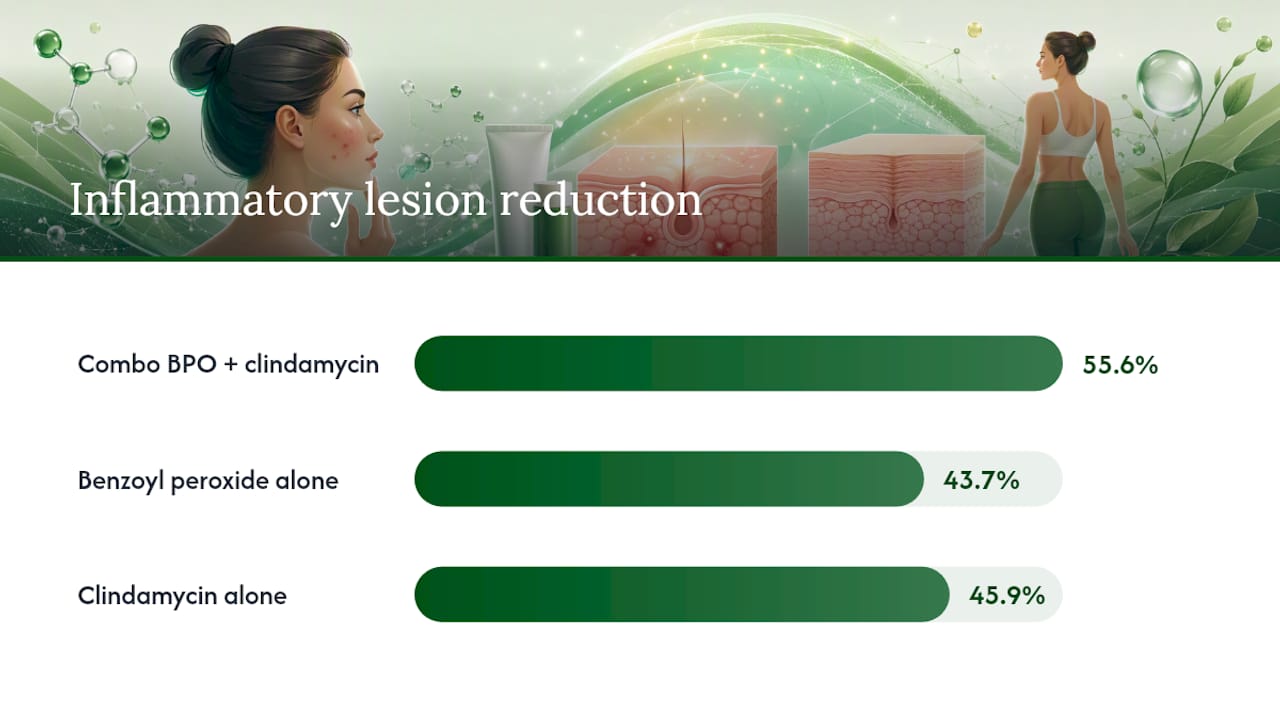
The clearest data point in this whole debate comes from a meta-analysis pooling multiple randomized trials: at 10 to 12 weeks, combination benzoyl peroxide plus clindamycin produced a weighted mean inflammatory lesion reduction of about 55.6%, versus 43.7% for benzoyl peroxide alone and 45.9% for clindamycin alone, according to Seidler and colleagues. That’s not a marginal edge. It’s roughly a 10 to 12 percentage point jump in how many inflamed pimples clear up, just from pairing the two ingredients instead of picking one.
Timelines matter here as much as the final numbers. Benzoyl peroxide acts fast because it’s chemically toxic to acne-causing bacteria on contact, so many people notice fewer new inflammatory lesions within 2 to 4 weeks. Clindamycin alone tends to work more slowly and less completely, since it depends on suppressing bacterial reproduction rather than killing bacteria outright. Full results for any of these regimens, including the combination, generally take the full 10 to 12 weeks to show up in lesion counts.
A separate phase-3 randomized trial adds a more clinically meaningful angle: it measured how many patients achieved a two-grade improvement on the Investigator’s Static Global Assessment, a standard severity scale dermatologists use in practice. The fixed-dose combination gel (clindamycin 1.2% and benzoyl peroxide 3%) outperformed either single ingredient at 12 weeks, and tolerability was similar across all three groups, per the phase-3 trial data. That last part surprises people. Combining two active ingredients doesn’t necessarily mean combining two sets of side effects.
What this means practically:
If you’re comparing benzoyl peroxide effectiveness against clindamycin in isolation, benzoyl peroxide tends to edge out clindamycin on its own, largely because bacteria can’t develop resistance to an oxidizing agent the way they can to an antibiotic. That distinction sets up almost everything else worth knowing about these two drugs.
Benzoyl peroxide is an oxidizer, not an antibiotic. It releases free oxygen radicals inside the hair follicle that damage the cell walls of Cutibacterium acnes (formerly called P. acnes), the bacteria strongly linked to inflammatory breakouts. It also has a mild exfoliating effect that helps unclog pores. One in vivo study found benzoyl peroxide reduced follicular bacterial counts faster and more thoroughly than 1% clindamycin over a 14-day period, which explains why it often shows visible results sooner, according to the comparative antimicrobial study.
Clindamycin works through an entirely different route. It’s a lincosamide antibiotic that blocks bacterial protein synthesis, which slows bacterial growth (bacteriostatic) rather than killing bacteria outright at typical topical concentrations. It also carries independent anti-inflammatory effects on the skin, separate from its antibacterial action, which is part of why it still adds value in combination even though benzoyl peroxide kills bacteria more efficiently on its own.
Here’s the mechanism that matters most for long-term use:
Benzoyl peroxide’s biggest downside is irritation. Redness, peeling, dryness, and a stinging sensation are common in the first one to two weeks, and the drug can bleach clothing, towels, and pillowcases, a fact that surprises a lot of first-time users. Higher concentrations don’t necessarily work faster, they just tend to irritate skin more, which is part of why many dermatologists start patients on 2.5% or 4% rather than jumping straight to 10%.
Clindamycin is generally gentler on the skin. Local side effects include mild dryness, peeling, and occasional itching. Systemic absorption is rare with topical use, but MedlinePlus notes that lincosamide antibiotics carry a rare risk of severe diarrhea from Clostridioides difficile overgrowth even when applied topically, so anyone who develops persistent watery diarrhea after starting clindamycin should contact a provider promptly.
Combination gels tend to land in the middle for irritation, sometimes even performing as well as benzoyl peroxide alone on tolerability, per the phase-3 trial results. Formulation matters too. Solubilized benzoyl peroxide systems can deliver comparable efficacy with less irritation than standard gel bases, according to research on formulation differences.
A few steps make either drug easier to tolerate:
Pro Tip: Apply benzoyl peroxide and clindamycin at different times of day (one in the morning, one at night) if daytime irritation is a problem. Splitting the dose reduces cumulative dryness without sacrificing the combined benefit, since both drugs work over hours, not minutes.
Clinical guidance consistently discourages topical antibiotic monotherapy for acne, and clindamycin is the textbook example of why. Bacteria exposed to a single antibiotic agent over weeks or months have room to mutate and survive, and resistant C. acnes strains have become common enough that stewardship is now a standard part of acne treatment guidelines, according to a review on antibiotic resistance in topical acne care.
Benzoyl peroxide is the fix, not a footnote. Because it kills bacteria through oxidation rather than a targeted antibiotic mechanism, adding it to any antibiotic regimen sharply reduces the odds that resistant strains survive and multiply. That’s the entire clinical rationale for fixed-dose combination products: they’re not just more effective, they’re safer from a public-health standpoint.
Practical stewardship looks like this:
Over-the-counter benzoyl peroxide comes in concentrations from 2.5% up to 10%, in washes, gels, spot treatments, and foams. Prescription clindamycin comes as a gel, lotion, or solution, usually at 1% to 1.2%, and fixed-dose combination gels (clindamycin 1.2% with benzoyl peroxide 3% or 5%) are available under various brand formulations that a clinician prescribes as a single product rather than two separate tubes.
A typical regimen looks like once-daily benzoyl peroxide in the morning and clindamycin or a combination gel at night, though some providers prescribe the combination product once daily and add a separate benzoyl peroxide wash for extra coverage.
Can you use clindamycin without benzoyl peroxide? Technically yes, but it isn’t advisable outside very specific short-term clinical scenarios, since monotherapy raises resistance risk without much efficacy upside.
For popped pimples specifically:
The Seidler meta-analysis remains the most frequently cited comparison in this space, pooling data across multiple randomized trials to land on that 55.6% versus 43.7% versus 45.9% inflammatory lesion reduction breakdown at 10 to 12 weeks. It’s the closest thing acne research has to a definitive head-to-head scorecard.
The phase-3 trial testing fixed-dose clindamycin 1.2%/benzoyl peroxide 3% gel adds the clinician’s-eye-view metric: more patients achieved a full two-grade severity improvement on standardized assessment scales with the combination than with either ingredient alone, at comparable tolerability, according to the phase-3 data.

A broader clinical overview from the NCBI Bookshelf confirms these findings hold up across the literature: combination benzoyl peroxide and antibiotic products are FDA-approved specifically because trial data consistently shows superiority over monotherapy, while also flagging that maintenance therapy with retinoids or benzoyl peroxide alone matters once acute treatment ends, per the NCBI clinical review.
A few caveats worth keeping in mind:
Benzoyl peroxide is widely available without a prescription in concentrations up to 10%, sold in cleansers, spot gels, and foams at most pharmacies. Topical clindamycin, on the other hand, requires a prescription in the United States, and so do all fixed-dose combination gels pairing clindamycin with benzoyl peroxide, according to the Mayo Clinic drug monograph. If OTC benzoyl peroxide alone hasn’t controlled inflammatory breakouts after 8 to 10 weeks, that’s generally the signal to ask a clinician about a prescription combination product rather than increasing the OTC concentration further. Telemedicine has made that step considerably easier than it used to be, since it no longer requires an in-person dermatology appointment just to get a combination gel evaluated.
A licensed provider can assess your acne severity, skin type, and history through a FitRx online consultation, then determine whether a prescription combination gel or another topical regimen fits your case. That evaluation matters because dosing and formulation choices, gel versus lotion, 3% versus 5% benzoyl peroxide, genuinely change both results and tolerability, and a provider can adjust based on how your skin responds.
Once a treatment plan is set, prescriptions may be shipped directly to your home and app-based support can help report irritation, answer questions about a slow-clearing regimen, or address dosage adjustments without necessarily booking a new appointment. For anyone managing sensitive or reactive skin alongside acne, a rosacea-aware treatment approach can also help calibrate irritation tolerance.
Not every case belongs in a virtual visit. Cystic acne, scarring, or breakouts that haven’t responded to a full course of combination therapy generally warrant an in-person dermatology referral, and a good telehealth provider should tell you that directly rather than trying to manage everything remotely.
For most people with mild to moderate inflammatory acne, benzoyl peroxide paired with clindamycin is generally the better option over either drug alone. Avoid antibiotic-only regimens and consult a clinician before committing to months of any single-agent treatment.
— Bryan
FitRx skips the weeks-long wait for a dermatology appointment: you get a licensed provider evaluation from home, and if a combination topical is right for your skin, the prescription ships to your door.

A skincare consultation walks through your acne history, current products, and skin sensitivity before a provider recommends a regimen, whether that’s a fixed-dose combination gel, a standalone treatment, or a maintenance plan once inflammation clears. Prescriptions arrive at your home, and the FitRx app lets you flag irritation or ask follow-up questions without scheduling another visit. If you’ve been cycling through drugstore benzoyl peroxide with no real progress, start a skincare consultation and find out whether a prescription combination is the missing piece.
This article is general information, not a substitute for advice from a qualified doctor. Consult a qualified healthcare professional about your own circumstances before acting on anything here.
Benzoyl peroxide generally outperforms clindamycin when each is used alone, since it kills bacteria faster and doesn’t carry resistance risk. The combination of both still beats either drug used by itself, reaching about 55.6% inflammatory lesion reduction versus 43.7% for benzoyl peroxide alone.
You can, but most guidelines advise against it because clindamycin monotherapy raises the risk of antibiotic-resistant bacteria without adding much efficacy benefit. Clinicians typically prescribe clindamycin only alongside benzoyl peroxide or as part of a short, closely monitored course.
Clindamycin adds real value as part of a combination regimen, particularly for inflammatory lesions, but it’s rarely worth using on its own long-term. A FitRx provider can evaluate whether a combination prescription makes sense for your specific case.
It’s best to avoid applying clindamycin directly to broken or open skin, since irritation and absorption both increase on compromised skin. Clean the area gently, let it close over, and only apply medication to intact skin unless a clinician has specifically directed otherwise.


.svg)
