Birth control pills split into two main categories: combination pills, which contain estrogen and progestin, and progestin-only pills, often called minipills. Combination pills are the most widely prescribed and offer the most flexibility, including options to skip periods entirely. Progestin-only pills suit people who cannot take estrogen and require much stricter daily timing. The right choice depends on your health history, so a conversation with a clinician still matters before you settle on one.
TL;DR:
- Combination pills offer greater flexibility and are easier to skip periods, while progestin-only pills require strict adherence to timing and are suited for those unable to take estrogen.
- Effectiveness drops from about 99% with perfect use to roughly 7% in real life for combined pills due to human error, compared to under 1% failure rates for IUDs and implants.
- Combining monophasic, multiphasic, and extended regimens allows users to customize hormone levels and bleeding frequency based on personal preferences and side effect management.
- Estrogen-containing pills are contraindicated for individuals with clotting risks, migraines with aura, or certain health conditions, making progestin-only pills the safer alternative in those cases.
- Telehealth options now enable prescription and ongoing management of birth control pills without in-person visits, provided clinicians assess individual health risks first.
Every oral contraceptive on the market falls into one of two families, and understanding that split is the fastest way to make sense of the pharmacy aisle or your provider’s recommendation.
Combined oral contraceptives (COCs) contain a synthetic estrogen, usually ethinyl estradiol or an estradiol derivative, paired with one of several progestin formulations. These are the pills most people picture when they hear “the pill,” and they remain the most commonly prescribed oral contraceptive in the country. About a quarter of American women aged 15 to 44 who use contraception name the pill as their go-to method, and most of those are on a combination formula.
Progestin-only pills (POPs), or minipills, skip estrogen entirely. They’re built around a single hormone and typically come in continuous 28-pill packs with no placebo week at all. That matters for people whose health history rules out estrogen, and it also changes how forgiving the pill is if you’re a few hours late taking it.
Pack format is where things get confusing for a lot of people picking up their first prescription. Common combination formats include:
“Active” pills contain hormones; “inactive” or placebo pills contain none and exist mainly to keep the daily habit intact. Progestin-only packs are almost always 28 active pills with zero placebo days, since even a short break can undermine the tighter timing these pills depend on.
Both pill types work by disrupting the reproductive cycle at multiple points rather than relying on one single mechanism. Combination pills primarily suppress ovulation by flattening the hormonal signals that trigger egg release. Progestin, in both pill types, also thickens cervical mucus so sperm can’t easily reach an egg and thins the uterine lining so implantation is less likely to succeed. Because POPs don’t have estrogen’s ovulation-suppressing power in every cycle, they lean more heavily on the mucus and lining effects, which is part of why timing matters so much more for this type.
The effectiveness numbers tell two different stories depending on how carefully you use the pill. Combined oral contraceptives run close to 99% effective with perfect use, meaning taken at the same time every single day without a miss. In real life, typical-use failure rates land around 7%, and that gap comes almost entirely from human error: a skipped day, a late refill, a stomach bug that interferes with absorption.
That 7% isn’t a flaw in the pill. It’s a measure of how unforgiving daily dosing is compared to methods that remove the daily decision entirely. IUDs and implants post typical-use failure rates well under 1% for exactly that reason. Pills stay popular anyway because they’re reversible on your own schedule and don’t require a procedure, but if remembering a daily pill sounds unrealistic for your life, that’s worth naming out loud during a consultation rather than discovering it after a missed dose.
Not all combination pills deliver the same hormone dose every day, and that distinction affects both side effects and how much control you have over your cycle.
Monophasic pills deliver the same dose of estrogen and progestin in every active pill. This is the simplest pattern, and it’s often the preferred starting point clinically because a steady dose makes side effects easier to track and makes it straightforward to skip placebo weeks if you want fewer periods.
Multiphasic pills (biphasic or triphasic) vary the hormone dose across the pack, mimicking the body’s natural hormonal rise and fall more closely. Some people find this reduces breakthrough bleeding; others find the varying doses make side effects harder to pin down. There’s no universal winner here, it’s a matter of individual response.
Extended and continuous regimens skip the placebo week altogether, either for three months at a time or indefinitely. Clinicians increasingly favor this approach for people with heavy bleeding or painful periods, since it reduces the frequency of withdrawal bleeding by design rather than as a side effect.
A few practical patterns worth knowing:
Estrogen isn’t safe for everyone, and this is the single most important screening question in a birth control consultation. Clinicians generally avoid prescribing estrogen containing pills for people with:
For anyone in these categories, progestin-only pills become the standard alternative, since they avoid the estrogen-related clotting and cardiovascular risks altogether.
Common side effects, whether you’re on combination pills or POPs, include breakthrough bleeding, breast tenderness, mild nausea, and mood shifts. Most of these settle down within the first three months as your body adjusts. If symptoms are still disruptive after that window, it’s usually time to talk about switching formulations rather than pushing through.
The rare but serious risks with estrogen containing pills are venous thromboembolism and stroke. These risks climb with age, smoking, obesity, and uncontrolled blood pressure, which is exactly why those factors show up on every screening questionnaire.
Pro Tip: Sudden severe leg pain, chest pain, sudden severe headache, or vision changes while on a combination pill are urgent symptoms. Stop and get medical attention immediately rather than waiting to see if they pass.
Consistency matters more with progestin-only pills than with combination pills, and the rules differ enough that mixing them up can lead to an unplanned pregnancy.
That three-hour window is the biggest practical difference between the two pill types, and it’s the detail people forget most often when they switch from one to the other.
Pro Tip: Set a daily phone alarm tied to something you already do without thinking, like brushing your teeth, rather than a generic reminder you’ll eventually start ignoring.
Most oral contraceptives, combination and progestin-only alike, still require a prescription in the United States. That changed slightly in early 2026, when the FDA approved certain progestin-only pills for nonprescription sale, letting those specific products move to pharmacy shelves without a doctor’s visit.
Everything else, including all combination pills, still runs through a clinician. Your options for that visit include:
Whichever route you take, come prepared with your blood pressure reading if you have one, a list of current medications, and any personal or family history of blood clots or migraines with aura.
Plenty of people start the pill for reasons beyond preventing pregnancy, and that’s a legitimate factor in choosing which formula makes sense.
Documented benefits of combination pills include:
The adjustment period is where most people either stick with a pill or ask to switch. Expect some breakthrough bleeding or mood changes in the first one to three months. If side effects haven’t leveled off by month three, that’s the signal to check in with your provider, not to just push through indefinitely. A different progestin formulation or a switch between monophasic and multiphasic can resolve issues that felt unmanageable on the original prescription. Track your symptoms during the first three cycles so that conversation is specific instead of vague.
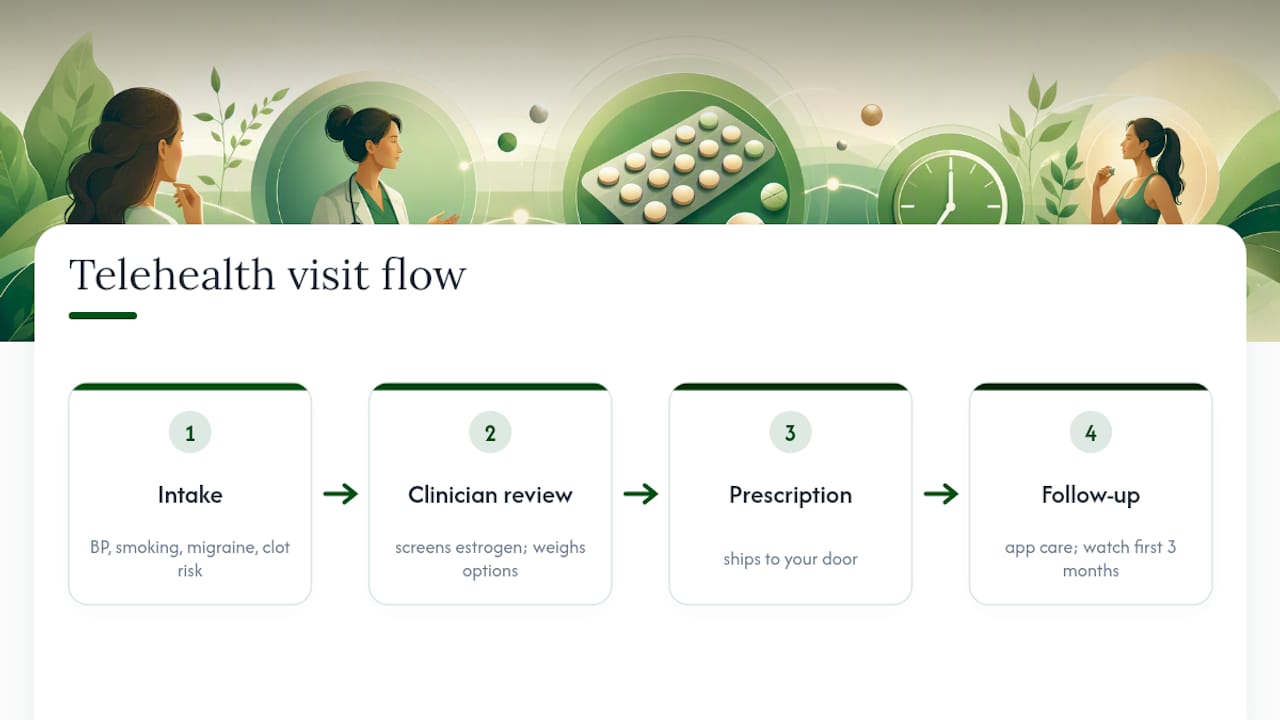
A telehealth contraception visit typically follows the same clinical logic as an in-person one, just without the waiting room. You complete a health history intake covering blood pressure, smoking status, migraine history, and clotting risk factors. A licensed clinician reviews that intake, screens for estrogen contraindications, and works through the options with you, weighing combination versus progestin-only based on what actually applies to your health.
Once a formula is agreed on, the prescription ships to your door, and follow-up happens through an app rather than a second waiting room visit. That matters most in the first three months, when side effects are most likely to show up and questions come up fastest…
The advantage isn’t just convenience. It’s having a clinician actually looking at your specific risk factors before a prescription gets written, rather than defaulting to whatever pill is easiest to hand out.
Picking a pill isn’t really a one-time decision, it’s closer to a fitting process. The formulation that works for your sister or your best friend might be wrong for you because your migraine history, your blood pressure, or your tolerance for a stricter timing window is different from theirs. What frustrates me about how this topic usually gets covered is the rush to name a single “best” pill, when the honest answer is that the best pill is the one that matches your specific contraindications and your actual daily habits.
Telehealth models built around real clinician screening and ongoing app check-ins exist precisely because the first prescription isn’t always the right one, and catching that early matters more than getting it perfect on day one.
— Bryan
Skip the clinic scheduling scramble. The process can be completed online: you complete a health intake, a licensed clinician reviews your history and screens for contraindications like clotting risk or uncontrolled blood pressure, and if a pill is appropriate, your prescription ships to your door.

You get ongoing app-based follow-up during the adjustment period instead of booking a second appointment just to ask about side effects. If you’re also weighing other health goals, FitRx’s platform covers areas beyond birth control, from weight management to mental health support, all through the same account. Start your intake at FitRx to see which pill type fits your health history and get a decision back from a licensed clinician.
This article is general information, not a substitute for advice from a qualified doctor. Consult a qualified healthcare professional about your own circumstances before acting on anything here.
Combination pills, which contain both estrogen and progestin, are the most widely prescribed oral contraceptive, used by about a quarter of American women aged 15 to 44 who use contraception.
The two categories are combination oral contraceptives, containing estrogen and progestin, and progestin-only pills (minipills), which contain no estrogen and require stricter daily timing.
Beyond pills, common methods include IUDs, implants, injections, patches, vaginal rings, condoms, and sterilization, each with different effectiveness and maintenance requirements compared to daily oral contraceptives.
IUDs, implants, and sterilization post the lowest typical-use failure rates because they don’t depend on daily action, while combination and progestin-only pills require consistent daily timing to reach their 99% perfect-use effectiveness.
Yes. Licensed clinicians can review your health history, screen for contraindications, and prescribe an appropriate pill through a telehealth visit, with prescriptions like those offered through FitRx shipped directly to your home.

.svg)