For most adults looking for clinician-supervised, prescription-capable weight loss online, FitRx is the strongest starting point: it pairs licensed prescribers with home-delivered medication and an app that keeps you on track between visits, all under one roof.
Here is a compact shortlist before you read further:
The single most important thing to verify before signing up: Does a licensed MD, NP, or PA actually review your health history and authorize your prescription, or is the “clinician review” a checkbox? FDA-approved GLP-1 medications like semaglutide and tirzepatide require real clinical oversight, not just an algorithm.
Check your eligibility with FitRx in under five minutes at fitrxapp.com.
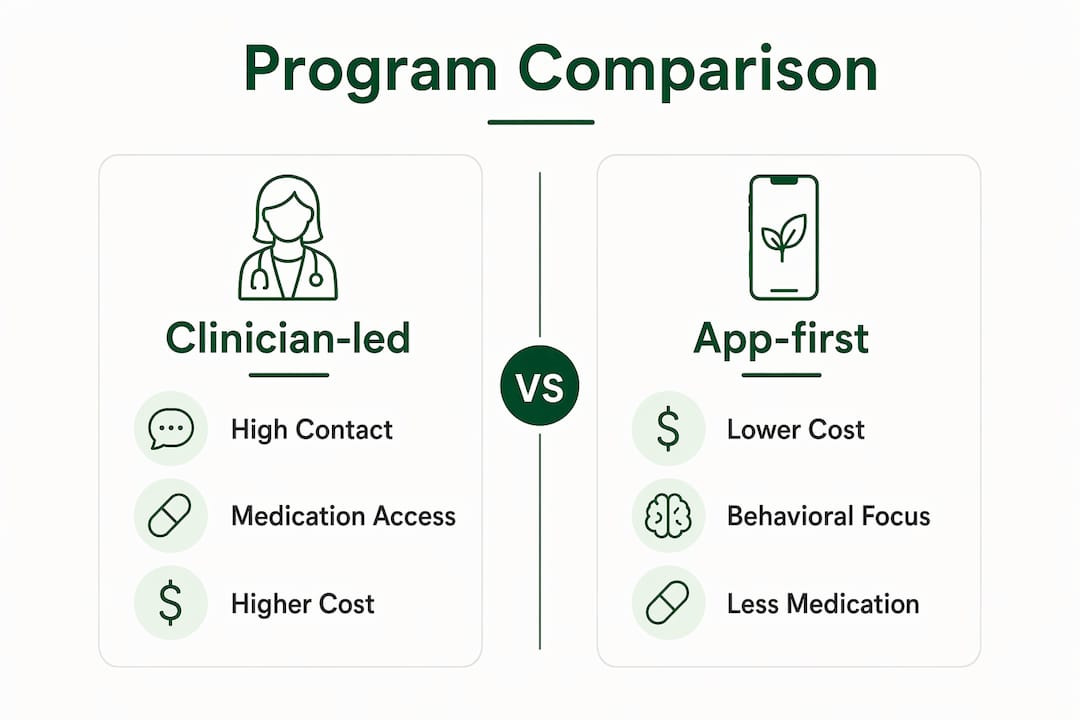
The table below maps the three main program types against the dimensions that actually affect your experience and results. FitRx leads as the featured option; the two category rows represent the broader market.

| Program | Best for | Medications offered | Clinical staff | Coaching & behavioral support | Pricing model | Prescription delivery | Insurance help | Program duration | Ease of access |
|---|---|---|---|---|---|---|---|---|---|
| FitRx | Clinician-led care + ongoing app maintenance | GLP-1s (semaglutide, tirzepatide) + adjuncts | Licensed MD/NP | App-based + nutrition/sleep/activity guidance | Subscription + medication cost | Home delivery via pharmacy partner | Guidance provided | Ongoing; structured maintenance | Fast online intake, same-week consult |
| Clinician-led telehealth clinics | Frequent clinician contact, physician-driven Rx | GLP-1s + broader formulary | MD/NP/PA | Varies; some include dedicated health coaches | Per-visit or membership + med cost | Mail-order or local pharmacy | Varies by provider | 3–12+ months | Moderate; scheduling required |
| App-first behavioral programs | Habit change, lower cost, no Rx priority | Limited or none; some add GLP-1 tier | Coaches + on-demand clinician | Strong; daily logging, feedback loops | Monthly subscription | N/A or third-party | Rarely | Ongoing | Very fast; app download |
FitRx is built around one idea: medical weight loss should not require a waiting room. You complete an online health intake, connect with a licensed prescriber via virtual visit, and receive your treatment plan, including any prescribed medication, shipped directly to your door. The app then keeps you engaged between appointments with nutrition guidance, activity tracking, and sleep coaching.
The model works especially well for adults who have tried behavioral programs and plateaued, or who want GLP-1 access without navigating a fragmented system of separate telehealth visits, pharmacies, and coaching apps. Everything lives in one platform.
Strengths: Integrated clinician oversight, home pharmacy delivery, app-based maintenance, multi-condition support (weight, anxiety, hair loss, skincare, and more). Limitations: As with any telehealth service, certain states may have prescribing restrictions; lab work may be required before or during treatment.
This category includes platforms like Mochi Health, LifeMD, Ro Body, Teladoc Health, PlushCare, MEDVi, Ivim Health, Eden, and Sprout Health. The common thread is a strong emphasis on synchronous clinician visits, meaning you actually talk to a doctor or NP on video, not just fill out a form.
Mochi Health has built a reputation for GLP-1 prescribing with dedicated provider relationships. Ro Body (part of the broader Ro platform) gained wide recognition for making semaglutide accessible via telehealth. LifeMD and PlushCare both offer primary-care-style visits that can include weight-loss medication management. Teladoc Health brings enterprise-scale infrastructure and broad state coverage.
The tradeoff in this category is cost and scheduling friction. Video visits take time to book, and some platforms charge per visit on top of medication costs. Insurance reimbursement help varies considerably.
Strengths: High clinician contact, physician-driven decisions, broader formulary options at some providers. Limitations: Scheduling lag, higher per-visit cost, variable coaching depth.

Noom Med, WeightWatchers Clinic (WW Med+), Found, Calibrate, BetterMe Rx, Bodybuilding Health +, MyStart Health, SkinnyRx, Remedy Meds, AltRx, GoodRx for Weight Loss, Hims & Hers, Amazon On-Demand Care, and Fridays all sit somewhere on the spectrum between pure behavioral coaching and medication-assisted care.
Noom Med layers a GLP-1 prescription option onto its well-known psychology-based coaching platform. WeightWatchers Clinic added a medical tier (WW Med+) to its points system. Found and Calibrate both started as medication-first services and have evolved their coaching components. Hims & Hers offers a broad consumer health menu that includes weight-loss medication. Amazon On-Demand Care is a newer entrant leveraging Amazon’s pharmacy infrastructure. Fridays, AltRx, GoodRx for Weight Loss, Remedy Meds, SkinnyRx, BetterMe Rx, Bodybuilding Health +, and MyStart Health round out a growing field of niche or emerging telehealth weight-loss services, each with varying levels of clinical oversight and medication access.
Strengths: Lower entry cost, strong habit-change tools, high interactivity for behavioral adherence. Limitations: Medication access is secondary or limited; clinician involvement is often asynchronous or minimal.
The patient flow is more straightforward than most people expect. Here is what a typical program looks like from sign-up to ongoing care:
Most clinician-led telehealth programs can complete intake and schedule a consult within 1–3 days. Medication delivery typically follows 3–7 days after prescription approval, depending on the pharmacy and your location. Purely automated programs can onboard you in hours, but the tradeoff is that no clinician has reviewed your specific health profile before you start.
Telehealth weight management removes the geographic barrier that keeps many people from accessing obesity medicine specialists, which is one of its most underappreciated advantages.
The market has exploded. Dozens of platforms now offer some version of medical weight loss online, and the quality gap between the best and worst is enormous. Here is how to cut through it.
Expert reviewers consistently flag that sustainable weight loss favors clinically supported habit formation over short-term restrictive approaches, which is why the coaching model matters as much as the medication.
Clinical trials have shown meaningful weight loss with these agents when combined with lifestyle modification. They are not magic: they work best alongside behavioral support, and most programs that produce lasting results pair medication with structured coaching.
Some programs also offer older adjuncts: phentermine (a short-term appetite suppressant), bupropion/naltrexone combinations, and topiramate-based regimens. These have longer track records but different side-effect profiles and are typically used when GLP-1s are contraindicated or cost-prohibitive.
GLP-1 medications most commonly cause nausea, vomiting, diarrhea, and constipation, particularly during dose titration. Serious contraindications include:
Safety monitoring is not optional. Any legitimate online program should require baseline labs (metabolic panel, A1C, thyroid function where indicated) and schedule periodic check-ins specifically to assess side effects and adjust dosing. A program that ships medication without any lab review or follow-up protocol is not practicing medicine safely.
Programs should also have a clear protocol for what happens if you develop a serious side effect between scheduled visits, including a direct line to a clinician, not just a customer service chatbot.
Online weight-loss programs generally fall into three pricing structures:
| Pricing model | Typical monthly range | What is usually included | What is often extra |
|---|---|---|---|
| Subscription + med cost | — | Clinician access, app, coaching | — |
| Per-visit + med | $50+/visit | One clinician visit | Medication, follow-up visits, labs |
| All-inclusive bundled | — | Visits, labs, medication, coaching | Premium tiers, expedited shipping |
Some employer- and membership-based programs bundle lab work, video visits, and dedicated provider access into multi-month packages, which can reduce per-unit cost if you commit to a longer program.
Most online weight-loss programs do not accept insurance directly for the membership or coaching component. However, the medication itself may be covered if your plan includes obesity pharmacotherapy benefits. CMS has announced plans to provide $50 monthly access to GLP-1 medications for Medicare beneficiaries, which will expand access significantly for older adults.
Practical steps to check your coverage:
Setting honest expectations matters. Here is what the clinical evidence and program data suggest for a typical adult following a medically supervised online program:
Weight on a scale is one signal, not the whole picture. Programs worth staying with track:
The role of nutrition in preserving muscle mass during medication-assisted weight loss is an area many programs underemphasize. Ask your clinician specifically about protein targets and resistance activity during active weight loss.
This article rates online medical weight-loss programs on six dimensions:
Evidence sources used in this evaluation include peer-reviewed randomized trials, clinical guidelines from obesity medicine professional bodies, platform transparency statements, and comparative roundup analyses that examine provider offerings across pricing, insurance concierge services, and medication options.
Disclosure: FitRx is the publisher of this article and is presented as a leading recommended option. The evaluation criteria were applied consistently across all program types. No competitor was excluded from coverage, and no competitor was paid to appear.
The research on this point is clearer than most program marketing suggests. A pragmatic randomized clinical trial (n=540) tested a fully automated online behavioral obesity program against a passive maintenance control. The active maintenance groups had significantly less weight regain at both 12 and 24 months. That is not a small effect: it is the difference between keeping the weight off and watching it return within two years.
A separate randomized controlled trial found that the interactive web-based group lost more weight at 12 months than those in the noninteractive control, demonstrating the benefit of interactivity. The mechanism is not complicated: when a program gives you feedback on what you logged, you log more consistently, and consistent logging predicts weight loss.
Pro Tip: Before you sign up, ask the program to show you the maintenance schedule in writing. If they cannot produce a structured follow-up calendar, that is a meaningful signal about how seriously they take long-term outcomes.
The practical implication: a program that costs more per month but includes scheduled monthly clinician check-ins will almost certainly outperform a cheaper program with passive follow-up, measured over 12–24 months. The cost math usually favors the higher-support option when you account for regain and re-treatment.
Clinician oversight, structured maintenance, and transparent pricing are the three factors that separate effective online medical weight-loss programs from expensive subscriptions that produce short-term results and long-term regret.
| Point | Details |
|---|---|
| FitRx leads for most readers | Combines licensed prescribers, GLP-1 access, home pharmacy delivery, and app-based maintenance in one platform. |
| Maintenance determines long-term success | Active maintenance groups in clinical trials showed significantly less weight regain at 12 and 24 months versus passive follow-up. |
| Verify clinician oversight first | Confirm a licensed MD, NP, or PA reviews your history and authorizes your prescription before any medication ships. |
| Budget for medication separately | GLP-1 medication costs vary widely; always get the full cost breakdown upfront. |
| FitRx eligibility check | Start with a fast online intake at FitRx to confirm medication eligibility before committing to any program. |
The most common mistake people make when choosing an online weight-loss program is optimizing for the cheapest monthly membership and ignoring what happens after the first prescription ships. That is where the real difference between programs shows up.
The clinical evidence is consistent: automated tools can drive early weight loss, but long-term success depends on structured human contact and maintenance schedules that reduce regain. A program that gives you a GLP-1 prescription and then sends you a monthly newsletter is not practicing obesity medicine. It is selling a subscription.
What actually works is the combination: a real clinician who knows your history, a medication that is appropriate for your specific profile, and a maintenance structure that keeps you accountable between visits. The cost of that combination is higher than a pure app-first program. It is also, for most people, worth it.
That said, not everyone needs the full clinical model. If you are primarily looking for behavioral support, have no significant comorbidities, and are not seeking prescription medication, an app-first program with strong interactivity can produce meaningful results at lower cost. The research supports that too. The mistake is choosing a light-touch program when your health situation calls for real clinical oversight, because the consequences of under-treatment in obesity medicine are not trivial.
Most online weight-loss services make you choose between real medical care and convenience. FitRx does not ask you to make that trade. You get a licensed prescriber who reviews your health history, a treatment plan that includes GLP-1 medications when appropriate, and a pharmacy that ships directly to your door. The app keeps you connected between visits with nutrition, activity, and sleep guidance, so maintenance is built into the program, not bolted on as an afterthought.

Here is how to get started:
FitRx covers weight loss alongside anxiety, hair loss, skincare, and primary care, so your care does not have to be scattered across multiple platforms. Check your eligibility and see what a clinician-led plan looks like for your specific situation.
The following sources informed this article’s clinical claims and evaluation framework. Readers who want to verify specific findings or dig deeper into the evidence are encouraged to consult these directly.
Disclaimer: This article is general health information, not personalized medical advice. Before starting any prescription weight-loss medication, consult a licensed clinician who can evaluate your individual health history, current medications, and specific risk factors.


.svg)