Most prescribers want five tests before you take your first GLP-1 injection: HbA1c, a comprehensive metabolic panel (CMP), TSH, a lipid panel, and a CBC. That’s the core baseline labs for GLP-1 therapy, full stop. Depending on your history, your provider may add a few situational tests: lipase and amylase if you’ve had pancreatitis, a pregnancy test if you can conceive, and a B12 check if you’re also on metformin.
If you already have labs from a routine physical or another provider, don’t assume you need to redo them. Most prescribers accept recent lab results, so a recent physical you had might save you a needle stick.
Quick fact: A study on pretreatment screening gaps found that comprehensive baseline assessment before starting semaglutide is inconsistently applied in real-world practice, which is exactly why it pays to ask your provider directly which of these five tests they’ve actually ordered for you.
Getting the five core baseline labs for GLP-1 before your first dose is the single most reliable way to avoid a preventable safety issue down the line.
| Point | Details |
|---|---|
| Core panel is five tests | HbA1c, CMP, TSH, lipid panel, and CBC cover the essential safety and efficacy baseline. |
| Existing labs often count | Most prescribers accept results up to six months old, so check before repeating tests. |
| Situational tests depend on history | Lipase/amylase, B12, and pregnancy testing apply only when your medical history calls for them. |
| Recheck timing follows a pattern | HbA1c at 3 months, full panel at 6 months, sooner if you’re high risk or have severe symptoms. |
| FitRx integrates labs into intake | FitRx reviews uploaded results or connects you to lab-ordering support before prescribing. |
Each of these five tests answers a different clinical question, and understanding what each one flags helps you make sense of your results instead of just filing them away.
HbA1c reflects your average blood sugar over the past two to three months, and it’s the test that determines whether you’re diabetic, prediabetic, or metabolically healthy going into treatment. That distinction changes everything downstream: it shapes which GLP-1 your provider prescribes, how aggressively they titrate the dose, and how often they’ll want to recheck your numbers. MedlinePlus explains that HbA1c is the standard marker used to diagnose diabetes precisely because it isn’t thrown off by what you ate for breakfast, unlike a fasting glucose snapshot. The CDC’s diabetes testing guidance notes that a 3-month recheck after starting therapy is standard practice for tracking glycemic response.
The CMP is really four tests wearing one coat. Creatinine and eGFR estimate how well your kidneys filter waste, which matters because GLP-1 medications carry a documented risk of acute kidney injury, usually tied to dehydration from GI side effects rather than the drug itself directly damaging the kidney. ALT, AST, and bilirubin establish your liver’s starting point before a drug that shifts how your body processes fat and glucose. Electrolytes like potassium and sodium matter more than people expect, because if nausea or diarrhea kicks in during the first few weeks, those numbers are your early warning system. The FDA’s prescribing information for semaglutide lists acute kidney injury among the risks it wants prescribers monitoring for, which is the entire reason this panel gets ordered before dose one.
TSH, sometimes paired with free T4, screens for thyroid dysfunction. This one draws extra attention because GLP-1 labels carry warnings related to thyroid C-cell tumors seen in rodent studies, and providers use TSH as part of ruling out preexisting thyroid abnormalities. Worth knowing: routine calcitonin testing isn’t recommended for most people starting these medications. Guidance on thyroid cancer screening reserves calcitonin testing for patients with a personal or family history of medullary thyroid cancer or MEN 2, not the general population.
The lipid panel sets your cholesterol and triglyceride baseline before treatment starts moving the numbers. And they usually do move: peer-reviewed research on GLP-1 effects shows triglyceride reductions in the range of 15 to 20 percent, alongside modest LDL improvements. Without a baseline, you can’t tell how much of that improvement came from the medication versus the diet changes you made alongside it.
CBC catches anemia or unusual cell counts that could complicate treatment or point to something unrelated that needs its own workup before you add a new medication into the mix.
Pro Tip: Ask for your actual numbers, not just “normal” or “abnormal.” Ranges vary by lab, and some clinicians track patients against tighter “optimal” targets rather than the wide standard reference range, which can reveal metabolic improvement months before your weight on the scale reflects it.
Beyond the core five, a handful of situational tests come up depending on your medical history. None of these are automatic for everyone, but each has a clear trigger.
None of these four require you to do anything differently before your appointment. They’re simply tests your provider might add based on what your history tells them, not tests you need to request preemptively.
A common monitoring schema looks like this: baseline labs before dose one, HbA1c recheck around 3 months, a fuller panel at 6 months, and annual monitoring after that if things are stable. People without diabetes often follow a lighter version of this schedule, since glycemic monitoring matters less when HbA1c was normal to begin with.

That schedule shifts if you’re higher risk. Anyone with chronic kidney disease or elevated liver enzymes at baseline typically gets a CMP recheck at 4 to 8 weeks, not 3 months, and creatinine or electrolytes get rechecked sooner after any stretch of severe vomiting or diarrhea.
| Trigger | Recommended action |
|---|---|
| Baseline, before first dose | Full core panel: HbA1c, CMP, TSH, lipid panel, CBC |
| 3 months | Recheck HbA1c to gauge glycemic response |
| 4 to 8 weeks (high risk only) | Recheck CMP if CKD or elevated baseline liver enzymes |
| 6 months | Repeat full panel |
| Severe abdominal pain | Check lipase and amylase promptly |
| Prolonged vomiting or diarrhea | Recheck CMP and electrolytes |
| Jaundice or dark urine | Recheck liver enzymes (ALT, AST, bilirubin) |
Some symptoms warrant a call to your provider before your next scheduled draw, not after. Markedly elevated lipase, a creatinine jump suggestive of acute kidney injury, or ALT/AST above three times the upper limit of normal are the kind of results that typically mean pausing the medication until your provider sorts out what’s going on. FitRx’s overview of GLP-1 side effects walks through which symptoms deserve that kind of urgency versus which ones are just part of adjusting to the drug.
You have three realistic paths to getting these tests done, and which one makes sense depends on how fast you need results and what your insurance covers.
Fasting for 8 to 12 hours improves accuracy for the lipid panel and glucose-related results. Some clinicians also recommend avoiding a blood draw within 48 hours of a weekly injection to get a cleaner baseline read, though this matters more for follow-up labs than your very first draw.
Cost typically runs lower through insurance-covered provider orders than through direct-access services paid out of pocket. Check your coverage before choosing a path, and see FitRx’s breakdown of GLP-1 insurance coverage for what’s usually reimbursable.
Pro Tip: If you can only get one test done before your first dose, make it the CMP. It covers kidney and liver function together, which are the two systems most likely to signal a problem early.
FitRx builds lab review into the GLP-1 intake process rather than treating it as an afterthought. Patients upload existing results or get connected to lab-ordering support as part of their consultation, so the core panel, HbA1c, CMP, TSH, lipid panel, and CBC, gets reviewed by a licensed provider before a prescription goes out.
Standardizing the baseline panel isn’t about adding friction to the process. It’s about catching the kidney or liver issue that would otherwise surface three months in, after you’ve already started titrating up.
This approach directly addresses what research on pretreatment screening gaps found across telehealth prescribing more broadly: comprehensive baseline testing is often skipped in the rush to get patients started.
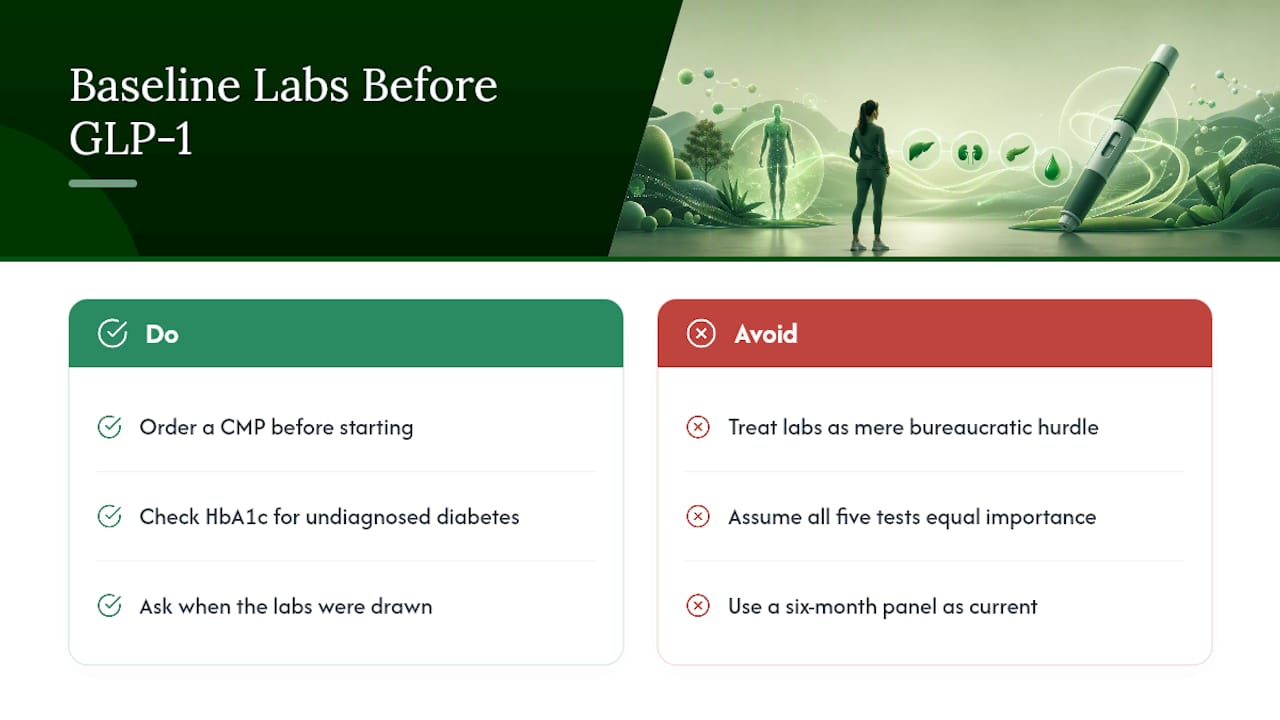
The conventional advice floating around online treats baseline labs as a bureaucratic hurdle rather than a genuinely useful diagnostic tool. That framing gets it backward. A CMP that shows early kidney strain, or a TSH that flags undiagnosed hypothyroidism, tells you something about your body that has nothing to do with whether you’re “allowed” to start treatment. It tells you what might be sabotaging your metabolism regardless of what medication you take.
I’d also push back on the idea that all five core tests carry equal weight. If I had to rank them, CMP and HbA1c do the heaviest lifting, because they catch the two things most likely to change your dosing or pause treatment altogether: kidney stress and undiagnosed diabetes. TSH and lipids are valuable context, but they rarely change what happens in week one.
The bigger failure I see isn’t skipping labs entirely. It’s treating a six-month-old panel as automatically current when your health has shifted since then. Ask when your labs were drawn, not just whether they exist.
FitRx removes the guesswork of figuring out which tests you need and where to get them. Instead of hunting for a lab, waiting weeks for a primary care appointment, or starting a GLP-1 prescription with no safety check at all, you get a licensed provider who reviews your labs (existing or newly ordered) as part of one consultation.

That means faster answers if your CMP or HbA1c comes back with something worth discussing, and a clear plan for repeat testing built into your treatment schedule instead of left to memory. FitRx’s approach folds lab review, prescribing, and ongoing symptom support into a single app-based workflow, so you’re not juggling separate portals for your bloodwork and your prescription. If you’re ready to see whether GLP-1 treatment fits your health picture, find out if weight loss injections could be right for you and start with a consultation that includes lab review from day one.
This article is general information, not a substitute for advice from a qualified doctor. Consult a qualified healthcare professional about your own circumstances before acting on anything here.
The core panel is HbA1c, a comprehensive metabolic panel, TSH, a lipid panel, and a CBC, with lipase/amylase, B12, or a pregnancy test added when your history calls for it.
Most prescribers require baseline bloodwork before starting GLP-1 therapy, though some telehealth platforms have historically skipped this step, which clinical research flags as a quality gap worth asking your provider about directly.
Tirzepatide follows the same baseline logic as other GLP-1 medications: HbA1c, CMP, TSH, lipid panel, and CBC, since the safety concerns around kidney function and pancreatic enzymes apply across the drug class.
Liver enzymes can shift during GLP-1 treatment, which is why baseline ALT and AST through the CMP matter, and why a result above three times the normal upper limit typically prompts a call to your provider rather than waiting for your next scheduled check.


.svg)